



 Chat with AI
Exam 14: Monopoly and Monopolistic Competition

Exam 1: Economics and Economic Reasoning158 Questions
Exam 2: The Production Possibility Model, Trade, and Globalization133 Questions
Exam 3: Economic Institutions163 Questions
Exam 4: Supply and Demand182 Questions
Exam 5: Using Supply and Demand163 Questions
Exam 6: Describing Supply and Demand: Elasticities216 Questions
Exam 7: Taxation and Government Intervention201 Questions
Exam 8: Market Failure Versus Government Failure197 Questions
Exam 9: Comparative Advantage, Exchange Rates, and Globalization118 Questions
Exam 10: International Trade Policy99 Questions
Exam 11: Production and Cost Analysis I194 Questions
Exam 12: Production and Cost Analysis II152 Questions
Exam 13: Perfect Competition170 Questions
Exam 14: Monopoly and Monopolistic Competition274 Questions
Exam 15: Oligopoly and Antitrust Policy142 Questions
Exam 16: Real-World Competition and Technology108 Questions
Exam 17: Work and the Labor Market150 Questions
Exam 18: Who Gets What the Distribution of Income131 Questions
Exam 19: The Logic of Individual Choice: the Foundation of Supply and Demand170 Questions
Exam 20: Game Theory, Strategic Decision Making, and Behavioral Economics103 Questions
Exam 21: Thinking Like a Modern Economist97 Questions
Exam 22: Behavioral Economics and Modern Economic Policy126 Questions
Exam 23: Microeconomic Policy, Economic Reasoning, and Beyond134 Questions
Exam 24: Economic Growth, Business Cycles, and Unemployment124 Questions
Exam 25: Measuring and Describing the Aggregate Economy229 Questions
Exam 26: The Keynesian Short-Run Policy Model: Demand-Side Policies220 Questions
Exam 27: The Classical Long-Run Policy Model: Growth and Supply-Side Policies133 Questions
Exam 28: The Financial Sector and the Economy214 Questions
Exam 29: Monetary Policy243 Questions
Exam 30: Financial Crises, Panics, and Unconventional Monetary Policy109 Questions
Exam 31: Deficits and Debt: the Austerity Debate150 Questions
Exam 32: The Fiscal Policy Dilemma119 Questions
Exam 33: Jobs and Unemployment78 Questions
Exam 34: Inflation, Deflation, and Macro Policy175 Questions
Exam 35: International Financial Policy211 Questions
Exam 36: Macro Policy in a Global Setting134 Questions
Exam 37: Structural Stagnation and Globalization125 Questions
Exam 38: Macro Policy in Developing Countries142 Questions
Select questions type


Demonstrate graphically and explain verbally the long-run equilibrium for a monopolistically competitive firm.How does this differ from the long run equilibrium of a monopoly firm?
(Essay)
5.0/5  (91)
(91) Refer to the graph shown of a monopolistically competitive firm. The graph shows that: 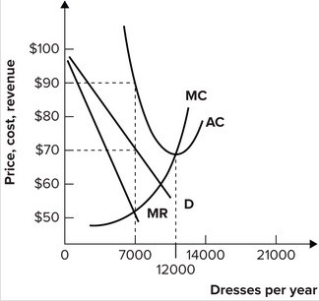
(Multiple Choice)
4.8/5 (79)
(79) How are a monopolist's price,output,and profit determined graphically?
(Essay)
4.7/5 (72)
(72) With a natural monopoly, the minimum price a single firm must charge to make a profit:
(Multiple Choice)
4.8/5 (93)
(93) Refer to the graph shown. According to the graph, this monopolistically competitive industry is currently: 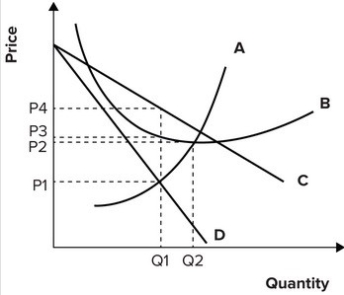
(Multiple Choice)
4.8/5 (83)
(83) Refer to the graph shown. Assuming that the monopoly maximizes profit, the social cost of monopoly will be: 
(Multiple Choice)
4.9/5 (72)
(72) As firms leave a monopolistically competitive industry that is sustaining economic losses:
(Multiple Choice)
4.8/5 (77)
(77) The difference between a monopolist and a monopolistic competitor is that:
(Multiple Choice)
4.8/5 (97)
(97) Refer to the following graph.  If the demand curve is curve D for a monopoly, the marginal revenue curve is:
 (Multiple Choice)
4.7/5 (75)
(75) Suppose marginal cost is constant and equal to 100 and market demand is given by Qd = 20- 1/10P. A profit-maximizing monopolist will set price equal to:
(Multiple Choice)
4.9/5 (79)
(79) Long-run equilibrium for firms in monopolistically competitive industries is similar to that for firms in perfect competition in that:
(Multiple Choice)
4.7/5 (81)
(81) As manager of a mutual fund,your job is to buy stocks in companies whose stock price will rise.You decide to only buy stocks of monopoly companies rather than perfectly competitive companies.Your rationale: the monopoly company stocks are a "sure-thing" since customers have no alternative suppliers,which means monopolies earn much more profit than perfectly competitive firms (which you expect to result in higher stock prices for the monopoly companies).What is wrong with assuming that monopolies must be profitable? Explain,using a diagram to illustrate your explanation.
(Essay)
4.9/5 (77)
(77) If MC = Q/15 represents marginal cost for a monopolist and market demand is given by Qd = 500 - 10P, the monopolist maximizes profit by producing:
(Multiple Choice)
4.9/5 (71)
(71) Monopolies that exist because economies of scale create a barrier to entry are called:
(Multiple Choice)
4.8/5 (88)
(88) If the demand for a newly released novel is less price-elastic than the demand for an older novel, which of the following pricing strategies would a price-discriminating publishing firm follow?
(Multiple Choice)
4.7/5 (98)
(98) A price-discriminating monopolist will make less in profit than will one that does not price-discriminate.
(True/False)
4.9/5 (79)
(79) How and why are the decisions facing a monopolist different from the collective decisions of firms in a perfectly competitive market?
(Essay)
4.9/5 (85)
(85) Suppose that the men's suit business is monopolistically competitive. It follows that in equilibrium, the marginal revenue of any firm in the industry:
(Multiple Choice)
4.8/5 (67)
(67) Since marginal revenue is less than price for a monopolist, a monopolist maximizes profits by equating marginal revenue and marginal cost, not price and marginal cost.
(True/False)
4.8/5 (77)
(77) 
Filters
- Essay(0)
- Multiple Choice(0)
- Short Answer(0)
- True False(0)
- Matching(0)