



 Chat with AI
Exam 10: International Trade Policy

Exam 1: Economics and Economic Reasoning158 Questions
Exam 2: The Production Possibility Model, Trade, and Globalization133 Questions
Exam 3: Economic Institutions163 Questions
Exam 4: Supply and Demand182 Questions
Exam 5: Using Supply and Demand163 Questions
Exam 6: Describing Supply and Demand: Elasticities216 Questions
Exam 7: Taxation and Government Intervention201 Questions
Exam 8: Market Failure Versus Government Failure197 Questions
Exam 9: Comparative Advantage, Exchange Rates, and Globalization118 Questions
Exam 10: International Trade Policy99 Questions
Exam 11: Production and Cost Analysis I194 Questions
Exam 12: Production and Cost Analysis II152 Questions
Exam 13: Perfect Competition170 Questions
Exam 14: Monopoly and Monopolistic Competition274 Questions
Exam 15: Oligopoly and Antitrust Policy142 Questions
Exam 16: Real-World Competition and Technology108 Questions
Exam 17: Work and the Labor Market150 Questions
Exam 18: Who Gets What the Distribution of Income131 Questions
Exam 19: The Logic of Individual Choice: the Foundation of Supply and Demand170 Questions
Exam 20: Game Theory, Strategic Decision Making, and Behavioral Economics103 Questions
Exam 21: Thinking Like a Modern Economist97 Questions
Exam 22: Behavioral Economics and Modern Economic Policy126 Questions
Exam 23: Microeconomic Policy, Economic Reasoning, and Beyond134 Questions
Exam 24: Economic Growth, Business Cycles, and Unemployment124 Questions
Exam 25: Measuring and Describing the Aggregate Economy229 Questions
Exam 26: The Keynesian Short-Run Policy Model: Demand-Side Policies220 Questions
Exam 27: The Classical Long-Run Policy Model: Growth and Supply-Side Policies133 Questions
Exam 28: The Financial Sector and the Economy214 Questions
Exam 29: Monetary Policy243 Questions
Exam 30: Financial Crises, Panics, and Unconventional Monetary Policy109 Questions
Exam 31: Deficits and Debt: the Austerity Debate150 Questions
Exam 32: The Fiscal Policy Dilemma119 Questions
Exam 33: Jobs and Unemployment78 Questions
Exam 34: Inflation, Deflation, and Macro Policy175 Questions
Exam 35: International Financial Policy211 Questions
Exam 36: Macro Policy in a Global Setting134 Questions
Exam 37: Structural Stagnation and Globalization125 Questions
Exam 38: Macro Policy in Developing Countries142 Questions
Select questions type


A free trade association is a group of countries that allows free trade among its members and, as a group, puts up common barriers against all other countries' goods.

Free
(True/False)
4.8/5  (76)
(76) Correct Answer: Verified
True
After one cow in Alberta, Canada was found with mad cow disease, the United States banned all imports of Canadian cattle and beef. This action is an example of:
(Multiple Choice)
4.9/5 (78)
(78) What role do appeals to national security play in arguments to justify trade restrictions? What forms do these restrictions take?
(Essay)
4.8/5 (73)
(73) Which of the following groups would be most likely to benefit from a tariff on Japanese-manufactured light trucks (i.e. , pickup trucks)?
(Multiple Choice)
4.8/5 (75)
(75) Domestic producers prefer quotas to tariffs because quotas raise the price of imports and tariffs do not.
(True/False)
4.8/5 (70)
(70) Refer to the graph shown. 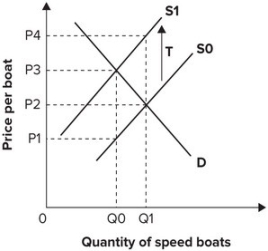 As a result of a tariff T imposed on speedboats, the price domestic consumers pay for speedboats probably will likely be:
 (Multiple Choice)
4.8/5 (85)
(85) The infant industry argument for protection is rejected by most economists because:
(Multiple Choice)
4.8/5 (81)
(81) When the United States imposed restrictions on imported steel in the 1950s and 1960s, the U.S. steel industry responded by:
(Multiple Choice)
4.8/5 (67)
(67) Duties imposed by the U.S. government on imported Chinese frozen and canned shrimp are an example of:
(Multiple Choice)
4.9/5 (79)
(79) The WTO authorized several countries to impose about $150 million in trade sanctions against the United States in retaliation for a U.S. import law that the WTO ruled to be illegal. The organization that issued this ruling against the United States is known as the:
(Multiple Choice)
4.9/5 (78)
(78) Which of the following is not a regulatory trade restriction?
(Multiple Choice)
4.9/5 (86)
(86) The central goal of the General Agreement on Tariffs and Trade (GATT)was to:
(Multiple Choice)
5.0/5 (83)
(83) A group of countries that allows free trade among its members and puts up common barriers against all other countries' goods is called:
(Multiple Choice)
4.8/5 (82)
(82) With what countries or regions does the United States trade the most?
(Essay)
4.9/5 (73)
(73) 
Filters
- Essay(0)
- Multiple Choice(0)
- Short Answer(0)
- True False(0)
- Matching(0)