



 Chat with AI
Exam 10: International Trade Policy

Exam 1: Economics and Economic Reasoning158 Questions
Exam 2: The Production Possibility Model, Trade, and Globalization133 Questions
Exam 3: Economic Institutions163 Questions
Exam 4: Supply and Demand182 Questions
Exam 5: Using Supply and Demand163 Questions
Exam 6: Describing Supply and Demand: Elasticities216 Questions
Exam 7: Taxation and Government Intervention201 Questions
Exam 8: Market Failure Versus Government Failure197 Questions
Exam 9: Comparative Advantage, Exchange Rates, and Globalization118 Questions
Exam 10: International Trade Policy99 Questions
Exam 11: Production and Cost Analysis I194 Questions
Exam 12: Production and Cost Analysis II152 Questions
Exam 13: Perfect Competition170 Questions
Exam 14: Monopoly and Monopolistic Competition274 Questions
Exam 15: Oligopoly and Antitrust Policy142 Questions
Exam 16: Real-World Competition and Technology108 Questions
Exam 17: Work and the Labor Market150 Questions
Exam 18: Who Gets What the Distribution of Income131 Questions
Exam 19: The Logic of Individual Choice: the Foundation of Supply and Demand170 Questions
Exam 20: Game Theory, Strategic Decision Making, and Behavioral Economics103 Questions
Exam 21: Thinking Like a Modern Economist97 Questions
Exam 22: Behavioral Economics and Modern Economic Policy126 Questions
Exam 23: Microeconomic Policy, Economic Reasoning, and Beyond134 Questions
Exam 24: Economic Growth, Business Cycles, and Unemployment124 Questions
Exam 25: Measuring and Describing the Aggregate Economy229 Questions
Exam 26: The Keynesian Short-Run Policy Model: Demand-Side Policies220 Questions
Exam 27: The Classical Long-Run Policy Model: Growth and Supply-Side Policies133 Questions
Exam 28: The Financial Sector and the Economy214 Questions
Exam 29: Monetary Policy243 Questions
Exam 30: Financial Crises, Panics, and Unconventional Monetary Policy109 Questions
Exam 31: Deficits and Debt: the Austerity Debate150 Questions
Exam 32: The Fiscal Policy Dilemma119 Questions
Exam 33: Jobs and Unemployment78 Questions
Exam 34: Inflation, Deflation, and Macro Policy175 Questions
Exam 35: International Financial Policy211 Questions
Exam 36: Macro Policy in a Global Setting134 Questions
Exam 37: Structural Stagnation and Globalization125 Questions
Exam 38: Macro Policy in Developing Countries142 Questions
Select questions type


Which of the following is not an argument in favor of protecting domestic industries from foreign competition?
(Multiple Choice)
4.9/5  (74)
(74) What are free trade associations? Explain why they help or hinder international trade.
(Essay)
4.8/5 (75)
(75) You are an influential CEO of a company like Wal-Mart,who imports foreign made clothing.The government wants to restrict the quantity of the product that your company imports.Should you use your political influence to lobby the Congress to impose a tariff on the product or a quota? Explain your answer.
(Essay)
4.8/5 (66)
(66) Quotas on imported automobiles cost jobs in the U.S. automobile industry but lower auto prices for domestic consumers.
(True/False)
4.7/5 (75)
(75) As a country develops economically, what changes usually take place in the goods it exports?
(Multiple Choice)
4.8/5 (83)
(83) Define tariffs and quotas,and explain the similarities and differences between them.
(Essay)
4.9/5 (85)
(85) The type of goods being imported has changed from primarily low-tech goods to agricultural goods.
(True/False)
4.7/5 (80)
(80) Which of the following groups might be expected to support high United States Department of Agriculture standards for imported citrus fruit?
(Multiple Choice)
4.9/5 (63)
(63) The benefits of free trade tend to be highly concentrated whereas the costs are widely scattered.
(True/False)
5.0/5 (82)
(82) Germany's environmental policies restrict the sale of nonrefillable bottles and cans. This policy reduces the imports of these products. A foreign country that argues that this policy is really intended to protect German beverage makers from competition is arguing that the policy is an example of:
(Multiple Choice)
4.9/5 (94)
(94) Cuba is known for its tobacco products. Which of the following results would we expect to see from a U.S. sanction on Cuba?
(Multiple Choice)
5.0/5 (78)
(78) Refer to the graph shown for a small country that is a price taker internationally. 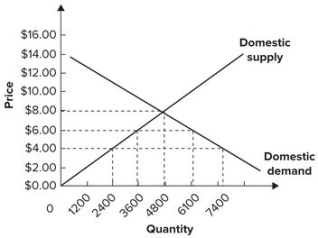 Assume the foreign supply of this product is perfectly elastic at a price of $4 per unit. Starting from a free trade equilibrium, an import quota of 2,500 would cause domestic consumption to:
 (Multiple Choice)
4.9/5 (75)
(75) The voluntary export restraints on autos by Japan in the early 1980s were:
(Multiple Choice)
4.8/5 (74)
(74) Refer to the graph shown for a small country that is a price taker internationally. 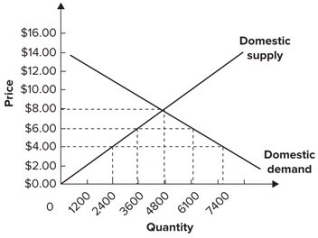 Assume the foreign supply of this product is perfectly elastic at a price of $4 per unit. Starting from a free trade equilibrium, a tariff in the amount of $2 per unit would be expected to cause domestic consumption to:
 (Multiple Choice)
4.9/5 (79)
(79) Most economists believe that the infant industry argument for protection, though theoretically justified, often keeps firms from becoming more competitive.
(True/False)
4.8/5 (88)
(88) 
Filters
- Essay(0)
- Multiple Choice(0)
- Short Answer(0)
- True False(0)
- Matching(0)