



 Chat with AI
Exam 35: International Financial Policy

Exam 1: Economics and Economic Reasoning158 Questions
Exam 2: The Production Possibility Model, Trade, and Globalization133 Questions
Exam 3: Economic Institutions163 Questions
Exam 4: Supply and Demand182 Questions
Exam 5: Using Supply and Demand163 Questions
Exam 6: Describing Supply and Demand: Elasticities216 Questions
Exam 7: Taxation and Government Intervention201 Questions
Exam 8: Market Failure Versus Government Failure197 Questions
Exam 9: Comparative Advantage, Exchange Rates, and Globalization118 Questions
Exam 10: International Trade Policy99 Questions
Exam 11: Production and Cost Analysis I194 Questions
Exam 12: Production and Cost Analysis II152 Questions
Exam 13: Perfect Competition170 Questions
Exam 14: Monopoly and Monopolistic Competition274 Questions
Exam 15: Oligopoly and Antitrust Policy142 Questions
Exam 16: Real-World Competition and Technology108 Questions
Exam 17: Work and the Labor Market150 Questions
Exam 18: Who Gets What the Distribution of Income131 Questions
Exam 19: The Logic of Individual Choice: the Foundation of Supply and Demand170 Questions
Exam 20: Game Theory, Strategic Decision Making, and Behavioral Economics103 Questions
Exam 21: Thinking Like a Modern Economist97 Questions
Exam 22: Behavioral Economics and Modern Economic Policy126 Questions
Exam 23: Microeconomic Policy, Economic Reasoning, and Beyond134 Questions
Exam 24: Economic Growth, Business Cycles, and Unemployment124 Questions
Exam 25: Measuring and Describing the Aggregate Economy229 Questions
Exam 26: The Keynesian Short-Run Policy Model: Demand-Side Policies220 Questions
Exam 27: The Classical Long-Run Policy Model: Growth and Supply-Side Policies133 Questions
Exam 28: The Financial Sector and the Economy214 Questions
Exam 29: Monetary Policy243 Questions
Exam 30: Financial Crises, Panics, and Unconventional Monetary Policy109 Questions
Exam 31: Deficits and Debt: the Austerity Debate150 Questions
Exam 32: The Fiscal Policy Dilemma119 Questions
Exam 33: Jobs and Unemployment78 Questions
Exam 34: Inflation, Deflation, and Macro Policy175 Questions
Exam 35: International Financial Policy211 Questions
Exam 36: Macro Policy in a Global Setting134 Questions
Exam 37: Structural Stagnation and Globalization125 Questions
Exam 38: Macro Policy in Developing Countries142 Questions
Select questions type


List the advantages and disadvantages of a flexible exchange rate system.

Free
(Essay)
4.8/5  (73)
(73) Correct Answer: Verified
Flexible exchange rates allow orderly incremental adjustments in exchange rates,rather than large jumps (advantage).They allow speculation in currency markets,contributing to volatility in exchange rates and departure of rates from underlying fundamentals (disadvantage).They allow governments flexibility in conducting domestic monetary and fiscal policy (both an advantage and a disadvantage).
The actual exchange rate of the real, Brazil's currency, is 2.50 real per U.S. dollar. According to the latest PPP estimations, the real is undervalued by 40 percent. This implies that the PPP exchange rate is:
Free
(Multiple Choice)
4.9/5 (62)
(62) Correct Answer:Verified
VerifiedC
Refer to the graph shown. The shift in the graph from D1 to D2 shows how a contractionary U.S. fiscal policy can cause a decrease in: 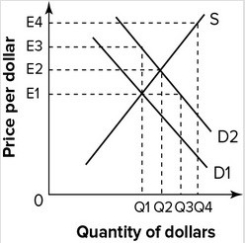
Free
(Multiple Choice)
4.8/5 (66)
(66) Correct Answer:Verified
VerifiedA
Considering its effects through income, the price level, and interest rates only, contractionary fiscal policy causes the value of a country's currency to:
(Multiple Choice)
4.8/5 (68)
(68) If a European billionaire buys stock in General Motors, then the purchase will be recorded in the:
(Multiple Choice)
4.8/5 (78)
(78) What are the three pathways through which monetary policy can influence exchange rates?
(Essay)
4.9/5 (83)
(83) Refer to the graph shown. An increase in American interest rates would shift: 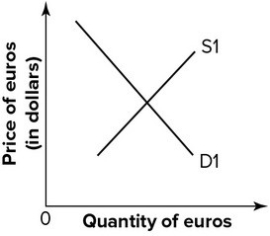
(Multiple Choice)
4.9/5 (96)
(96) How can a country influence its exchange rate through expansionary monetary policy?
(Essay)
4.7/5 (89)
(89) Suppose a McDonald's Big Mac costs 30 pesos in Argentina. At the same time, suppose the exchange rate between the peso and the euro is roughly 15 pesos per euro. According to purchasing power parity, a Big Mac in Europe should cost:
(Multiple Choice)
4.8/5 (88)
(88) Some economists believe that if Greece had its own currency, it would not have been as vulnerable to a financial crisis as was the case with being in the Eurozone.
(True/False)
4.9/5 (82)
(82) Because of the European Monetary Union, each EU member is now:
(Multiple Choice)
4.8/5 (65)
(65) Demonstrate graphically and explain in words the effect of a decrease in demand for Japanese yen on the exchange rate for yens.
(Essay)
4.8/5 (81)
(81) In 2002, the euro replaced the currencies of most of the members of the European Union. The euro has:
(Multiple Choice)
4.9/5 (78)
(78) (a)Why is the supply of dollars upward sloping? Why is the demand for dollars downward sloping?
(b)Given the private supply and demand for the dollar shown below,if the government wants to keep the exchange rate value of the dollar at P0 by intervening in the exchange market,what must it do?
(c)How does this action show up on the balance of payments account?
(d)At an exchange rate of P0,does the country have a private balance of payments surplus or deficit? Or is it in balance? 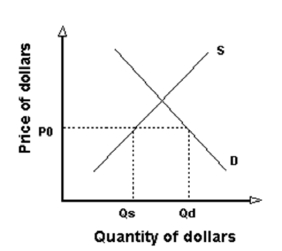
(Essay)
4.8/5 (69)
(69) Suppose the market for Japanese yen is as illustrated in the following supply and demand diagram: 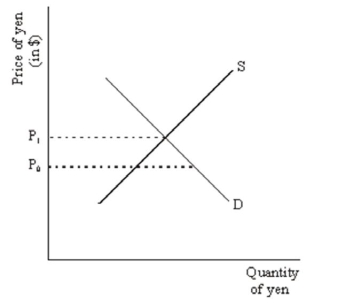 If the private market price is P1 but the government wants to facilitate exports by having a price of P0,what can it do?
 (Essay)
4.8/5 (66)
(66) What is a fixed exchange rate policy? What must the government do to fix its exchange rate?
(Essay)
4.8/5 (83)
(83) In the balance of payments account, imports and exports are listed as part of:
(Multiple Choice)
4.7/5 (97)
(97) 
Filters
- Essay(0)
- Multiple Choice(0)
- Short Answer(0)
- True False(0)
- Matching(0)