



 Chat with AI
Exam 35: International Financial Policy

Exam 1: Economics and Economic Reasoning158 Questions
Exam 2: The Production Possibility Model, Trade, and Globalization133 Questions
Exam 3: Economic Institutions163 Questions
Exam 4: Supply and Demand182 Questions
Exam 5: Using Supply and Demand163 Questions
Exam 6: Describing Supply and Demand: Elasticities216 Questions
Exam 7: Taxation and Government Intervention201 Questions
Exam 8: Market Failure Versus Government Failure197 Questions
Exam 9: Comparative Advantage, Exchange Rates, and Globalization118 Questions
Exam 10: International Trade Policy99 Questions
Exam 11: Production and Cost Analysis I194 Questions
Exam 12: Production and Cost Analysis II152 Questions
Exam 13: Perfect Competition170 Questions
Exam 14: Monopoly and Monopolistic Competition274 Questions
Exam 15: Oligopoly and Antitrust Policy142 Questions
Exam 16: Real-World Competition and Technology108 Questions
Exam 17: Work and the Labor Market150 Questions
Exam 18: Who Gets What the Distribution of Income131 Questions
Exam 19: The Logic of Individual Choice: the Foundation of Supply and Demand170 Questions
Exam 20: Game Theory, Strategic Decision Making, and Behavioral Economics103 Questions
Exam 21: Thinking Like a Modern Economist97 Questions
Exam 22: Behavioral Economics and Modern Economic Policy126 Questions
Exam 23: Microeconomic Policy, Economic Reasoning, and Beyond134 Questions
Exam 24: Economic Growth, Business Cycles, and Unemployment124 Questions
Exam 25: Measuring and Describing the Aggregate Economy229 Questions
Exam 26: The Keynesian Short-Run Policy Model: Demand-Side Policies220 Questions
Exam 27: The Classical Long-Run Policy Model: Growth and Supply-Side Policies133 Questions
Exam 28: The Financial Sector and the Economy214 Questions
Exam 29: Monetary Policy243 Questions
Exam 30: Financial Crises, Panics, and Unconventional Monetary Policy109 Questions
Exam 31: Deficits and Debt: the Austerity Debate150 Questions
Exam 32: The Fiscal Policy Dilemma119 Questions
Exam 33: Jobs and Unemployment78 Questions
Exam 34: Inflation, Deflation, and Macro Policy175 Questions
Exam 35: International Financial Policy211 Questions
Exam 36: Macro Policy in a Global Setting134 Questions
Exam 37: Structural Stagnation and Globalization125 Questions
Exam 38: Macro Policy in Developing Countries142 Questions
Select questions type


What kind of pressure will a surplus in the U.S.balance of payments account place on the value of the dollar?
(Essay)
4.8/5  (77)
(77) Refer to the graph shown. A purchase of shekels by the Israeli government would shift the: 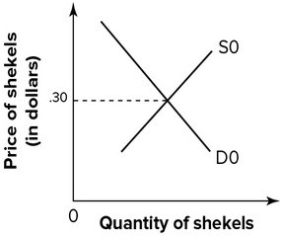
(Multiple Choice)
4.8/5 (70)
(70) The actual exchange rate of the real, Brazil's currency, is 2.40 real per U.S. dollar. According to the PPP estimation, the exchange rate should be 1.20 real per U.S. dollar. This implies that the real is:
(Multiple Choice)
4.8/5 (63)
(63) Consider the following supply and demand diagram for dollars in exchange for euros: 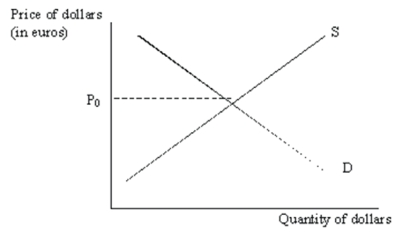 Describe and illustrate the impact each of the following will have on the supply and demand diagram shown above.
(a)Unemployment increases in Europe.
(b)Inflation in the U.S.drops to an all-time low relative to all other industrialized countries
(c)The European Central Bank raises interest rates.
Describe and illustrate the impact each of the following will have on the supply and demand diagram shown above.
(a)Unemployment increases in Europe.
(b)Inflation in the U.S.drops to an all-time low relative to all other industrialized countries
(c)The European Central Bank raises interest rates. (Essay)
4.8/5 (72)
(72) In the U.S. current account, most of the trade deficit results from an excess of imported:
(Multiple Choice)
4.7/5 (66)
(66) You have recently been net surfing with your friends in Russia;the main topic of your recent e-mail exchange is the newest Drake album.You inform your friends in Russia that you can purchase the album at a U.S.seller for $11.99.You are told that in Russia the album costs 70,000 rubles.Suppose that the current dollar/ruble exchange rate is 1 ruble = $.000175 (or equivalently $1 = 5,714 rubles).According to the purchasing power parity view of exchange rate calculations,does the current exchange rate represent a long-run equilibrium exchange rate? Is the dollar overvalued or undervalued? The ruble? Explain.
(Essay)
4.8/5 (70)
(70) In theory, a direct exchange rate policy can succeed if the objective is exchange rate stabilization. However, in practice, this success also depends on the:
(Multiple Choice)
4.8/5 (73)
(73) Under the Bretton Woods system, whenever a country ran a short-term balance of payments deficit, it was:
(Multiple Choice)
4.8/5 (86)
(86) For each of the following,state whether it creates a demand for or a supply of U.S.dollars:
(a)A Japanese automobile firm builds an assembly plant in Ohio.
(b)A U.S.importer purchases a shipload of Saudi Arabia oil.
(c)A U.S.student spends a summer in England studying in Oxford.
(d)A French exporter ships products to Argentina using an American freighter.
(e)Currency traders feel that the value of the U.S.dollar will fall in the near future and act on that feeling.
(Essay)
4.7/5 (77)
(77) What is an exchange rate and how is it related to its balance of payments? What are the four fundamental determinants of a country's exchange rate and what is likely to happen to the exchange rate in the following cases?
(1)A fall in the U.S.interest rate relative to interest rates abroad (dollar).
(2)A higher inflation rate in Japan compared to other countries (yen).
(3)A severe recession in Europe (euro).
(4)The U.S.imposes a 15% tariff on Japanese imported cars (dollar).
(Essay)
4.9/5 (75)
(75) Which of the following is an advantage of the European Monetary Union?
(Multiple Choice)
5.0/5 (89)
(89) Under the gold standard, a nation with a private balance of payments surplus would experience:
(Multiple Choice)
4.9/5 (73)
(73) The government of Crossland wants to influence its exchange rate. It will do so by buying and selling:
(Multiple Choice)
4.8/5 (69)
(69) What overall effect does contractionary monetary policy have on a country's exchange rate?
(Essay)
4.9/5 (72)
(72) If the government chooses not to buy or sell foreign currencies, it has a:
(Multiple Choice)
4.7/5 (87)
(87) List the advantages and disadvantages of a fixed exchange rate system.
(Essay)
4.8/5 (75)
(75) 
Filters
- Essay(0)
- Multiple Choice(0)
- Short Answer(0)
- True False(0)
- Matching(0)