



 Chat with AI
Exam 35: International Financial Policy

Exam 1: Economics and Economic Reasoning158 Questions
Exam 2: The Production Possibility Model, Trade, and Globalization133 Questions
Exam 3: Economic Institutions163 Questions
Exam 4: Supply and Demand182 Questions
Exam 5: Using Supply and Demand163 Questions
Exam 6: Describing Supply and Demand: Elasticities216 Questions
Exam 7: Taxation and Government Intervention201 Questions
Exam 8: Market Failure Versus Government Failure197 Questions
Exam 9: Comparative Advantage, Exchange Rates, and Globalization118 Questions
Exam 10: International Trade Policy99 Questions
Exam 11: Production and Cost Analysis I194 Questions
Exam 12: Production and Cost Analysis II152 Questions
Exam 13: Perfect Competition170 Questions
Exam 14: Monopoly and Monopolistic Competition274 Questions
Exam 15: Oligopoly and Antitrust Policy142 Questions
Exam 16: Real-World Competition and Technology108 Questions
Exam 17: Work and the Labor Market150 Questions
Exam 18: Who Gets What the Distribution of Income131 Questions
Exam 19: The Logic of Individual Choice: the Foundation of Supply and Demand170 Questions
Exam 20: Game Theory, Strategic Decision Making, and Behavioral Economics103 Questions
Exam 21: Thinking Like a Modern Economist97 Questions
Exam 22: Behavioral Economics and Modern Economic Policy126 Questions
Exam 23: Microeconomic Policy, Economic Reasoning, and Beyond134 Questions
Exam 24: Economic Growth, Business Cycles, and Unemployment124 Questions
Exam 25: Measuring and Describing the Aggregate Economy229 Questions
Exam 26: The Keynesian Short-Run Policy Model: Demand-Side Policies220 Questions
Exam 27: The Classical Long-Run Policy Model: Growth and Supply-Side Policies133 Questions
Exam 28: The Financial Sector and the Economy214 Questions
Exam 29: Monetary Policy243 Questions
Exam 30: Financial Crises, Panics, and Unconventional Monetary Policy109 Questions
Exam 31: Deficits and Debt: the Austerity Debate150 Questions
Exam 32: The Fiscal Policy Dilemma119 Questions
Exam 33: Jobs and Unemployment78 Questions
Exam 34: Inflation, Deflation, and Macro Policy175 Questions
Exam 35: International Financial Policy211 Questions
Exam 36: Macro Policy in a Global Setting134 Questions
Exam 37: Structural Stagnation and Globalization125 Questions
Exam 38: Macro Policy in Developing Countries142 Questions
Select questions type


If a country wants to fix its exchange rate at a rate that is lower than the market rate,what monetary or fiscal policy must it use? Explain.
(Essay)
5.0/5  (70)
(70) A country that fixes a price for its currency that is above the market price will:
(Multiple Choice)
4.8/5 (92)
(92) Refer to the graph shown. The shift in the graph from D1 to D2 is least likely to be caused by: 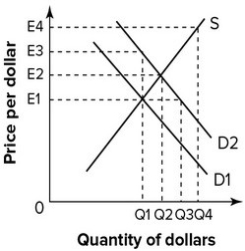
(Multiple Choice)
4.9/5 (82)
(82) What are the dangers associated with maintaining a high fixed exchange rate.
(Essay)
4.9/5 (77)
(77) Refer to the graph shown. A shift in the supply of dollars from S1 to S2 is most likely the result of: 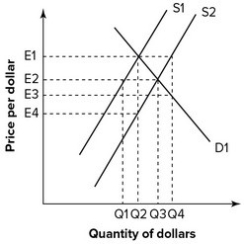
(Multiple Choice)
4.9/5 (75)
(75) Since the mid-1980s, the dollar's value has fallen from over 300 yen per dollar to about 136 yen per dollar. This trend might be explained by:
(Multiple Choice)
4.8/5 (68)
(68) Where would each of the following appear in the balance of payments account?
(a)You order some tulip bulbs from a supplier in Holland.
(b)While on vacation in London,you pay to have your shoes repaired.
(c)A U.S.firm buys shares in a German company.
(d)You receive dividends from the ownership of a German company's stock.
(e)A Japanese citizen buys a U.S.bond.
(f)A U.S.company builds a manufacturing plant in Mexico.
(Essay)
4.7/5 (88)
(88) What is the difference between currency support and currency stabilization?
(Essay)
4.9/5 (84)
(84) How does the balance of payments differ from the balance on goods and services? How do these balances relate to the international supply and demand for a nation's currency?
(Essay)
4.9/5 (73)
(73) What is the difference between a fixed,flexible,and partially flexible exchange rate regime? What are the advantages and disadvantages of each of these exchange rate regimes?
(Essay)
4.9/5 (76)
(76) Expansionary monetary policy definitely lowers the exchange rate.
(True/False)
4.8/5 (66)
(66) In late 1994 and early 1995, the Mexican peso fell by more than 40 percent. In an effort to strengthen the peso, then Mexican President Zedillo concentrated on the effects inflation had on the value of the peso. His plan most likely included:
(Multiple Choice)
4.9/5 (64)
(64) Refer to the graph shown. A sale of shekels by the Israeli government would shift the: 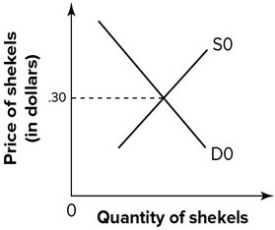
(Multiple Choice)
4.8/5 (88)
(88) General Electric, a U.S. company, buys $50 million of Japanese securities. This transaction causes the U.S.:
(Multiple Choice)
4.9/5 (69)
(69) Monetary policy affects exchange rates in all the following ways except:
(Multiple Choice)
4.9/5 (76)
(76) What is an exchange rate,and what are the factors that influence it?
(Essay)
4.8/5 (92)
(92) From the late 1990s into the early 2000s, Hong Kong suffered from deflation. Most economists believed that the period of deflation ended and that inflation would begin to pick up slowly. Prices, however, were believed to be held in check because the Hong Kong dollar is pegged to the U.S. dollar. What does the monetary authority in Hong Kong have to do to peg its dollar to the U.S. dollar?
(Multiple Choice)
4.9/5 (70)
(70) 
Filters
- Essay(0)
- Multiple Choice(0)
- Short Answer(0)
- True False(0)
- Matching(0)