



 Chat with AI
Exam 35: International Financial Policy

Exam 1: Economics and Economic Reasoning158 Questions
Exam 2: The Production Possibility Model, Trade, and Globalization133 Questions
Exam 3: Economic Institutions163 Questions
Exam 4: Supply and Demand182 Questions
Exam 5: Using Supply and Demand163 Questions
Exam 6: Describing Supply and Demand: Elasticities216 Questions
Exam 7: Taxation and Government Intervention201 Questions
Exam 8: Market Failure Versus Government Failure197 Questions
Exam 9: Comparative Advantage, Exchange Rates, and Globalization118 Questions
Exam 10: International Trade Policy99 Questions
Exam 11: Production and Cost Analysis I194 Questions
Exam 12: Production and Cost Analysis II152 Questions
Exam 13: Perfect Competition170 Questions
Exam 14: Monopoly and Monopolistic Competition274 Questions
Exam 15: Oligopoly and Antitrust Policy142 Questions
Exam 16: Real-World Competition and Technology108 Questions
Exam 17: Work and the Labor Market150 Questions
Exam 18: Who Gets What the Distribution of Income131 Questions
Exam 19: The Logic of Individual Choice: the Foundation of Supply and Demand170 Questions
Exam 20: Game Theory, Strategic Decision Making, and Behavioral Economics103 Questions
Exam 21: Thinking Like a Modern Economist97 Questions
Exam 22: Behavioral Economics and Modern Economic Policy126 Questions
Exam 23: Microeconomic Policy, Economic Reasoning, and Beyond134 Questions
Exam 24: Economic Growth, Business Cycles, and Unemployment124 Questions
Exam 25: Measuring and Describing the Aggregate Economy229 Questions
Exam 26: The Keynesian Short-Run Policy Model: Demand-Side Policies220 Questions
Exam 27: The Classical Long-Run Policy Model: Growth and Supply-Side Policies133 Questions
Exam 28: The Financial Sector and the Economy214 Questions
Exam 29: Monetary Policy243 Questions
Exam 30: Financial Crises, Panics, and Unconventional Monetary Policy109 Questions
Exam 31: Deficits and Debt: the Austerity Debate150 Questions
Exam 32: The Fiscal Policy Dilemma119 Questions
Exam 33: Jobs and Unemployment78 Questions
Exam 34: Inflation, Deflation, and Macro Policy175 Questions
Exam 35: International Financial Policy211 Questions
Exam 36: Macro Policy in a Global Setting134 Questions
Exam 37: Structural Stagnation and Globalization125 Questions
Exam 38: Macro Policy in Developing Countries142 Questions
Select questions type


What are the three pathways through which fiscal policy can influence exchange rates?
(Essay)
4.9/5  (88)
(88) What is the difference between a fixed,flexible,and partially flexible exchange rate regime?
(Essay)
4.8/5 (80)
(80) Refer to the graph shown. If the supply curve shifts from S1 to S2, the value of the dollar will: 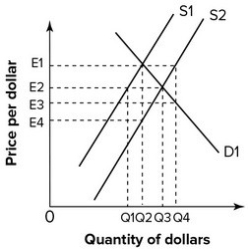
(Multiple Choice)
4.9/5 (77)
(77) Expansionary monetary policy affects domestic income in a way that causes:
(Multiple Choice)
4.8/5 (85)
(85) Using a supply and demand diagram for British Pounds,demonstrate graphically and explain in words how Great Britain can increase the exchange rate value of the Pound by influencing private demand for its currency.
(Essay)
4.9/5 (87)
(87) What is purchasing power parity and how is it related to changes in the real exchange rate?
(Essay)
4.9/5 (83)
(83) A country that wants to fix its exchange rate cannot achieve an interest rate target and an exchange rate target simultaneously.Explain why.
(Essay)
5.0/5 (76)
(76) Answer the questions below based upon the following Balance of Payments table for Tundraland (figures are in millions of cugats):
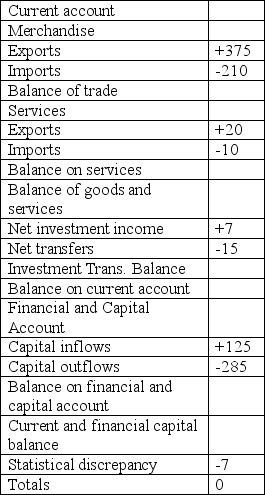 (a)What is the balance on the current account? Did more cugats flow in or out of that account?
(b)What is the balance on the financial and capital account? Did more cugats flow in or out of that account?
(c)Suppose Tundraland had purchased cugats.How would you know? Would it be trying to lower or raise the value of its currency? Show graphically.
(a)What is the balance on the current account? Did more cugats flow in or out of that account?
(b)What is the balance on the financial and capital account? Did more cugats flow in or out of that account?
(c)Suppose Tundraland had purchased cugats.How would you know? Would it be trying to lower or raise the value of its currency? Show graphically. (Essay)
4.9/5 (81)
(81) If a basket of goods costs $10 in the United States and 100,000 rubles in Russia, then purchasing power parity will exist if the exchange rate between the ruble and the dollar is:
(Multiple Choice)
4.8/5 (74)
(74) Which of the following is an advantage of the European Monetary Union?
(Multiple Choice)
4.8/5 (81)
(81) Suppose a given basket of goods and services costs 9 dollars in Australia and 5,400 baht in Thailand. If the exchange rate is 600 baht per Australian dollar, purchasing power parity implies that the:
(Multiple Choice)
4.7/5 (73)
(73) Suppose a McDonald's Big Mac costs 29 pesos in Mexico, and the exchange rate between the peso and the Canadian dollar is 10 pesos per Canadian dollar. According to purchasing power parity, a Canadian Big Mac should cost:
(Multiple Choice)
4.8/5 (84)
(84) Other things being equal, an increase in trade restrictions on imports will:
(Multiple Choice)
4.8/5 (67)
(67) 
Filters
- Essay(0)
- Multiple Choice(0)
- Short Answer(0)
- True False(0)
- Matching(0)