



 Chat with AI
Exam 6: Describing Supply and Demand: Elasticities

Exam 1: Economics and Economic Reasoning158 Questions
Exam 2: The Production Possibility Model, Trade, and Globalization133 Questions
Exam 3: Economic Institutions163 Questions
Exam 4: Supply and Demand182 Questions
Exam 5: Using Supply and Demand163 Questions
Exam 6: Describing Supply and Demand: Elasticities216 Questions
Exam 7: Taxation and Government Intervention201 Questions
Exam 8: Market Failure Versus Government Failure197 Questions
Exam 9: Comparative Advantage, Exchange Rates, and Globalization118 Questions
Exam 10: International Trade Policy99 Questions
Exam 11: Production and Cost Analysis I194 Questions
Exam 12: Production and Cost Analysis II152 Questions
Exam 13: Perfect Competition170 Questions
Exam 14: Monopoly and Monopolistic Competition274 Questions
Exam 15: Oligopoly and Antitrust Policy142 Questions
Exam 16: Real-World Competition and Technology108 Questions
Exam 17: Work and the Labor Market150 Questions
Exam 18: Who Gets What the Distribution of Income131 Questions
Exam 19: The Logic of Individual Choice: the Foundation of Supply and Demand170 Questions
Exam 20: Game Theory, Strategic Decision Making, and Behavioral Economics103 Questions
Exam 21: Thinking Like a Modern Economist97 Questions
Exam 22: Behavioral Economics and Modern Economic Policy126 Questions
Exam 23: Microeconomic Policy, Economic Reasoning, and Beyond134 Questions
Exam 24: Economic Growth, Business Cycles, and Unemployment124 Questions
Exam 25: Measuring and Describing the Aggregate Economy229 Questions
Exam 26: The Keynesian Short-Run Policy Model: Demand-Side Policies220 Questions
Exam 27: The Classical Long-Run Policy Model: Growth and Supply-Side Policies133 Questions
Exam 28: The Financial Sector and the Economy214 Questions
Exam 29: Monetary Policy243 Questions
Exam 30: Financial Crises, Panics, and Unconventional Monetary Policy109 Questions
Exam 31: Deficits and Debt: the Austerity Debate150 Questions
Exam 32: The Fiscal Policy Dilemma119 Questions
Exam 33: Jobs and Unemployment78 Questions
Exam 34: Inflation, Deflation, and Macro Policy175 Questions
Exam 35: International Financial Policy211 Questions
Exam 36: Macro Policy in a Global Setting134 Questions
Exam 37: Structural Stagnation and Globalization125 Questions
Exam 38: Macro Policy in Developing Countries142 Questions
Select questions type


If the supply of a product is inelastic, this implies that a specific percentage change in price leads to:

Free
(Multiple Choice)
4.8/5  (82)
(82) Correct Answer: Verified
C
If elasticity of demand is less than 1:
Free
(Multiple Choice)
4.9/5 (85)
(85) Correct Answer:Verified
VerifiedD
Income elasticity is defined as the:
Free
(Multiple Choice)
4.8/5 (89)
(89) Correct Answer:Verified
VerifiedB
If demand is highly inelastic and supply shifts to the left:
(Multiple Choice)
4.9/5 (70)
(70) Suppose that the price elasticity of demand is 6.If price rises by 10% how much will quantity demanded fall?
(Essay)
4.8/5 (79)
(79) Most likely, the elasticity of demand for transportation is greater than the elasticity of demand for cars.
(True/False)
4.8/5 (91)
(91) In California, the price elasticity for vanity license plates is .5 and their price is $78. California is:
(Multiple Choice)
4.9/5 (83)
(83) Refer to the graph shown. Demand is unit elastic when revenue is: 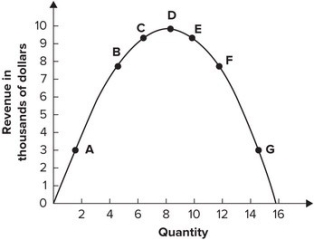
(Multiple Choice)
4.8/5 (85)
(85) Consider the following demand curve: 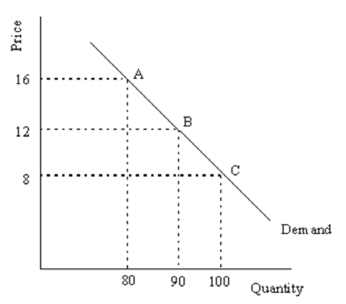 (a)Calculate the elasticity of demand between points A and B.
(b)Calculate the elasticity of demand between points B and C.
(a)Calculate the elasticity of demand between points A and B.
(b)Calculate the elasticity of demand between points B and C. (Essay)
4.9/5 (88)
(88) If two goods have a cross-price elasticity value of +3,are they substitutes or complements?
(Essay)
4.9/5 (86)
(86) If supply is highly elastic and demand shifts to the right:
(Multiple Choice)
4.8/5 (78)
(78) Refer to the following table to answer the question. A local government is looking to reduce "undesirable" behavior on the part of its citizens: drinking alcoholic beverages and smoking. Assuming people cannot shop for alcoholic beverages out of town, a 10 percent tax on all alcoholic beverages would have the largest proportionate effect on the sale of: Good Elasticity Cigarettes .3 Liquor .5 Wine .4 Beer .1
(Multiple Choice)
4.8/5 (64)
(64) 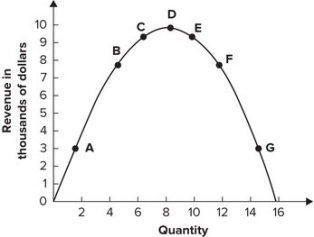
The supply of Russian caviar from the Caspian Sea diminished after the collapse of Soviet communism. The price of caviar rose from $395 a pound to $595 a pound. Still, revenue from the sale of caviar rose 30 percent. You can conclude that:
(Multiple Choice)
4.8/5 (86)
(86) The short-run elasticity of demand for gasoline sold at gasoline stations is 0.20. If terrorism causes the supply of gasoline to fall, resulting in a 5 percent drop in quantity, and other things remain the same, the price per gallon will increase by:
(Multiple Choice)
4.9/5 (81)
(81) Refer to the graph shown. Which of the following curves demonstrates a perfectly inelastic demand curve? 
(Multiple Choice)
4.8/5 (73)
(73) Refer to the graph shown. When price declines by 11 percent, quantity supplied falls by 8 percent. Which curve best demonstrates the elasticity in this example? 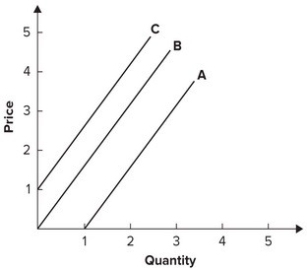
(Multiple Choice)
4.7/5 (102)
(102) 
Filters
- Essay(0)
- Multiple Choice(0)
- Short Answer(0)
- True False(0)
- Matching(0)