



 Chat with AI
Exam 6: Describing Supply and Demand: Elasticities

Exam 1: Economics and Economic Reasoning158 Questions
Exam 2: The Production Possibility Model, Trade, and Globalization133 Questions
Exam 3: Economic Institutions163 Questions
Exam 4: Supply and Demand182 Questions
Exam 5: Using Supply and Demand163 Questions
Exam 6: Describing Supply and Demand: Elasticities216 Questions
Exam 7: Taxation and Government Intervention201 Questions
Exam 8: Market Failure Versus Government Failure197 Questions
Exam 9: Comparative Advantage, Exchange Rates, and Globalization118 Questions
Exam 10: International Trade Policy99 Questions
Exam 11: Production and Cost Analysis I194 Questions
Exam 12: Production and Cost Analysis II152 Questions
Exam 13: Perfect Competition170 Questions
Exam 14: Monopoly and Monopolistic Competition274 Questions
Exam 15: Oligopoly and Antitrust Policy142 Questions
Exam 16: Real-World Competition and Technology108 Questions
Exam 17: Work and the Labor Market150 Questions
Exam 18: Who Gets What the Distribution of Income131 Questions
Exam 19: The Logic of Individual Choice: the Foundation of Supply and Demand170 Questions
Exam 20: Game Theory, Strategic Decision Making, and Behavioral Economics103 Questions
Exam 21: Thinking Like a Modern Economist97 Questions
Exam 22: Behavioral Economics and Modern Economic Policy126 Questions
Exam 23: Microeconomic Policy, Economic Reasoning, and Beyond134 Questions
Exam 24: Economic Growth, Business Cycles, and Unemployment124 Questions
Exam 25: Measuring and Describing the Aggregate Economy229 Questions
Exam 26: The Keynesian Short-Run Policy Model: Demand-Side Policies220 Questions
Exam 27: The Classical Long-Run Policy Model: Growth and Supply-Side Policies133 Questions
Exam 28: The Financial Sector and the Economy214 Questions
Exam 29: Monetary Policy243 Questions
Exam 30: Financial Crises, Panics, and Unconventional Monetary Policy109 Questions
Exam 31: Deficits and Debt: the Austerity Debate150 Questions
Exam 32: The Fiscal Policy Dilemma119 Questions
Exam 33: Jobs and Unemployment78 Questions
Exam 34: Inflation, Deflation, and Macro Policy175 Questions
Exam 35: International Financial Policy211 Questions
Exam 36: Macro Policy in a Global Setting134 Questions
Exam 37: Structural Stagnation and Globalization125 Questions
Exam 38: Macro Policy in Developing Countries142 Questions
Select questions type


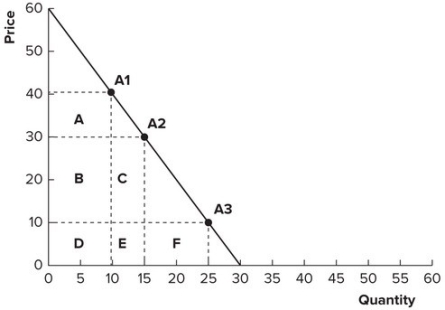

In which case will the price change be the greatest (assuming the shifts described are the same size)?
(Multiple Choice)
4.7/5  (87)
(87) If demand is highly elastic and supply shifts to the right:
(Multiple Choice)
4.8/5 (87)
(87) Consider the following demand curve for Starbucks coffee. 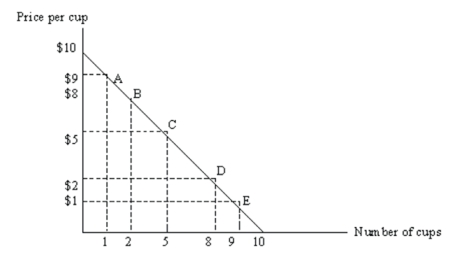 (a)Suppose the current price is $8 per cup.Using elasticity of demand,explain why Starbucks should not increase the price in order to increase total revenue.
(b)Suppose the current price is $2 per cup.Using elasticity of demand,explain why Starbucks should not lower the price in order to increase total revenue.
(a)Suppose the current price is $8 per cup.Using elasticity of demand,explain why Starbucks should not increase the price in order to increase total revenue.
(b)Suppose the current price is $2 per cup.Using elasticity of demand,explain why Starbucks should not lower the price in order to increase total revenue. (Essay)
4.8/5 (68)
(68) Are the elasticities of demand and supply the same as the slopes of demand and supply curves? Explain.
(Essay)
4.8/5 (86)
(86) You started a pajama business four years ago and it is now becoming quite successful.You are thinking of hiring an economic consultant to help you rise to the next level in your industry.One consultant is familiar with the concept of elasticity;one is not.Which one would you hire? Explain your reasoning.
(Essay)
4.8/5 (74)
(74) If frost in Florida reduces the quantity of vegetables sold by 20 percent and increases their retail price by 30 percent, one can conclude that:
(Multiple Choice)
4.8/5 (83)
(83) Refer to the graph shown. When price rises by 20 percent, quantity supplied rises by 25 percent. Which curve best demonstrates elasticity in this example? 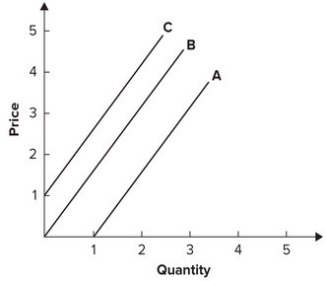
(Multiple Choice)
4.8/5 (67)
(67) If the quantity of houses supplied in an area increases 10 percent when the price goes up 25 percent, the supply:
(Multiple Choice)
4.8/5 (83)
(83) The cross-price elasticity of demand is the percentage change in price divided by the percentage change in the price of another good.
(True/False)
4.9/5 (85)
(85) If a $100 drop in the price of a $10,000 car resulted in an increase in the quantity of cars purchased from 100 to 110 and a $100 drop in the price of a $1,000 vacation rental resulted in an increase in the quantity of weekly vacation homes rented from 100 to 110, the price elasticity of demand is:
(Multiple Choice)
4.8/5 (76)
(76) Along a straight-line demand curve, total revenue is the highest when elasticity of demand is:
(Multiple Choice)
4.8/5 (85)
(85) If an economist observed that higher hot dog prices lead to an increase in the demand for chili, she most likely would conclude that:
(Multiple Choice)
4.8/5 (77)
(77) If the price of a good goes up by 5 percent and, in response, the quantity demanded falls by 15 percent, the price elasticity of demand will be:
(Multiple Choice)
4.8/5 (82)
(82) If quantity demanded does not change when the price changes, the demand:
(Multiple Choice)
4.9/5 (80)
(80) How can the cross-price elasticity be used to determine whether two goods are complements or substitutes?
(Essay)
4.8/5 (81)
(81) 
Filters
- Essay(0)
- Multiple Choice(0)
- Short Answer(0)
- True False(0)
- Matching(0)