



 Chat with AI
Exam 6: Describing Supply and Demand: Elasticities

Exam 1: Economics and Economic Reasoning158 Questions
Exam 2: The Production Possibility Model, Trade, and Globalization133 Questions
Exam 3: Economic Institutions163 Questions
Exam 4: Supply and Demand182 Questions
Exam 5: Using Supply and Demand163 Questions
Exam 6: Describing Supply and Demand: Elasticities216 Questions
Exam 7: Taxation and Government Intervention201 Questions
Exam 8: Market Failure Versus Government Failure197 Questions
Exam 9: Comparative Advantage, Exchange Rates, and Globalization118 Questions
Exam 10: International Trade Policy99 Questions
Exam 11: Production and Cost Analysis I194 Questions
Exam 12: Production and Cost Analysis II152 Questions
Exam 13: Perfect Competition170 Questions
Exam 14: Monopoly and Monopolistic Competition274 Questions
Exam 15: Oligopoly and Antitrust Policy142 Questions
Exam 16: Real-World Competition and Technology108 Questions
Exam 17: Work and the Labor Market150 Questions
Exam 18: Who Gets What the Distribution of Income131 Questions
Exam 19: The Logic of Individual Choice: the Foundation of Supply and Demand170 Questions
Exam 20: Game Theory, Strategic Decision Making, and Behavioral Economics103 Questions
Exam 21: Thinking Like a Modern Economist97 Questions
Exam 22: Behavioral Economics and Modern Economic Policy126 Questions
Exam 23: Microeconomic Policy, Economic Reasoning, and Beyond134 Questions
Exam 24: Economic Growth, Business Cycles, and Unemployment124 Questions
Exam 25: Measuring and Describing the Aggregate Economy229 Questions
Exam 26: The Keynesian Short-Run Policy Model: Demand-Side Policies220 Questions
Exam 27: The Classical Long-Run Policy Model: Growth and Supply-Side Policies133 Questions
Exam 28: The Financial Sector and the Economy214 Questions
Exam 29: Monetary Policy243 Questions
Exam 30: Financial Crises, Panics, and Unconventional Monetary Policy109 Questions
Exam 31: Deficits and Debt: the Austerity Debate150 Questions
Exam 32: The Fiscal Policy Dilemma119 Questions
Exam 33: Jobs and Unemployment78 Questions
Exam 34: Inflation, Deflation, and Macro Policy175 Questions
Exam 35: International Financial Policy211 Questions
Exam 36: Macro Policy in a Global Setting134 Questions
Exam 37: Structural Stagnation and Globalization125 Questions
Exam 38: Macro Policy in Developing Countries142 Questions
Select questions type


If the price elasticity of supply is 0.5, a 10 percent increase in price will cause a:
(Multiple Choice)
4.7/5  (81)
(81) Suppose that the price elasticity of supply is 0.5.If price falls by 10% how much will quantity supplied fall?
(Essay)
4.9/5 (74)
(74) As the price of beachfront cottages in Florida was raised from $400,000 to $500,000, their quantity supplied rose from 2,000 to 2,100. Rounding to the nearest tenth, the elasticity of supply of beachfront cottages is:
(Multiple Choice)
4.8/5 (81)
(81) When demand is perfectly inelastic, there is no change in quantity demanded after a change in price.
(True/False)
4.9/5 (79)
(79) When the demand curve is highly inelastic, there is a strong incentive for suppliers to find a way to collectively reduce the quantity sold in the market and raise the price of the product.
(True/False)
4.9/5 (87)
(87) As the price of samosas (a triangular pastry in India)was raised from 2 to 3 rupees (Indian currency), their quantity demanded fell from 15,000 to 12,000. Rounding to the nearest tenth, the elasticity of demand of samosas is:
(Multiple Choice)
4.8/5 (72)
(72) During World War II, the price of rubber went up considerably. The rise in price stimulated research for alternatives. Today's automobile tires are made almost entirely from synthetic materials. As a result, the increase in the price of rubber eventually led to a very large drop in quantity demanded. This is an example of how the price elasticity of demand:
(Multiple Choice)
4.9/5 (92)
(92) Under which of the following two scenarios would demand be more elastic? Explain.
(a)Demand for a new car.
(b)Demand for a tank of gas for your current car.
(Essay)
4.9/5 (79)
(79) Demonstrate graphically and explain verbally a perfectly inelastic demand curve.
(Essay)
4.9/5 (70)
(70) Refer to the graph shown. At which point is elasticity infinite? 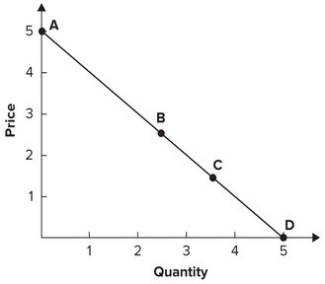
(Multiple Choice)
4.7/5 (86)
(86) If the demand for agricultural output is highly inelastic, an improvement in the technology used in the agricultural industry most likely will cause a:
(Multiple Choice)
5.0/5 (77)
(77) Consider the following demand curve: 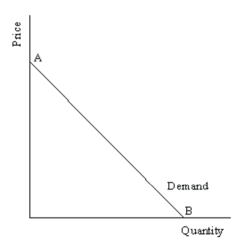 What is the price elasticity at point A? At point B?
 (Essay)
4.9/5 (82)
(82) If milk and cookies are complements and the price of cookies falls, we would expect to see:
(Multiple Choice)
4.7/5 (84)
(84) Refer to the following table to answer the question. Which of the following statements is true? Price of Quantity Demanded of Quantity Demanded of Quantity Demanded of \ 1.00 80 100 5 \ 1.50 60 98 10 \ 2.00 40 96 15 \ 2.50 20 94 20 \ 3.00 0 92 25
(Multiple Choice)
4.9/5 (73)
(73) What is the difference between elastic and inelastic demand and supply?
(Essay)
4.8/5 (81)
(81) It is estimated that a 10 percent decline in income will reduce cigarette smoking by 1.4 percent. From this information one can conclude that cigarettes are most likely:
(Multiple Choice)
4.8/5 (85)
(85) The demand for a good is inelastic. Which of the following would be the most likely explanation for this?
(Multiple Choice)
4.8/5 (73)
(73) Refer to the following graph.  Elasticity is greatest at point:
 (Multiple Choice)
4.8/5 (77)
(77) Refer to the following graph. 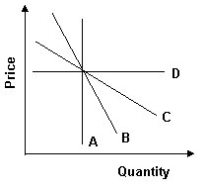 The demand curve with the greatest elasticity is:
 (Multiple Choice)
4.8/5 (76)
(76) 
Filters
- Essay(0)
- Multiple Choice(0)
- Short Answer(0)
- True False(0)
- Matching(0)