



 Chat with AI
Exam 6: Describing Supply and Demand: Elasticities

Exam 1: Economics and Economic Reasoning158 Questions
Exam 2: The Production Possibility Model, Trade, and Globalization133 Questions
Exam 3: Economic Institutions163 Questions
Exam 4: Supply and Demand182 Questions
Exam 5: Using Supply and Demand163 Questions
Exam 6: Describing Supply and Demand: Elasticities216 Questions
Exam 7: Taxation and Government Intervention201 Questions
Exam 8: Market Failure Versus Government Failure197 Questions
Exam 9: Comparative Advantage, Exchange Rates, and Globalization118 Questions
Exam 10: International Trade Policy99 Questions
Exam 11: Production and Cost Analysis I194 Questions
Exam 12: Production and Cost Analysis II152 Questions
Exam 13: Perfect Competition170 Questions
Exam 14: Monopoly and Monopolistic Competition274 Questions
Exam 15: Oligopoly and Antitrust Policy142 Questions
Exam 16: Real-World Competition and Technology108 Questions
Exam 17: Work and the Labor Market150 Questions
Exam 18: Who Gets What the Distribution of Income131 Questions
Exam 19: The Logic of Individual Choice: the Foundation of Supply and Demand170 Questions
Exam 20: Game Theory, Strategic Decision Making, and Behavioral Economics103 Questions
Exam 21: Thinking Like a Modern Economist97 Questions
Exam 22: Behavioral Economics and Modern Economic Policy126 Questions
Exam 23: Microeconomic Policy, Economic Reasoning, and Beyond134 Questions
Exam 24: Economic Growth, Business Cycles, and Unemployment124 Questions
Exam 25: Measuring and Describing the Aggregate Economy229 Questions
Exam 26: The Keynesian Short-Run Policy Model: Demand-Side Policies220 Questions
Exam 27: The Classical Long-Run Policy Model: Growth and Supply-Side Policies133 Questions
Exam 28: The Financial Sector and the Economy214 Questions
Exam 29: Monetary Policy243 Questions
Exam 30: Financial Crises, Panics, and Unconventional Monetary Policy109 Questions
Exam 31: Deficits and Debt: the Austerity Debate150 Questions
Exam 32: The Fiscal Policy Dilemma119 Questions
Exam 33: Jobs and Unemployment78 Questions
Exam 34: Inflation, Deflation, and Macro Policy175 Questions
Exam 35: International Financial Policy211 Questions
Exam 36: Macro Policy in a Global Setting134 Questions
Exam 37: Structural Stagnation and Globalization125 Questions
Exam 38: Macro Policy in Developing Countries142 Questions
Select questions type


What is the income elasticity of demand? How can it be used to determine whether a good is a normal good or an inferior good? What is the cross-price elasticity of demand? How can it be used to determine whether two goods are substitutes or complements?
(Essay)
4.9/5  (74)
(74) A sporting goods store observes that as they reduce the price of squash balls from $5 to $4, their quantity demanded rises from 200 to 220. Rounding to the nearest tenth, they correctly compute the elasticity of demand of squash balls to be:
(Multiple Choice)
4.8/5 (86)
(86) It has been estimated that the price elasticity of demand for attending baseball games is 0.23. Other things held constant, a 10 percent increase in attendance can be explained by a:
(Multiple Choice)
4.9/5 (71)
(71) Refer to the graph shown. When price rises from $30 to $40: 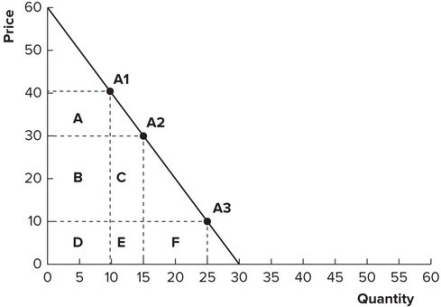
(Multiple Choice)
4.7/5 (83)
(83) Refer to the following graph.  Since the supply curve intersects the horizontal axis, all the points along the supply curve shown are inelastic.
 (True/False)
4.9/5 (70)
(70) An economist estimates that with every 15 percent increase in income, the quantity of turkey purchased declines by 1.8 percent. From this information one would conclude that turkey is:
(Multiple Choice)
4.8/5 (81)
(81) Refer to the graph shown. The elasticity of demand is closest to 1 on line segment: 
(Multiple Choice)
4.8/5 (77)
(77) Refer to the following graph.  Elasticity is greatest at point:
 (Multiple Choice)
4.8/5 (89)
(89) Under which of the following two scenarios would demand be more elastic? Explain.
(a)Demand for a camera.
(b)Demand for a 35 mm SLR camera with auto rewind,advance,zoom,and flash.
(Essay)
4.8/5 (78)
(78) Refer to the graph shown. Between points E and F demand is: 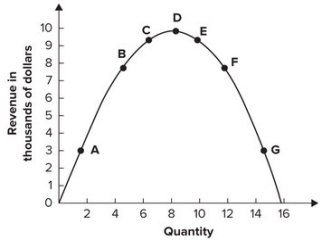
(Multiple Choice)
4.8/5 (88)
(88) Refer to the graph shown. Which supply curve is perfectly elastic? 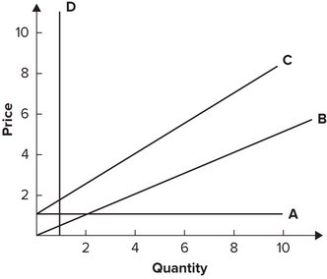
(Multiple Choice)
4.8/5 (83)
(83) Consider the following supply curve: 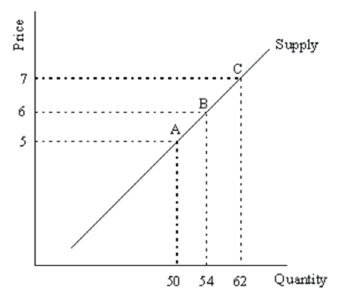 (a)Calculate the elasticity of supply between points A and B.
(b)Calculate the elasticity of supply between points B and C.
(a)Calculate the elasticity of supply between points A and B.
(b)Calculate the elasticity of supply between points B and C. (Essay)
4.7/5 (77)
(77) Under which of the following two scenarios would demand for hot dogs be more elastic? Explain.
(a)You are at a baseball game at Wrigley Field and want to eat a hot dog.
(b)It's Tuesday,you are planning the menu for a picnic you are going to have on Saturday and you decide to serve hot dogs.
(Essay)
5.0/5 (88)
(88) Elizabeth Savoca estimated that for every 1 percent increase in tuition costs at a college, 2.4 percent fewer students applied to that college. This indicates that the elasticity of applying to college is:
(Multiple Choice)
4.9/5 (89)
(89) 
Filters
- Essay(0)
- Multiple Choice(0)
- Short Answer(0)
- True False(0)
- Matching(0)