



 Chat with AI
Exam 6: Describing Supply and Demand: Elasticities

Exam 1: Economics and Economic Reasoning158 Questions
Exam 2: The Production Possibility Model, Trade, and Globalization133 Questions
Exam 3: Economic Institutions163 Questions
Exam 4: Supply and Demand182 Questions
Exam 5: Using Supply and Demand163 Questions
Exam 6: Describing Supply and Demand: Elasticities216 Questions
Exam 7: Taxation and Government Intervention201 Questions
Exam 8: Market Failure Versus Government Failure197 Questions
Exam 9: Comparative Advantage, Exchange Rates, and Globalization118 Questions
Exam 10: International Trade Policy99 Questions
Exam 11: Production and Cost Analysis I194 Questions
Exam 12: Production and Cost Analysis II152 Questions
Exam 13: Perfect Competition170 Questions
Exam 14: Monopoly and Monopolistic Competition274 Questions
Exam 15: Oligopoly and Antitrust Policy142 Questions
Exam 16: Real-World Competition and Technology108 Questions
Exam 17: Work and the Labor Market150 Questions
Exam 18: Who Gets What the Distribution of Income131 Questions
Exam 19: The Logic of Individual Choice: the Foundation of Supply and Demand170 Questions
Exam 20: Game Theory, Strategic Decision Making, and Behavioral Economics103 Questions
Exam 21: Thinking Like a Modern Economist97 Questions
Exam 22: Behavioral Economics and Modern Economic Policy126 Questions
Exam 23: Microeconomic Policy, Economic Reasoning, and Beyond134 Questions
Exam 24: Economic Growth, Business Cycles, and Unemployment124 Questions
Exam 25: Measuring and Describing the Aggregate Economy229 Questions
Exam 26: The Keynesian Short-Run Policy Model: Demand-Side Policies220 Questions
Exam 27: The Classical Long-Run Policy Model: Growth and Supply-Side Policies133 Questions
Exam 28: The Financial Sector and the Economy214 Questions
Exam 29: Monetary Policy243 Questions
Exam 30: Financial Crises, Panics, and Unconventional Monetary Policy109 Questions
Exam 31: Deficits and Debt: the Austerity Debate150 Questions
Exam 32: The Fiscal Policy Dilemma119 Questions
Exam 33: Jobs and Unemployment78 Questions
Exam 34: Inflation, Deflation, and Macro Policy175 Questions
Exam 35: International Financial Policy211 Questions
Exam 36: Macro Policy in a Global Setting134 Questions
Exam 37: Structural Stagnation and Globalization125 Questions
Exam 38: Macro Policy in Developing Countries142 Questions
Select questions type


Online music streaming services, such as Spotify, have decimated the market for CDs. Based on this information, you can conclude that streaming services:
(Multiple Choice)
4.9/5  (82)
(82) Refer to the following graph.  Elasticity is greatest at point:
 (Multiple Choice)
4.8/5 (79)
(79) If quantity demanded falls by 25 percent when price rises by 50 percent, demand is said to be:
(Multiple Choice)
4.9/5 (72)
(72) Susan's price elasticity of restaurant meals is 2.27. If the price of a restaurant meal falls by 2 percent, the quantity of restaurant meals Susan demands will:
(Multiple Choice)
4.7/5 (79)
(79) If consumers won't pay more than $1.50 for a pack of gum and at $1.50 they will buy an almost infinite amount, price elasticity of demand at $1.50 is:
(Multiple Choice)
4.7/5 (73)
(73) College students tend to eat more ramen noodles than do recent college graduates. A primary reason for this is that:
(Multiple Choice)
4.8/5 (90)
(90) Refer to the graph shown. Which point has an elasticity greater than 1? 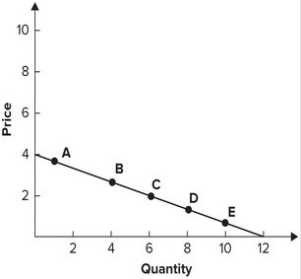
(Multiple Choice)
5.0/5 (76)
(76) The price elasticity of demand for insulin by diabetic patients is much smaller than the price elasticity of demand for leather shoes. This is an example of how the price elasticity of demand:
(Multiple Choice)
4.8/5 (57)
(57) If demand is highly inelastic and supply shifts to the right, price:
(Multiple Choice)
4.8/5 (68)
(68) Which of the following statements is true about a downward-sloping demand curve that is a straight line?
(Multiple Choice)
4.9/5 (75)
(75) A newspaper recently lowered its price from 50 cents to 30 cents, causing the number of newspapers sold to increase from 240,000 to 280,000. Other things equal, the data imply that the elasticity of demand for this newspaper is about:
(Multiple Choice)
4.9/5 (80)
(80) If the quantity of picture frames supplied increases 15 percent when the price goes up 20 percent, the elasticity of supply is:
(Multiple Choice)
4.8/5 (68)
(68) It has been estimated that the price elasticity for cigarettes is 0.164. Assuming there are currently no taxes on cigarettes, to reduce cigarette purchases by 5 percent, the government would need to tax cigarettes enough to:
(Multiple Choice)
4.9/5 (84)
(84) Charlie will purchase 10 percent more cans of Coke if the price of a can of Coke falls by 5 percent. Charlie's price elasticity of demand for cans of Coke is:
(Multiple Choice)
4.8/5 (71)
(71) Compared to the elasticity of demand for off-peak trains, one would expect elasticity of demand for peak-time trains to be:
(Multiple Choice)
4.7/5 (77)
(77) If the percentage increase in the quantity supplied is smaller than the percentage increase in the price, the supply:
(Multiple Choice)
4.9/5 (84)
(84) Suppose the demand for butter increases from 800 to 1,000 pounds when income falls from $40,000 to 30,000. Income elasticity is:
(Multiple Choice)
5.0/5 (78)
(78) The president of a college has been told that when they raised their tuition by 15 percent the previous year, total revenue from tuition remained unchanged. Assuming the change in revenue is due to the change in tuition only, the president could conclude that demand for that college, over that tuition range, must be:
(Multiple Choice)
4.8/5 (63)
(63) Compute the approximate elasticity of demand from the following data: Price Quantity Initial situation \ 23 11.5 New situation 20 13.5
(Multiple Choice)
5.0/5 (81)
(81) 
Filters
- Essay(0)
- Multiple Choice(0)
- Short Answer(0)
- True False(0)
- Matching(0)