



 Chat with AI
Exam 6: Describing Supply and Demand: Elasticities

Exam 1: Economics and Economic Reasoning158 Questions
Exam 2: The Production Possibility Model, Trade, and Globalization133 Questions
Exam 3: Economic Institutions163 Questions
Exam 4: Supply and Demand182 Questions
Exam 5: Using Supply and Demand163 Questions
Exam 6: Describing Supply and Demand: Elasticities216 Questions
Exam 7: Taxation and Government Intervention201 Questions
Exam 8: Market Failure Versus Government Failure197 Questions
Exam 9: Comparative Advantage, Exchange Rates, and Globalization118 Questions
Exam 10: International Trade Policy99 Questions
Exam 11: Production and Cost Analysis I194 Questions
Exam 12: Production and Cost Analysis II152 Questions
Exam 13: Perfect Competition170 Questions
Exam 14: Monopoly and Monopolistic Competition274 Questions
Exam 15: Oligopoly and Antitrust Policy142 Questions
Exam 16: Real-World Competition and Technology108 Questions
Exam 17: Work and the Labor Market150 Questions
Exam 18: Who Gets What the Distribution of Income131 Questions
Exam 19: The Logic of Individual Choice: the Foundation of Supply and Demand170 Questions
Exam 20: Game Theory, Strategic Decision Making, and Behavioral Economics103 Questions
Exam 21: Thinking Like a Modern Economist97 Questions
Exam 22: Behavioral Economics and Modern Economic Policy126 Questions
Exam 23: Microeconomic Policy, Economic Reasoning, and Beyond134 Questions
Exam 24: Economic Growth, Business Cycles, and Unemployment124 Questions
Exam 25: Measuring and Describing the Aggregate Economy229 Questions
Exam 26: The Keynesian Short-Run Policy Model: Demand-Side Policies220 Questions
Exam 27: The Classical Long-Run Policy Model: Growth and Supply-Side Policies133 Questions
Exam 28: The Financial Sector and the Economy214 Questions
Exam 29: Monetary Policy243 Questions
Exam 30: Financial Crises, Panics, and Unconventional Monetary Policy109 Questions
Exam 31: Deficits and Debt: the Austerity Debate150 Questions
Exam 32: The Fiscal Policy Dilemma119 Questions
Exam 33: Jobs and Unemployment78 Questions
Exam 34: Inflation, Deflation, and Macro Policy175 Questions
Exam 35: International Financial Policy211 Questions
Exam 36: Macro Policy in a Global Setting134 Questions
Exam 37: Structural Stagnation and Globalization125 Questions
Exam 38: Macro Policy in Developing Countries142 Questions
Select questions type


Five brief scenarios are presented below.Apply the correct elasticity term to each scenario and explain your answer.
(a)John must have an appendectomy.Upon arriving at the hospital he is told that for this week only they are doing abdominal operations at half price.Even in the face of a 50 percent price cut,John insists that he wants only one operation.
(b)Apple announces that it is willing to sell as many model 3000 computers as are ordered at a fixed price of $500 per unit.
(c)Northwest Airlines increased all its fares by 25 percent.As a result the number of passengers declined by 25 percent and the total revenue of Northwest Airlines remained the same.
(d)Newsweek magazine raised its price to annual subscribers by 50 percent.As a result annual subscriptions fell by 30 percent.Although it lost some readership,Newsweek significantly increased its revenues.
(e)The price of soybeans went up by 60 percent.In response farmers planted more soybeans and output increase by 70 percent.
(Essay)
4.7/5  (67)
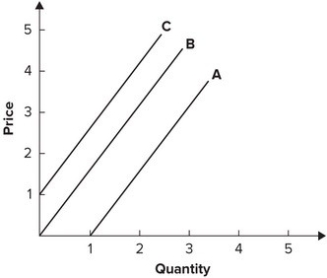
(67) 
Refer to the following graph. 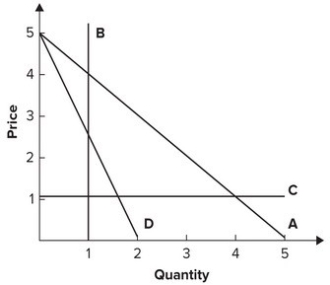 Which of the following curves demonstrates a unit elastic demand curve? (That is, a curve where elasticity is 1 at each point. )
 (Multiple Choice)
4.9/5 (80)
(80) An economist estimates that for every 1 percent increase in the price of natural Christmas trees, the demand for artificial trees rises by .2 percent. From this information one can conclude that:
(Multiple Choice)
4.8/5 (77)
(77) Refer to the graph shown. Which point has an elasticity less than 1? 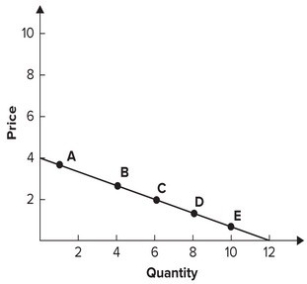
(Multiple Choice)
4.9/5 (71)
(71) Bill's Homemade Pizza recently increased the price of its super jumbo size pepperoni pizza by 12%.As a result of this price increase the quantity demanded for this type of pizza decreased by 3%.What is the price elasticity of demand for Bill's super jumbo size pepperoni pizza?
(Essay)
4.8/5 (86)
(86) Under which of the following two scenarios would demand be more elastic? Explain.
(a)Demand for blood pressure medicine by those with high blood pressure.
(b)Demand for chemical-free hair coloring.
(Essay)
4.9/5 (82)
(82) Refer to the graph shown. For which curve does the price elasticity of supply decrease as price increases? 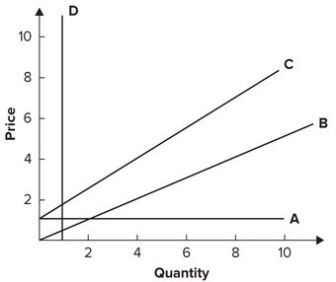
(Multiple Choice)
4.8/5 (77)
(77) Refer to the following graph. 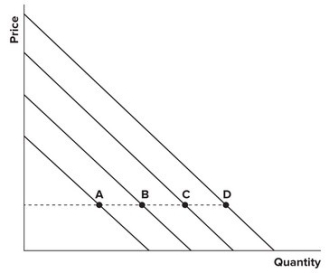 Elasticity is smallest at which point?
 (Multiple Choice)
4.9/5 (72)
(72) Define the price elasticity of demand and the price elasticity of supply.What is the difference between elastic and inelastic demand?
(Essay)
4.8/5 (80)
(80) Refer to the graph shown. When price is $40, revenue equals areas: 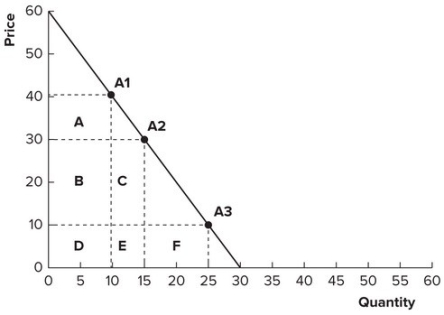
(Multiple Choice)
4.8/5 (78)
(78) Refer to the following graph.  If price is currently at B and rises, total revenue will rise.
 (True/False)
4.8/5 (75)
(75) The Honolulu tourism commission proposed a 6 percent tax on hotel rooms to pay for an outdoor amphitheater. A Purdue University economist estimates that the tax would result in a 6 percent increase in the price of hotel rooms. If the elasticity of demand is 1.33, what is the expected change in quantity demanded?
(Multiple Choice)
4.8/5 (93)
(93) If milk and cookies are complements and the price of cookies rises, we would expect to see:
(Multiple Choice)
4.9/5 (87)
(87) If the elasticity of demand for electricity is 0.13, the demand for electricity is:
(Multiple Choice)
4.8/5 (77)
(77) Refer to the following table to answer the question. Supply shown by the table is: Price Quantity Demanded \ 6.00 \ 8.00 90 \ 10.00 100 \ 12.00 110 \ 14.00 120
(Multiple Choice)
4.7/5 (76)
(76) 
Filters
- Essay(0)
- Multiple Choice(0)
- Short Answer(0)
- True False(0)
- Matching(0)