



 Chat with AI
Exam 23: Microeconomic Policy, Economic Reasoning, and Beyond

Exam 1: Economics and Economic Reasoning158 Questions
Exam 2: The Production Possibility Model, Trade, and Globalization133 Questions
Exam 3: Economic Institutions163 Questions
Exam 4: Supply and Demand182 Questions
Exam 5: Using Supply and Demand163 Questions
Exam 6: Describing Supply and Demand: Elasticities216 Questions
Exam 7: Taxation and Government Intervention201 Questions
Exam 8: Market Failure Versus Government Failure197 Questions
Exam 9: Comparative Advantage, Exchange Rates, and Globalization118 Questions
Exam 10: International Trade Policy99 Questions
Exam 11: Production and Cost Analysis I194 Questions
Exam 12: Production and Cost Analysis II152 Questions
Exam 13: Perfect Competition170 Questions
Exam 14: Monopoly and Monopolistic Competition274 Questions
Exam 15: Oligopoly and Antitrust Policy142 Questions
Exam 16: Real-World Competition and Technology108 Questions
Exam 17: Work and the Labor Market150 Questions
Exam 18: Who Gets What the Distribution of Income131 Questions
Exam 19: The Logic of Individual Choice: the Foundation of Supply and Demand170 Questions
Exam 20: Game Theory, Strategic Decision Making, and Behavioral Economics103 Questions
Exam 21: Thinking Like a Modern Economist97 Questions
Exam 22: Behavioral Economics and Modern Economic Policy126 Questions
Exam 23: Microeconomic Policy, Economic Reasoning, and Beyond134 Questions
Exam 24: Economic Growth, Business Cycles, and Unemployment124 Questions
Exam 25: Measuring and Describing the Aggregate Economy229 Questions
Exam 26: The Keynesian Short-Run Policy Model: Demand-Side Policies220 Questions
Exam 27: The Classical Long-Run Policy Model: Growth and Supply-Side Policies133 Questions
Exam 28: The Financial Sector and the Economy214 Questions
Exam 29: Monetary Policy243 Questions
Exam 30: Financial Crises, Panics, and Unconventional Monetary Policy109 Questions
Exam 31: Deficits and Debt: the Austerity Debate150 Questions
Exam 32: The Fiscal Policy Dilemma119 Questions
Exam 33: Jobs and Unemployment78 Questions
Exam 34: Inflation, Deflation, and Macro Policy175 Questions
Exam 35: International Financial Policy211 Questions
Exam 36: Macro Policy in a Global Setting134 Questions
Exam 37: Structural Stagnation and Globalization125 Questions
Exam 38: Macro Policy in Developing Countries142 Questions
Select questions type


Economic policy in the real world reflects:

Free
(Multiple Choice)
4.8/5  (79)
(79) Correct Answer: Verified
C
Consider the following supply and demand diagrams. 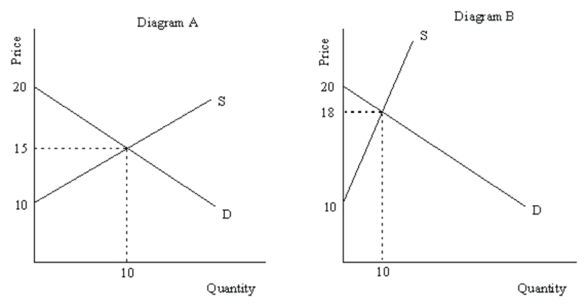 (a)Compute the amount of consumer plus producer surplus in each case.
(b)Which outcome would the majority of society prefer? Explain.
(a)Compute the amount of consumer plus producer surplus in each case.
(b)Which outcome would the majority of society prefer? Explain.Free
(Essay)
4.9/5 (76)
(76) Correct Answer:Verified
Verified(a)The calculations of consumer and producer surplus:
Surplus in Diagram A:
Consumer surplus = 0.5 × 5 × 10 = 25
Producer surplus = 0.5 × 5 × 10 = 25
Total surplus = 50
Surplus in Diagram B:
Consumer surplus = 0.5 × 2 × 10 = 10
Producer surplus = 0.5 × 8 × 10 = 40
Total surplus = 50
(b)If there are more consumers than producers,the majority of the society might prefer the outcome from Diagram A for distributional reasons (since obviously consumers get more surplus in Diagram A).
Suppose a radar-activated braking system that can help prevent crashes is an option on a new car. It costs $600 and reduces the chance of dying in an auto accident by 1/700. The implicit value placed on life by a person who does not have the system installed is therefore:
Free
(Multiple Choice)
5.0/5 (92)
(92) Correct Answer:Verified
VerifiedB
The Safety Commissioner for the state of North Dakota is contemplating requiring anyone who applies for a hunting license to take a gun safety class.The state's insurance commissioner has determined that taking this course will reduce the likelihood of a self-inflicted mortality by 1/1,000,000.Recent work by an economist at the University of North Dakota indicates that hunters in North Dakota value their lives at $5,000,000.Since the Safety Commissioner is up for re-election soon,he wants to make sure the cost to hunters of the program is not too high.What price should he charge hunters for this safety class? Why might N.D.offer the course for less than the expected benefit to hunters? Explain.
(Essay)
4.9/5 (82)
(82) Which of the following ultimately must decide what externalities should be addressed?
(Multiple Choice)
4.9/5 (87)
(87) The government is contemplating legalizing,and then taxing crack cocaine.Would the government prefer that the demand for crack cocaine be elastic or inelastic? Explain,using supply and demand diagrams.
(Essay)
4.9/5 (84)
(84) To use cost/benefit analysis to decide whether to attend college, a prospective student must take into account all of the following except the:
(Multiple Choice)
4.8/5 (78)
(78) Cannibalism is illegal. What issue in the text does this law best illustrate?
(Multiple Choice)
4.8/5 (75)
(75) Which of the following is one of the reasons economists sometimes differ in their views on social policy?
(Multiple Choice)
4.8/5 (85)
(85) In Europe, government regulations discourage consumer credit. "It's to protect the consumer from himself," says Jacques Zeegers, secretary general to the Belgian Banking Association. As far as Mr. Zeegers is concerned, the government should worry that there is a failure caused by:
(Multiple Choice)
4.8/5 (79)
(79) Politics enters into the determination of economic policy in a negative way because:
(Multiple Choice)
4.9/5 (85)
(85) Anna is expecting a child but has decided that she is not ready to be a mother. She chooses to sell her newborn to Bob and Sue, a couple who have been unable to conceive a child of their own but want one desperately. This is an example of a trade that:
(Multiple Choice)
4.9/5 (86)
(86) Why are the poor given little weight in the measure of consumer surplus?
(Multiple Choice)
4.7/5 (66)
(66) "The consumer is sovereign. Businesses produce what people want. The problem today is that because of externalities, often the decisions of firms do not reflect consumer preferences." The speaker is implying:
(Multiple Choice)
4.9/5 (85)
(85) A person will pay $1,000 (and not more)extra for a bigger car that he or she feels is safer. This car will reduce the chance of dying in an automobile accident by 1/550. That means that the buyer is implicitly valuing his or her life at roughly:
(Multiple Choice)
4.8/5 (71)
(71) Critics of advertising sometimes argue that the overall effect of advertising is to make people believe that possessing lots of material goods is the only route to happiness. These critics also believe that this is a misleading view of happiness. Hence, these critics:
(Multiple Choice)
4.8/5 (71)
(71) If individuals' demand in the marketplace does not reflect their true welfare:
(Multiple Choice)
4.8/5 (79)
(79) In prisoner-of-war camps during World War II, the prisoners received identical packets of food and supplies. Nonetheless, prisoners traded items from those identical packets because their tastes differed. The initial distribution of packets was:
(Multiple Choice)
4.8/5 (78)
(78) 
Filters
- Essay(0)
- Multiple Choice(0)
- Short Answer(0)
- True False(0)
- Matching(0)