



 Chat with AI
Exam 32: The Fiscal Policy Dilemma


What is the Ricardian Equivalence Theorem and why is it important to debates about fiscal policy?

 (68)
 Verified
David Ricardo's Ricardian Equivalence Theorem stated that government spending financed by selling government bonds (the government running a budget deficit)was no different from government spending financed by taxes (the government running a balanced budget).Government would have to increase taxes in the future both to pay the interest on the bonds and to repay the bonds when they came due.Assuming people can borrow and save,and thereby shift spending between now and the future,people would save more now to pay for those future taxes.So,there is no reason why deficit financed spending should affect the aggregate level of income differently than tax financed spending.It followed that a government deficit would not lead to an expansion of output in the economy.This theoretical proposition that deficits do not affect the level of output in the economy because individuals will increase their savings to account for expected future tax payments to repay the deficit has become known as the Ricardian Equivalence Theorem.
Based on Ricardian equivalence,some have argued that whether a government deficit is financed by bonds (deficit spending)or by taxes (balanced budget)is irrelevant.The method of funding government spending does not affect aggregate output.
When the government runs a deficit it must:
(76) VerifiedB
According to the Ricardian equivalence theorem, government deficits do not affect output because people:
(87) VerifiedB
Contractionary fiscal policy that reduces the budget deficit may:
(91) An economist who follows a functional finance principle believes that the government should:
(80) Suppose the government increases spending by $30 billion and raises taxes by $20 billion at the same time. Then:
(74) What is the crowding out effect? Using the AS/AD model,demonstrate graphically and explain in words the impact of expansionary fiscal policy on the crowding out effect.
(78) The government's running of a deficit or a surplus with the objective of affecting the level of output in the economy is called:
(84) According to the Ricardian equivalence theorem, people increase savings when the government increases deficits because they recognize the link between government deficits and higher future taxes.
(73) Most of the government budget is mandatory spending through programs like Medicare and Social Security, and much of the rest is politically difficult to alter. Because of this:
(81) If an economy is above potential output and the government opts for a contractionary fiscal policy (running surpluses)to shift the AD curve, an economist with a Classical view, who holds the Ricardian equivalence theorem to be practically true, would conclude that the AD curve:
(76) If private investment is relatively sensitive to interest rates, then a fiscal expansion financed by government bond sales will:
(87) When the economy is experiencing inflation, an economist who follows the functional finance theorem is most likely to suggest that the government should:
(82) Refer to the graph shown. Suppose the government borrows $50 million to finance an increase in its spending and that as a result, the level of investment is reduced by $50 million. In this case, the aggregate demand curve will: 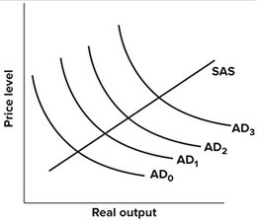
(87) If the government knew the level of potential income and had sufficient information about the economy it could fine-tune the economy.
(88) 
Filters
- Essay(0)
- Multiple Choice(0)
- Short Answer(0)
- True False(0)
- Matching(0)