



 Chat with AI
Exam 32: The Fiscal Policy Dilemma

Exam 1: Economics and Economic Reasoning158 Questions
Exam 2: The Production Possibility Model, Trade, and Globalization133 Questions
Exam 3: Economic Institutions163 Questions
Exam 4: Supply and Demand182 Questions
Exam 5: Using Supply and Demand163 Questions
Exam 6: Describing Supply and Demand: Elasticities216 Questions
Exam 7: Taxation and Government Intervention201 Questions
Exam 8: Market Failure Versus Government Failure197 Questions
Exam 9: Comparative Advantage, Exchange Rates, and Globalization118 Questions
Exam 10: International Trade Policy99 Questions
Exam 11: Production and Cost Analysis I194 Questions
Exam 12: Production and Cost Analysis II152 Questions
Exam 13: Perfect Competition170 Questions
Exam 14: Monopoly and Monopolistic Competition274 Questions
Exam 15: Oligopoly and Antitrust Policy142 Questions
Exam 16: Real-World Competition and Technology108 Questions
Exam 17: Work and the Labor Market150 Questions
Exam 18: Who Gets What the Distribution of Income131 Questions
Exam 19: The Logic of Individual Choice: the Foundation of Supply and Demand170 Questions
Exam 20: Game Theory, Strategic Decision Making, and Behavioral Economics103 Questions
Exam 21: Thinking Like a Modern Economist97 Questions
Exam 22: Behavioral Economics and Modern Economic Policy126 Questions
Exam 23: Microeconomic Policy, Economic Reasoning, and Beyond134 Questions
Exam 24: Economic Growth, Business Cycles, and Unemployment124 Questions
Exam 25: Measuring and Describing the Aggregate Economy229 Questions
Exam 26: The Keynesian Short-Run Policy Model: Demand-Side Policies220 Questions
Exam 27: The Classical Long-Run Policy Model: Growth and Supply-Side Policies133 Questions
Exam 28: The Financial Sector and the Economy214 Questions
Exam 29: Monetary Policy243 Questions
Exam 30: Financial Crises, Panics, and Unconventional Monetary Policy109 Questions
Exam 31: Deficits and Debt: the Austerity Debate150 Questions
Exam 32: The Fiscal Policy Dilemma119 Questions
Exam 33: Jobs and Unemployment78 Questions
Exam 34: Inflation, Deflation, and Macro Policy175 Questions
Exam 35: International Financial Policy211 Questions
Exam 36: Macro Policy in a Global Setting134 Questions
Exam 37: Structural Stagnation and Globalization125 Questions
Exam 38: Macro Policy in Developing Countries142 Questions
Select questions type


What did the sound finance approach to fiscal policy use to support its view?
(Multiple Choice)
4.7/5  (93)
(93) Between 1999 and 2009, the U.S. federal budget deficit moved from a record surplus to a record deficit. Other things being equal, the most likely effect of this shift would be:
(Multiple Choice)
4.7/5 (81)
(81) Suppose the government never borrows, so that it always finances its expenditures with taxes. Suppose further that government spending does not depend on income. In this case:
(Multiple Choice)
4.8/5 (63)
(63) The theoretical proposition that government deficits do not affect the level of output because individuals realize that they have to pay the deficits in the future, and therefore increase their savings now, is called:
(Multiple Choice)
4.9/5 (75)
(75) The 2008-2009 deficit stimulus spending by the federal government is an example of expansionary sound finance.
(True/False)
4.9/5 (89)
(89) In contrast to the functional finance view, Classical sound finance macroeconomics assumes that individuals:
(Multiple Choice)
4.8/5 (94)
(94) Many economists argue that certain rules must guide the use of economic policies.What are the benefits and costs of economic policies conducted by rules?
(Essay)
4.8/5 (62)
(62) What fiscal policy was implemented in response to the financial crisis of 2008? How does this fit into the broader discussion of sound versus functional finance?
(Essay)
4.8/5 (91)
(91) What is the Ricardian equivalence theorem? What is the significance of this theorem for government deficit financing?
(Essay)
4.8/5 (72)
(72) The Ricardian equivalence theorem is correct if two assumptions are true. These assumptions are that people have:
(Multiple Choice)
4.8/5 (96)
(96) In 2009, output was beneath potential. At the same time, the budget deficit hit a record high of over $1 trillion. If President Obama were to have pursued budget cuts, given the state of the economy, these spending cuts would have:
(Multiple Choice)
4.8/5 (84)
(84) Refer to the graph shown. Assume the economy is in short-run equilibrium at point A below potential output. The government opts for an expansionary fiscal policy that shifts the AD curve from AD0 to AD1 in an attempt to pull the economy out of the recession. Not taking into account shifts in aggregate supply, an economist with a functional finance view who believes there will be no crowding out effect would conclude that the economy will end up at point: 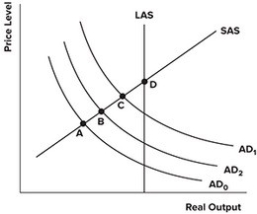
(Multiple Choice)
4.8/5 (75)
(75) If a fiscal expansion financed by government bond sales does not affect interest rates, then:
(Multiple Choice)
4.8/5 (92)
(92) Because reducing both unemployment and inflation simultaneously are conflicting goals:
(Multiple Choice)
4.7/5 (83)
(83) According to the Classical advocates of sound finance, if an economy is in a recession, the government should run:
(Multiple Choice)
4.9/5 (83)
(83) What is the difference between demand side policies and supply side policies?
(Essay)
4.8/5 (74)
(74) 
Filters
- Essay(0)
- Multiple Choice(0)
- Short Answer(0)
- True False(0)
- Matching(0)