



 Chat with AI
Exam 32: The Fiscal Policy Dilemma

Exam 1: Economics and Economic Reasoning158 Questions
Exam 2: The Production Possibility Model, Trade, and Globalization133 Questions
Exam 3: Economic Institutions163 Questions
Exam 4: Supply and Demand182 Questions
Exam 5: Using Supply and Demand163 Questions
Exam 6: Describing Supply and Demand: Elasticities216 Questions
Exam 7: Taxation and Government Intervention201 Questions
Exam 8: Market Failure Versus Government Failure197 Questions
Exam 9: Comparative Advantage, Exchange Rates, and Globalization118 Questions
Exam 10: International Trade Policy99 Questions
Exam 11: Production and Cost Analysis I194 Questions
Exam 12: Production and Cost Analysis II152 Questions
Exam 13: Perfect Competition170 Questions
Exam 14: Monopoly and Monopolistic Competition274 Questions
Exam 15: Oligopoly and Antitrust Policy142 Questions
Exam 16: Real-World Competition and Technology108 Questions
Exam 17: Work and the Labor Market150 Questions
Exam 18: Who Gets What the Distribution of Income131 Questions
Exam 19: The Logic of Individual Choice: the Foundation of Supply and Demand170 Questions
Exam 20: Game Theory, Strategic Decision Making, and Behavioral Economics103 Questions
Exam 21: Thinking Like a Modern Economist97 Questions
Exam 22: Behavioral Economics and Modern Economic Policy126 Questions
Exam 23: Microeconomic Policy, Economic Reasoning, and Beyond134 Questions
Exam 24: Economic Growth, Business Cycles, and Unemployment124 Questions
Exam 25: Measuring and Describing the Aggregate Economy229 Questions
Exam 26: The Keynesian Short-Run Policy Model: Demand-Side Policies220 Questions
Exam 27: The Classical Long-Run Policy Model: Growth and Supply-Side Policies133 Questions
Exam 28: The Financial Sector and the Economy214 Questions
Exam 29: Monetary Policy243 Questions
Exam 30: Financial Crises, Panics, and Unconventional Monetary Policy109 Questions
Exam 31: Deficits and Debt: the Austerity Debate150 Questions
Exam 32: The Fiscal Policy Dilemma119 Questions
Exam 33: Jobs and Unemployment78 Questions
Exam 34: Inflation, Deflation, and Macro Policy175 Questions
Exam 35: International Financial Policy211 Questions
Exam 36: Macro Policy in a Global Setting134 Questions
Exam 37: Structural Stagnation and Globalization125 Questions
Exam 38: Macro Policy in Developing Countries142 Questions
Select questions type


Refer to the graph shown. Assume the economy is in short-run equilibrium at point A below potential output. The government opts for an expansionary fiscal policy in an attempt to pull the economy out of the recession. An economist with a Classical view holding the Ricardian equivalence theorem to be practically true would conclude that the economy will most likely end up at point: 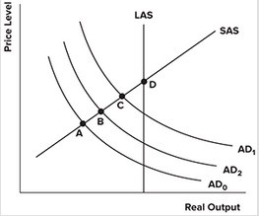
(Multiple Choice)
4.9/5  (87)
(87) Using fiscal policy to stabilize the economy is difficult because:
(Multiple Choice)
4.8/5 (80)
(80) If interest rates adjust to equate savings and investment, then an expansionary fiscal policy is:
(Multiple Choice)
4.9/5 (78)
(78) Refer to the graph shown. Assume the economy is in short-run equilibrium at point A below potential output. The government opts for an expansionary fiscal policy that shifts the AD curve from AD0 to AD1 in an attempt to pull the economy out of the recession. An economist with a functional finance view, who also recognizes that there will be a certain degree of crowding out, would conclude that the economy will likely end up at point: 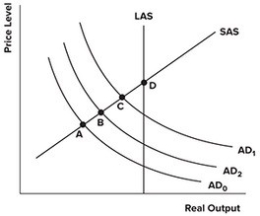
(Multiple Choice)
4.9/5 (77)
(77) What is the difference between "sound finance" and "functional finance"? Why did the advocates of each view of public finance take such different positions?
(Essay)
4.8/5 (67)
(67) Which of the following issues will economists likely agree about?
(Multiple Choice)
4.8/5 (90)
(90) Because automatic stabilizers increase government spending and decrease tax revenue during a recession and have the opposite effect during a recovery, they tend to create budget:
(Multiple Choice)
4.9/5 (80)
(80) Sound finance holds that government spending should be directed toward sound investment.
(True/False)
4.9/5 (79)
(79) Automatic stabilizers are government programs or policies that will counteract the business cycle without any new government action.
(True/False)
4.9/5 (76)
(76) Generally speaking, the government implements fiscal policy in a:
(Multiple Choice)
4.8/5 (86)
(86) It is generally true that elected officials find it easier to:
(Multiple Choice)
4.8/5 (84)
(84) Which of the following policies would reduce the procyclical nature of fiscal policy at the state level?
(Multiple Choice)
4.8/5 (96)
(96) Financing expansionary fiscal policy by increasing the deficit does not generally affect interest rates.
(True/False)
4.8/5 (75)
(75) In terms of fiscal policy, which of the following is an example of a fiscal automatic stabilizer?
(Multiple Choice)
4.9/5 (81)
(81) What are three advantages and disadvantages of expansionary fiscal policy?
(Essay)
5.0/5 (85)
(85) Empirical evidence over the past two decades suggests that the percentage of unemployed who receive unemployment insurance has been declining,and in 2017 only about 27% of unemployed persons collected benefits.What does this decline do to the impact of unemployment insurance as an automatic stabilizer?
(Essay)
4.9/5 (84)
(84) 
Filters
- Essay(0)
- Multiple Choice(0)
- Short Answer(0)
- True False(0)
- Matching(0)