



 Chat with AI
Exam 6: Describing Supply and Demand: Elasticities

Exam 1: Economics and Economic Reasoning158 Questions
Exam 2: The Production Possibility Model, Trade, and Globalization133 Questions
Exam 3: Economic Institutions163 Questions
Exam 4: Supply and Demand182 Questions
Exam 5: Using Supply and Demand163 Questions
Exam 6: Describing Supply and Demand: Elasticities216 Questions
Exam 7: Taxation and Government Intervention201 Questions
Exam 8: Market Failure Versus Government Failure197 Questions
Exam 9: Comparative Advantage, Exchange Rates, and Globalization118 Questions
Exam 10: International Trade Policy99 Questions
Exam 11: Production and Cost Analysis I194 Questions
Exam 12: Production and Cost Analysis II152 Questions
Exam 13: Perfect Competition170 Questions
Exam 14: Monopoly and Monopolistic Competition274 Questions
Exam 15: Oligopoly and Antitrust Policy142 Questions
Exam 16: Real-World Competition and Technology108 Questions
Exam 17: Work and the Labor Market150 Questions
Exam 18: Who Gets What the Distribution of Income131 Questions
Exam 19: The Logic of Individual Choice: the Foundation of Supply and Demand170 Questions
Exam 20: Game Theory, Strategic Decision Making, and Behavioral Economics103 Questions
Exam 21: Thinking Like a Modern Economist97 Questions
Exam 22: Behavioral Economics and Modern Economic Policy126 Questions
Exam 23: Microeconomic Policy, Economic Reasoning, and Beyond134 Questions
Exam 24: Economic Growth, Business Cycles, and Unemployment124 Questions
Exam 25: Measuring and Describing the Aggregate Economy229 Questions
Exam 26: The Keynesian Short-Run Policy Model: Demand-Side Policies220 Questions
Exam 27: The Classical Long-Run Policy Model: Growth and Supply-Side Policies133 Questions
Exam 28: The Financial Sector and the Economy214 Questions
Exam 29: Monetary Policy243 Questions
Exam 30: Financial Crises, Panics, and Unconventional Monetary Policy109 Questions
Exam 31: Deficits and Debt: the Austerity Debate150 Questions
Exam 32: The Fiscal Policy Dilemma119 Questions
Exam 33: Jobs and Unemployment78 Questions
Exam 34: Inflation, Deflation, and Macro Policy175 Questions
Exam 35: International Financial Policy211 Questions
Exam 36: Macro Policy in a Global Setting134 Questions
Exam 37: Structural Stagnation and Globalization125 Questions
Exam 38: Macro Policy in Developing Countries142 Questions
Select questions type


If average movie ticket prices rise by about 5 percent and attendance falls by about 2 percent, other things being equal, the elasticity of demand for movie tickets is about:
(Multiple Choice)
4.8/5  (87)
(87) Demonstrate graphically and explain verbally the impact of an increase in income on the demand of a normal good.
(Essay)
4.8/5 (88)
(88) Demonstrate graphically and explain verbally the impact on price and quantity when supply decreases and demand is highly elastic.
(Essay)
4.9/5 (78)
(78) Demonstrate graphically and explain verbally a perfectly elastic demand curve.
(Essay)
4.9/5 (66)
(66) An economist estimates that on average, for every 1 percent increase in income, the quantity of European cars demanded increases by 1.93 percent. From this information one can conclude that European cars are:
(Multiple Choice)
4.7/5 (77)
(77) Repeated hurricanes in Florida have caused some retirees to choose to retire to Arizona instead. Based on this information, retirement housing in Florida and that in Arizona are what kinds of goods?
(Multiple Choice)
4.9/5 (77)
(77) What is the key factor in determining how elastic or inelastic a demand curve will be? Explain.
(Essay)
5.0/5 (97)
(97) Refer to the table shown to answer the question. Between $2.20 and $2.40, demand is: Price Qu.ntity Demanded \ 1.60 130 \ 1.80 120 \ 2.00 110 \ 2.20 100 \ 2.40 90 \ 2.60 80
(Multiple Choice)
5.0/5 (77)
(77) Refer to the graph shown. Calculate the approximate average elasticity of demand as the price falls from $18 to $0: 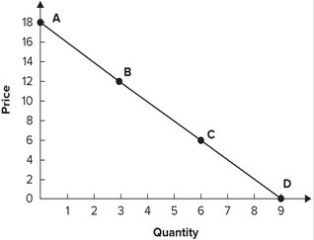
(Multiple Choice)
5.0/5 (70)
(70) How can the income elasticity of demand be used to determine whether a good is a normal good or an inferior good?
(Essay)
4.8/5 (81)
(81) If the supply curve intersects the vertical (price)axis, the supply curve has an elasticity:
(Multiple Choice)
4.9/5 (77)
(77) Suppose you own two Domino's Pizza franchises in your town.After reading the latest issue of Pizza Monthly,you have concluded that both of your locations are generating below average revenue.You hire a local economics professor to conduct a pricing experiment.Here is her report:
Location 1: A 10% increase in price resulted in a 5% drop in the quantity demanded.
Location 2: A 10% increase in the price resulted in a 20% drop in the quantity demanded.
Using this information,how should you alter your pricing policy to increase your revenue at each location?
(Essay)
4.8/5 (70)
(70) If quantity demanded changes infinitely when the price changes, the demand:
(Multiple Choice)
4.8/5 (74)
(74) If the price of corn goes up by $1 a bushel and the quantity supplied rises by 100 bushels, the price elasticity of supply has to be 100.
(True/False)
4.9/5 (87)
(87) George Davis and Michael Wohlgenant estimate that for every 1 percent increase in the price of Christmas trees, quantity demanded falls by 0.6 percent. The demand for Christmas trees is:
(Multiple Choice)
5.0/5 (79)
(79) What will happen to total revenue of a firm if it raises its price and its demand is elastic (or inelastic)?
(Essay)
4.9/5 (76)
(76) The elasticity of demand for sunscreen is 0.8 and the elasticity of supply is 2.2.Suppose that the demand for sunscreen increased by 10% during an unseasonably hot month.Calculate the percentage change in the equilibrium price of sunscreen.
(Essay)
4.8/5 (86)
(86) Refer to the graph shown. At which point is elasticity zero? 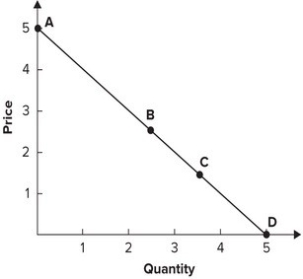
(Multiple Choice)
4.7/5 (82)
(82) If supply is highly elastic and demand shifts to the left:
(Multiple Choice)
4.8/5 (77)
(77) 
Filters
- Essay(0)
- Multiple Choice(0)
- Short Answer(0)
- True False(0)
- Matching(0)