



 Chat with AI
Exam 35: International Financial Policy

Exam 1: Economics and Economic Reasoning158 Questions
Exam 2: The Production Possibility Model, Trade, and Globalization133 Questions
Exam 3: Economic Institutions163 Questions
Exam 4: Supply and Demand182 Questions
Exam 5: Using Supply and Demand163 Questions
Exam 6: Describing Supply and Demand: Elasticities216 Questions
Exam 7: Taxation and Government Intervention201 Questions
Exam 8: Market Failure Versus Government Failure197 Questions
Exam 9: Comparative Advantage, Exchange Rates, and Globalization118 Questions
Exam 10: International Trade Policy99 Questions
Exam 11: Production and Cost Analysis I194 Questions
Exam 12: Production and Cost Analysis II152 Questions
Exam 13: Perfect Competition170 Questions
Exam 14: Monopoly and Monopolistic Competition274 Questions
Exam 15: Oligopoly and Antitrust Policy142 Questions
Exam 16: Real-World Competition and Technology108 Questions
Exam 17: Work and the Labor Market150 Questions
Exam 18: Who Gets What the Distribution of Income131 Questions
Exam 19: The Logic of Individual Choice: the Foundation of Supply and Demand170 Questions
Exam 20: Game Theory, Strategic Decision Making, and Behavioral Economics103 Questions
Exam 21: Thinking Like a Modern Economist97 Questions
Exam 22: Behavioral Economics and Modern Economic Policy126 Questions
Exam 23: Microeconomic Policy, Economic Reasoning, and Beyond134 Questions
Exam 24: Economic Growth, Business Cycles, and Unemployment124 Questions
Exam 25: Measuring and Describing the Aggregate Economy229 Questions
Exam 26: The Keynesian Short-Run Policy Model: Demand-Side Policies220 Questions
Exam 27: The Classical Long-Run Policy Model: Growth and Supply-Side Policies133 Questions
Exam 28: The Financial Sector and the Economy214 Questions
Exam 29: Monetary Policy243 Questions
Exam 30: Financial Crises, Panics, and Unconventional Monetary Policy109 Questions
Exam 31: Deficits and Debt: the Austerity Debate150 Questions
Exam 32: The Fiscal Policy Dilemma119 Questions
Exam 33: Jobs and Unemployment78 Questions
Exam 34: Inflation, Deflation, and Macro Policy175 Questions
Exam 35: International Financial Policy211 Questions
Exam 36: Macro Policy in a Global Setting134 Questions
Exam 37: Structural Stagnation and Globalization125 Questions
Exam 38: Macro Policy in Developing Countries142 Questions
Select questions type


Explain the effect of an expansionary fiscal policy on the exchange rate of the U.S.dollar through the price path.
(Essay)
4.8/5  (94)
(94) Refer to the graph shown. An exchange rate of $2.95 per dinar creates excess: 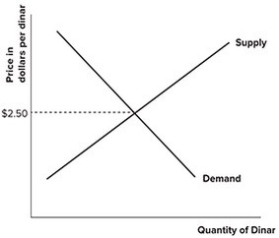
(Multiple Choice)
4.8/5 (92)
(92) If a basket of goods costs 10 dollars in the United States and 11 euros in Belgium, then purchasing power parity will exist if the exchange rate between the euro and the dollar is:
(Multiple Choice)
4.8/5 (79)
(79) When the euro appreciated significantly against the U.S. dollar, European policymakers were concerned.To stop the appreciation of the euro, the European Central Bank could have adopted a macroeconomic policy that:
(Multiple Choice)
4.9/5 (73)
(73) Which of the following is a disadvantage of the European Monetary Union to member countries?
(Multiple Choice)
4.8/5 (92)
(92) Under the existing system of partially-flexible exchange rates, a country experiencing what it believes is a long-term balance of payments deficit might be expected to:
(Multiple Choice)
4.9/5 (82)
(82) For many years, China tightly managed its currency through intervention and capital controls, effectively pegging the yuan to the U.S. dollar (a rate of about 8 yuan per dollar). Which of the exchange rate regimes discussed in the textbook did China have at that time?
(Multiple Choice)
4.7/5 (74)
(74) A country with a balance of payments deficit that wants to maintain the current exchange rate:
(Multiple Choice)
4.9/5 (80)
(80) The part of the balance of payments account that lists all payments related to the buying and selling of assets is called the:
(Multiple Choice)
4.8/5 (84)
(84) What are four economic advantages and three disadvantages of adopting a common currency,such as the euro?
(Essay)
4.8/5 (82)
(82) If the euro becomes an international reserve currency, the EU may enjoy:
(Multiple Choice)
4.9/5 (79)
(79) The difference between the value of goods exported and imported is the:
(Multiple Choice)
4.8/5 (72)
(72) 
Filters
- Essay(0)
- Multiple Choice(0)
- Short Answer(0)
- True False(0)
- Matching(0)