



 Chat with AI
Exam 10: International Trade Policy

Exam 1: Economics and Economic Reasoning158 Questions
Exam 2: The Production Possibility Model, Trade, and Globalization133 Questions
Exam 3: Economic Institutions163 Questions
Exam 4: Supply and Demand182 Questions
Exam 5: Using Supply and Demand163 Questions
Exam 6: Describing Supply and Demand: Elasticities216 Questions
Exam 7: Taxation and Government Intervention201 Questions
Exam 8: Market Failure Versus Government Failure197 Questions
Exam 9: Comparative Advantage, Exchange Rates, and Globalization118 Questions
Exam 10: International Trade Policy99 Questions
Exam 11: Production and Cost Analysis I194 Questions
Exam 12: Production and Cost Analysis II152 Questions
Exam 13: Perfect Competition170 Questions
Exam 14: Monopoly and Monopolistic Competition274 Questions
Exam 15: Oligopoly and Antitrust Policy142 Questions
Exam 16: Real-World Competition and Technology108 Questions
Exam 17: Work and the Labor Market150 Questions
Exam 18: Who Gets What the Distribution of Income131 Questions
Exam 19: The Logic of Individual Choice: the Foundation of Supply and Demand170 Questions
Exam 20: Game Theory, Strategic Decision Making, and Behavioral Economics103 Questions
Exam 21: Thinking Like a Modern Economist97 Questions
Exam 22: Behavioral Economics and Modern Economic Policy126 Questions
Exam 23: Microeconomic Policy, Economic Reasoning, and Beyond134 Questions
Exam 24: Economic Growth, Business Cycles, and Unemployment124 Questions
Exam 25: Measuring and Describing the Aggregate Economy229 Questions
Exam 26: The Keynesian Short-Run Policy Model: Demand-Side Policies220 Questions
Exam 27: The Classical Long-Run Policy Model: Growth and Supply-Side Policies133 Questions
Exam 28: The Financial Sector and the Economy214 Questions
Exam 29: Monetary Policy243 Questions
Exam 30: Financial Crises, Panics, and Unconventional Monetary Policy109 Questions
Exam 31: Deficits and Debt: the Austerity Debate150 Questions
Exam 32: The Fiscal Policy Dilemma119 Questions
Exam 33: Jobs and Unemployment78 Questions
Exam 34: Inflation, Deflation, and Macro Policy175 Questions
Exam 35: International Financial Policy211 Questions
Exam 36: Macro Policy in a Global Setting134 Questions
Exam 37: Structural Stagnation and Globalization125 Questions
Exam 38: Macro Policy in Developing Countries142 Questions
Select questions type


Analysts have suggested that the cost of bras is related to trade restrictions on textile imports. What does the price of bras have to do with tariffs and quotas?
(Multiple Choice)
4.9/5  (95)
(95) What is the major reason why developing countries often impose tariffs on imports rather than quotas?
(Essay)
4.8/5 (70)
(70) Transshipments, which are used commonly in international trade, tend to:
(Multiple Choice)
4.9/5 (87)
(87) Refer to the graph shown for a small country that is a price taker internationally. 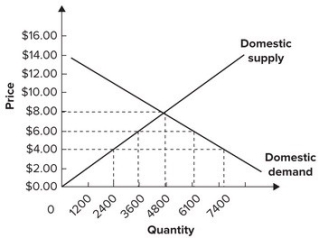 Assume the foreign supply of this product is perfectly elastic at a price of $4 per unit. If there are no trade restrictions, this country will produce:
 (Multiple Choice)
4.9/5 (79)
(79) The voluntary export restraints on autos by Japan in the early 1980s were:
(Multiple Choice)
4.8/5 (82)
(82) The text suggests that if economists had a mantra, it would be:
(Multiple Choice)
4.9/5 (70)
(70) Countries restrict international trade for all of the following reasons except:
(Multiple Choice)
4.8/5 (82)
(82) A country imposing trade restrictions can benefit only if other countries also impose trade restrictions.
(True/False)
4.9/5 (90)
(90) Import duties ranging from 28 percent to 113 percent on Chinese frozen and canned shrimp are an example of a policy that:
(Multiple Choice)
4.9/5 (73)
(73) In strategic trade bargaining it is sometimes reasonable to be unreasonable.
(True/False)
4.9/5 (81)
(81) Free trade associations can potentially be harmful to international trade.
(True/False)
4.9/5 (85)
(85) What does it mean for a country to be a debtor nation? What has to happen for a country to change from a debtor nation to a creditor nation?
(Essay)
4.7/5 (74)
(74) The percentage of goods and services the United States has imported from China and India over the last 15 years:
(Multiple Choice)
4.9/5 (93)
(93) Threats to put tariffs on a nation in an attempt to get that nation to reduce its restrictions on trade are called:
(Multiple Choice)
4.9/5 (82)
(82) Refer to the graph shown for a small country that is a price taker internationally. 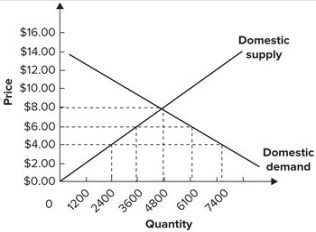 Assume the foreign supply of this product is perfectly elastic at a price of $4 per unit. Starting from a free trade equilibrium, a tariff in the amount of $2 per unit would be expected to cause domestic production to:
 (Multiple Choice)
4.9/5 (89)
(89) 
Filters
- Essay(0)
- Multiple Choice(0)
- Short Answer(0)
- True False(0)
- Matching(0)