



 Chat with AI
Exam 14: Monopoly and Monopolistic Competition

Exam 1: Economics and Economic Reasoning158 Questions
Exam 2: The Production Possibility Model, Trade, and Globalization133 Questions
Exam 3: Economic Institutions163 Questions
Exam 4: Supply and Demand182 Questions
Exam 5: Using Supply and Demand163 Questions
Exam 6: Describing Supply and Demand: Elasticities216 Questions
Exam 7: Taxation and Government Intervention201 Questions
Exam 8: Market Failure Versus Government Failure197 Questions
Exam 9: Comparative Advantage, Exchange Rates, and Globalization118 Questions
Exam 10: International Trade Policy99 Questions
Exam 11: Production and Cost Analysis I194 Questions
Exam 12: Production and Cost Analysis II152 Questions
Exam 13: Perfect Competition170 Questions
Exam 14: Monopoly and Monopolistic Competition274 Questions
Exam 15: Oligopoly and Antitrust Policy142 Questions
Exam 16: Real-World Competition and Technology108 Questions
Exam 17: Work and the Labor Market150 Questions
Exam 18: Who Gets What the Distribution of Income131 Questions
Exam 19: The Logic of Individual Choice: the Foundation of Supply and Demand170 Questions
Exam 20: Game Theory, Strategic Decision Making, and Behavioral Economics103 Questions
Exam 21: Thinking Like a Modern Economist97 Questions
Exam 22: Behavioral Economics and Modern Economic Policy126 Questions
Exam 23: Microeconomic Policy, Economic Reasoning, and Beyond134 Questions
Exam 24: Economic Growth, Business Cycles, and Unemployment124 Questions
Exam 25: Measuring and Describing the Aggregate Economy229 Questions
Exam 26: The Keynesian Short-Run Policy Model: Demand-Side Policies220 Questions
Exam 27: The Classical Long-Run Policy Model: Growth and Supply-Side Policies133 Questions
Exam 28: The Financial Sector and the Economy214 Questions
Exam 29: Monetary Policy243 Questions
Exam 30: Financial Crises, Panics, and Unconventional Monetary Policy109 Questions
Exam 31: Deficits and Debt: the Austerity Debate150 Questions
Exam 32: The Fiscal Policy Dilemma119 Questions
Exam 33: Jobs and Unemployment78 Questions
Exam 34: Inflation, Deflation, and Macro Policy175 Questions
Exam 35: International Financial Policy211 Questions
Exam 36: Macro Policy in a Global Setting134 Questions
Exam 37: Structural Stagnation and Globalization125 Questions
Exam 38: Macro Policy in Developing Countries142 Questions
Select questions type


Refer to the graph shown. Suppose the industry is currently perfectly competitive but then is taken over by a monopolist. Assuming that the monopolist maximizes profit: 
(Multiple Choice)
4.9/5  (82)
(82) Compared with a normal monopolist, an effective price-discriminating monopolist produces a:
(Multiple Choice)
4.7/5 (80)
(80) Microsoft sells a special version of its Windows operating system at a low price in countries where cheap pirated software is widespread. Since the cost of producing another copy of this software is the same as the cost of producing another copy of the regular Windows product, why is Microsoft charging this lower price?
(Multiple Choice)
4.8/5 (77)
(77) A movie theater is a price-discriminating monopolist and charges a higher ticket price for late-evening showings. From this we know that:
(Multiple Choice)
4.9/5 (77)
(77) Demonstrate graphically and explain verbally an example where a monopolist is better-off shutting down.
(Essay)
4.9/5 (74)
(74) Suppose marginal cost is constant and equal to 50 and marginal revenue equals 100 - 10Q. A profit-maximizing monopolist will set quantity equal to:
(Multiple Choice)
4.9/5 (73)
(73) Refer to the graph shown. The equilibrium quantity for the monopolistically competitive firm represented is: 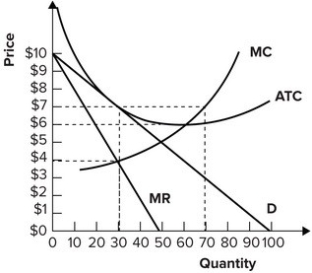
(Multiple Choice)
4.8/5 (74)
(74) When a monopolistically competitive industry is in long-run equilibrium:
(Multiple Choice)
4.8/5 (78)
(78) Which of the following is the best example of a network externality?
(Multiple Choice)
4.9/5 (79)
(79) Refer to the graph shown. The profit-maximizing monopolist produces output: 
(Multiple Choice)
4.8/5 (83)
(83) Regulations created some years ago allow cell phone customers to keep the same phone number even when they switch to a different provider. This change:
(Multiple Choice)
4.8/5 (73)
(73) Because a monopolistic competitor has some monopoly power, advertising to increase that monopoly power makes sense as long as:
(Multiple Choice)
4.8/5 (90)
(90) When a monopolistically competitive firm is in long-run equilibrium, average total cost is at its minimum.
(True/False)
4.9/5 (77)
(77) The price at which a monopolistically competitive firm sells its product:
(Multiple Choice)
4.7/5 (67)
(67) Despite the fact that the Quick-Buzz Coffee Company provides a coupon in the local newspaper that can be redeemed for $1 off the price of its best-selling coffee beans, not all buyers actually use the coupon. Assuming everyone has a subscription to the newspaper, from this we know that:
(Multiple Choice)
4.9/5 (88)
(88) Demonstrate graphically the price and quantity a natural monopolist would choose in the absence of regulation.Shade the area representing profit.In a diagram show what happens to that profit if the monopolist is required to charge a price equal to marginal cost,PC.
(Essay)
4.7/5 (80)
(80) Demonstrate graphically and explain verbally the case of a monopolist earning zero economic profit.
(Essay)
4.8/5 (75)
(75) If a college student's demand for newspaper subscriptions is more price-elastic than a business executive's demand for newspaper subscriptions, which of the following pricing strategies would a price-discriminating newspaper publisher follow?
(Multiple Choice)
4.9/5 (81)
(81) Why will a monopolistic firm maximize total profit if it produces at the output level where marginal revenue equals marginal cost?
(Essay)
4.9/5 (85)
(85) 
Filters
- Essay(0)
- Multiple Choice(0)
- Short Answer(0)
- True False(0)
- Matching(0)