



 Chat with AI
Exam 14: Monopoly and Monopolistic Competition

Exam 1: Economics and Economic Reasoning158 Questions
Exam 2: The Production Possibility Model, Trade, and Globalization133 Questions
Exam 3: Economic Institutions163 Questions
Exam 4: Supply and Demand182 Questions
Exam 5: Using Supply and Demand163 Questions
Exam 6: Describing Supply and Demand: Elasticities216 Questions
Exam 7: Taxation and Government Intervention201 Questions
Exam 8: Market Failure Versus Government Failure197 Questions
Exam 9: Comparative Advantage, Exchange Rates, and Globalization118 Questions
Exam 10: International Trade Policy99 Questions
Exam 11: Production and Cost Analysis I194 Questions
Exam 12: Production and Cost Analysis II152 Questions
Exam 13: Perfect Competition170 Questions
Exam 14: Monopoly and Monopolistic Competition274 Questions
Exam 15: Oligopoly and Antitrust Policy142 Questions
Exam 16: Real-World Competition and Technology108 Questions
Exam 17: Work and the Labor Market150 Questions
Exam 18: Who Gets What the Distribution of Income131 Questions
Exam 19: The Logic of Individual Choice: the Foundation of Supply and Demand170 Questions
Exam 20: Game Theory, Strategic Decision Making, and Behavioral Economics103 Questions
Exam 21: Thinking Like a Modern Economist97 Questions
Exam 22: Behavioral Economics and Modern Economic Policy126 Questions
Exam 23: Microeconomic Policy, Economic Reasoning, and Beyond134 Questions
Exam 24: Economic Growth, Business Cycles, and Unemployment124 Questions
Exam 25: Measuring and Describing the Aggregate Economy229 Questions
Exam 26: The Keynesian Short-Run Policy Model: Demand-Side Policies220 Questions
Exam 27: The Classical Long-Run Policy Model: Growth and Supply-Side Policies133 Questions
Exam 28: The Financial Sector and the Economy214 Questions
Exam 29: Monetary Policy243 Questions
Exam 30: Financial Crises, Panics, and Unconventional Monetary Policy109 Questions
Exam 31: Deficits and Debt: the Austerity Debate150 Questions
Exam 32: The Fiscal Policy Dilemma119 Questions
Exam 33: Jobs and Unemployment78 Questions
Exam 34: Inflation, Deflation, and Macro Policy175 Questions
Exam 35: International Financial Policy211 Questions
Exam 36: Macro Policy in a Global Setting134 Questions
Exam 37: Structural Stagnation and Globalization125 Questions
Exam 38: Macro Policy in Developing Countries142 Questions
Select questions type


Refer to the table shown, which shows the demand schedule for a firm that has a monopoly on the sale of computers in the country of Oz. If the marginal cost of producing computers is $1,000 no matter how many are produced and the monopolist seeks to maximize profit, it should set the price of computers at:
(Multiple Choice)
4.9/5  (95)
(95) As the number of people who use Facebook increases, the value of Facebook to its users increases. This is an example of:
(Multiple Choice)
5.0/5 (76)
(76) If a firm has a monopoly over the sale of camera drones and seeks to maximize profits, it:
(Multiple Choice)
4.8/5 (75)
(75) If a monopolist had no production costs, it would produce the output where marginal revenue intersects the quantity axis. At this point, the price elasticity of demand would be:
(Multiple Choice)
4.9/5 (86)
(86) Refer to the graph shown. To maximize profit, the monopolistically competitive firm represented in this graph will produce: 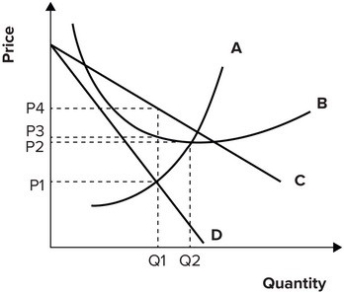
(Multiple Choice)
4.8/5 (84)
(84) Refer to the graph shown of average costs for a typical firm. If this industry consisted of one firm producing 1,000 units and one firm producing 500 units: 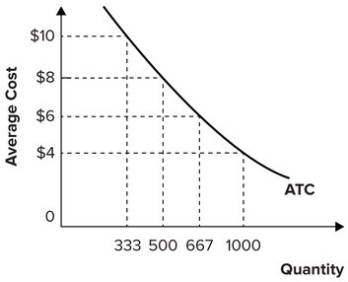
(Multiple Choice)
4.9/5 (82)
(82) Give three real world examples of price discrimination practices that some companies follow.
(Essay)
4.8/5 (88)
(88) An industry that has many sellers offering slightly differentiated products is called:
(Multiple Choice)
5.0/5 (88)
(88) Refer to the graph shown. The profits earned by the monopolistically competitive firm represented equal: 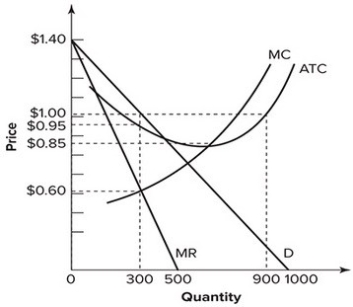
(Multiple Choice)
4.8/5 (70)
(70) The reason a profit-maximizing natural monopolist cannot set price equal to marginal cost is that it would:
(Multiple Choice)
4.9/5 (73)
(73) Demonstrate graphically and explain verbally how forcing a natural monopoly to produce at the competitive market solution (P = MC)results in a loss for the monopolist.
(Essay)
4.9/5 (93)
(93) Often, gas stations only a few miles apart differ in price by as much as $0.10 per gallon. The most likely explanation for this kind of price discrimination is that:
(Multiple Choice)
4.9/5 (73)
(73) Refer to the graph shown. If this monopolist were allowed to choose the profit-maximizing level of output, it would produce: 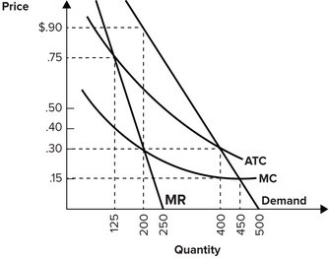
(Multiple Choice)
4.8/5 (71)
(71) Refer to the graph shown. The monopolistically competitive firm represented is in: 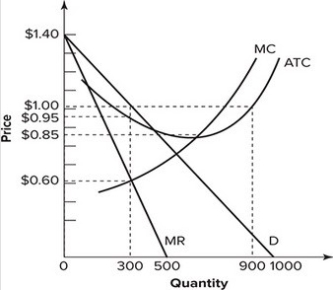
(Multiple Choice)
4.9/5 (86)
(86) Compare how P,ATC,MC,and MR are related to each other in the long-run equilibrium of a perfectly competitive firm and a monopolistically competitive firm.What is the key difference between them?
(Essay)
4.9/5 (66)
(66) The law of demand states that the greater the quantity of a good purchased,the lower its price will have to be,other things held constant.Explain why monopoly firms see this law in action but perfectly competitive firms do not.
(Essay)
4.8/5 (90)
(90) 
Filters
- Essay(0)
- Multiple Choice(0)
- Short Answer(0)
- True False(0)
- Matching(0)