



 Chat with AI
Exam 14: Monopoly and Monopolistic Competition

Exam 1: Economics and Economic Reasoning158 Questions
Exam 2: The Production Possibility Model, Trade, and Globalization133 Questions
Exam 3: Economic Institutions163 Questions
Exam 4: Supply and Demand182 Questions
Exam 5: Using Supply and Demand163 Questions
Exam 6: Describing Supply and Demand: Elasticities216 Questions
Exam 7: Taxation and Government Intervention201 Questions
Exam 8: Market Failure Versus Government Failure197 Questions
Exam 9: Comparative Advantage, Exchange Rates, and Globalization118 Questions
Exam 10: International Trade Policy99 Questions
Exam 11: Production and Cost Analysis I194 Questions
Exam 12: Production and Cost Analysis II152 Questions
Exam 13: Perfect Competition170 Questions
Exam 14: Monopoly and Monopolistic Competition274 Questions
Exam 15: Oligopoly and Antitrust Policy142 Questions
Exam 16: Real-World Competition and Technology108 Questions
Exam 17: Work and the Labor Market150 Questions
Exam 18: Who Gets What the Distribution of Income131 Questions
Exam 19: The Logic of Individual Choice: the Foundation of Supply and Demand170 Questions
Exam 20: Game Theory, Strategic Decision Making, and Behavioral Economics103 Questions
Exam 21: Thinking Like a Modern Economist97 Questions
Exam 22: Behavioral Economics and Modern Economic Policy126 Questions
Exam 23: Microeconomic Policy, Economic Reasoning, and Beyond134 Questions
Exam 24: Economic Growth, Business Cycles, and Unemployment124 Questions
Exam 25: Measuring and Describing the Aggregate Economy229 Questions
Exam 26: The Keynesian Short-Run Policy Model: Demand-Side Policies220 Questions
Exam 27: The Classical Long-Run Policy Model: Growth and Supply-Side Policies133 Questions
Exam 28: The Financial Sector and the Economy214 Questions
Exam 29: Monetary Policy243 Questions
Exam 30: Financial Crises, Panics, and Unconventional Monetary Policy109 Questions
Exam 31: Deficits and Debt: the Austerity Debate150 Questions
Exam 32: The Fiscal Policy Dilemma119 Questions
Exam 33: Jobs and Unemployment78 Questions
Exam 34: Inflation, Deflation, and Macro Policy175 Questions
Exam 35: International Financial Policy211 Questions
Exam 36: Macro Policy in a Global Setting134 Questions
Exam 37: Structural Stagnation and Globalization125 Questions
Exam 38: Macro Policy in Developing Countries142 Questions
Select questions type


Consider the following diagram: 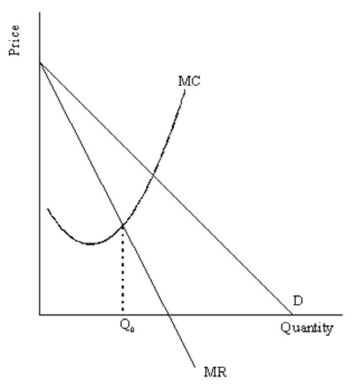 Demonstrate graphically and explain verbally why moving away from producing output level Q0 will result in a decrease in profit for this monopolist.
 (Essay)
4.8/5  (92)
(92) The price at which a monopolistic competitor sells its product in both the long run and the short run is equal to:
(Multiple Choice)
4.9/5 (80)
(80) iTunes charges British customers 20 percent more than customers in France and Germany. Apple defended the price difference, saying that the "underlying economic model in each country has an impact on how we price our track downloads." An economist would say that Apple is engaged in:
(Multiple Choice)
4.8/5 (80)
(80) eBay.com dominates the online auction business because sellers want to go where the buyers are and buyers want to go where the sellers are. Bigger is thus better. Hence, eBay.com illustrates the concept of:
(Multiple Choice)
4.9/5 (88)
(88) In long-run equilibrium in both perfect competition and monopolistic competition there is zero economic profit and yet the two cases are not identical.What is the key difference between them?
(Essay)
4.8/5 (63)
(63) Demonstrate graphically and explain verbally an example of a monopolist earning a positive economic profit.
(Essay)
4.9/5 (80)
(80) Why do some stores offer senior citizens discounts on Tuesdays?
(Multiple Choice)
4.8/5 (81)
(81) At one time,the FCC auctioned off the rights to use public airwaves for wireless communications devices,receiving $23 billion dollars in bids for 4,249 licenses.More than $10 billion was turned over to the U.S.Treasury.These auctions may be thought of as a government sale of a monopoly since one company's use of a particular frequency prevents another from using it.Who gains and who loses when the government sells a monopoly,compared to the case where monopolies don't require licenses to operate? Explain.
(Essay)
5.0/5 (80)
(80) Refer to the graph shown. If this monopolist were allowed to choose the profit-maximizing level of output, it would charge a price of: 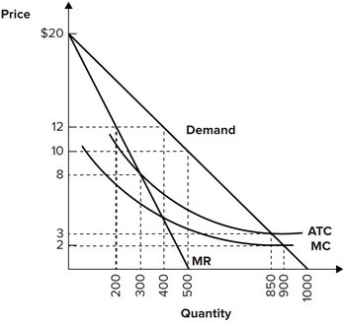
(Multiple Choice)
5.0/5 (81)
(81) Refer to the graph shown. The loss of surplus to consumers resulting from monopoly is: 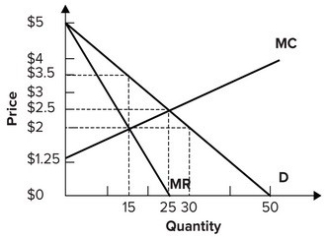
(Multiple Choice)
4.7/5 (75)
(75) Refer to the graph shown. If the monopoly firm maximizes profit, there will be a welfare loss equal to: 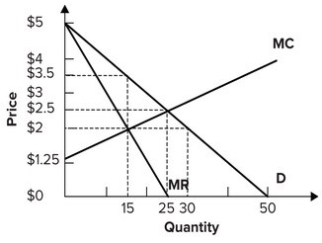
(Multiple Choice)
4.8/5 (80)
(80) A monopolistically competitive firm faces a downward-sloping demand curve.
(True/False)
4.8/5 (81)
(81) If a monopolist increases sales from 10 to 11 by lowering its price from $40 to $38, its marginal revenue is:
(Multiple Choice)
4.8/5 (77)
(77) Refer to the graph shown. If the government's goal is to eliminate the welfare costs of monopoly, it will: 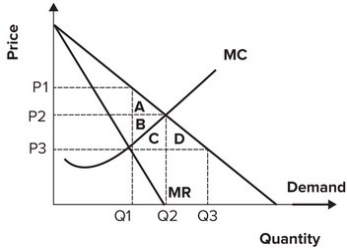
(Multiple Choice)
4.9/5 (82)
(82) The DeBeers Company is a profit-maximizing monopolist that exercises monopoly power in the distribution of diamonds. If the company earns positive economic profits this year, the price of diamonds will:
(Multiple Choice)
4.8/5 (80)
(80) Refer to the graph shown. The short-run equilibrium price for the monopolistically competitive firm represented is: 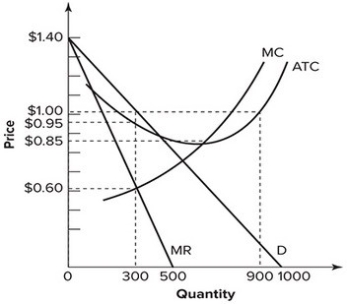
(Multiple Choice)
5.0/5 (72)
(72) Refer to the graph shown. If the monopoly firm maximizes profit, it will produce: 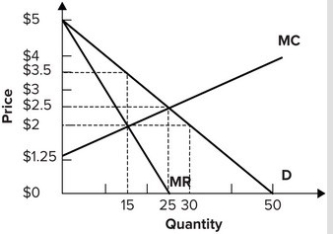
(Multiple Choice)
4.9/5 (69)
(69) Define monopoly.What is the primary reason for the existence of a monopoly? Describe three types of barriers to entry.
(Essay)
4.7/5 (81)
(81) 
Filters
- Essay(0)
- Multiple Choice(0)
- Short Answer(0)
- True False(0)
- Matching(0)