



 Chat with AI
Exam 14: Monopoly and Monopolistic Competition

Exam 1: Economics and Economic Reasoning158 Questions
Exam 2: The Production Possibility Model, Trade, and Globalization133 Questions
Exam 3: Economic Institutions163 Questions
Exam 4: Supply and Demand182 Questions
Exam 5: Using Supply and Demand163 Questions
Exam 6: Describing Supply and Demand: Elasticities216 Questions
Exam 7: Taxation and Government Intervention201 Questions
Exam 8: Market Failure Versus Government Failure197 Questions
Exam 9: Comparative Advantage, Exchange Rates, and Globalization118 Questions
Exam 10: International Trade Policy99 Questions
Exam 11: Production and Cost Analysis I194 Questions
Exam 12: Production and Cost Analysis II152 Questions
Exam 13: Perfect Competition170 Questions
Exam 14: Monopoly and Monopolistic Competition274 Questions
Exam 15: Oligopoly and Antitrust Policy142 Questions
Exam 16: Real-World Competition and Technology108 Questions
Exam 17: Work and the Labor Market150 Questions
Exam 18: Who Gets What the Distribution of Income131 Questions
Exam 19: The Logic of Individual Choice: the Foundation of Supply and Demand170 Questions
Exam 20: Game Theory, Strategic Decision Making, and Behavioral Economics103 Questions
Exam 21: Thinking Like a Modern Economist97 Questions
Exam 22: Behavioral Economics and Modern Economic Policy126 Questions
Exam 23: Microeconomic Policy, Economic Reasoning, and Beyond134 Questions
Exam 24: Economic Growth, Business Cycles, and Unemployment124 Questions
Exam 25: Measuring and Describing the Aggregate Economy229 Questions
Exam 26: The Keynesian Short-Run Policy Model: Demand-Side Policies220 Questions
Exam 27: The Classical Long-Run Policy Model: Growth and Supply-Side Policies133 Questions
Exam 28: The Financial Sector and the Economy214 Questions
Exam 29: Monetary Policy243 Questions
Exam 30: Financial Crises, Panics, and Unconventional Monetary Policy109 Questions
Exam 31: Deficits and Debt: the Austerity Debate150 Questions
Exam 32: The Fiscal Policy Dilemma119 Questions
Exam 33: Jobs and Unemployment78 Questions
Exam 34: Inflation, Deflation, and Macro Policy175 Questions
Exam 35: International Financial Policy211 Questions
Exam 36: Macro Policy in a Global Setting134 Questions
Exam 37: Structural Stagnation and Globalization125 Questions
Exam 38: Macro Policy in Developing Countries142 Questions
Select questions type


When starting up, platform monopolies often spend money like it was free, and investors often are willing to provide money for them to do so. A likely explanation for this is that
(Multiple Choice)
4.8/5  (76)
(76) At the socially optimum quantity of production, price equals:
(Multiple Choice)
4.9/5 (96)
(96) If MC = Q/15 represents marginal cost for a monopolist and market demand is given by Qd = 500 - 10P, the equation for marginal revenue is:
(Multiple Choice)
4.8/5 (79)
(79) Monopolistic competition is similar to perfect competition in that:
(Multiple Choice)
4.9/5 (73)
(73) Refer to the graph shown. If the firm seeks to maximize profit, it should set a price equal to: 
(Multiple Choice)
4.9/5 (88)
(88) If a monopolistically competitive market became perfectly competitive, output probably would:
(Multiple Choice)
4.8/5 (78)
(78) Demonstrate graphically and explain verbally the difference between long-run equilibrium for a perfectly competitive firm and a monopolistically competitive firm.
(Essay)
4.8/5 (78)
(78) Refer to the graph shown. If a competitive industry producing hamburgers is taken over by a pure monopoly firm that maximizes profit: 
(Multiple Choice)
4.9/5 (78)
(78) Refer to the graph shown. Assuming that this monopolist maximizes profit, the marginal cost of its last unit of output will be: 
(Multiple Choice)
4.9/5 (88)
(88) What is a central reason monopoly forces are especially strong in sectors dominated by platform businesses?
(Multiple Choice)
4.8/5 (76)
(76) Which of the following is the best example of a market that exhibits network externalities?
(Multiple Choice)
4.9/5 (71)
(71) The drug maker Wyeth produces the hormone-therapy drug Premarin, which is derived from the urine of pregnant mares. Not even Wyeth knows exactly what chemicals are in it, and the method of making the drug is a trade secret. Barr Laboratories has been trying to make a pill that is close enough to Premarin to be approved by the U.S. Food and Drug Administration as an "equivalent" drug. This story illustrates the importance of:
(Multiple Choice)
4.9/5 (84)
(84) Refer to the graph shown. Producer surplus that is lost to society as a result of monopoly is: 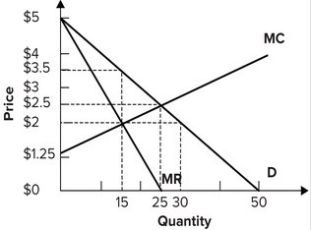
(Multiple Choice)
4.8/5 (85)
(85) Refer to the graph shown. The short-run equilibrium output level for the monopolistically competitive firm represented is: 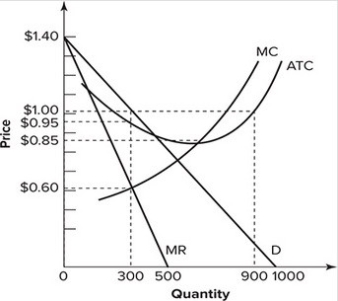
(Multiple Choice)
4.9/5 (65)
(65) Refer to the graph shown. If this monopolist sets the price to maximize profit, it will charge: 
(Multiple Choice)
4.7/5 (96)
(96) Does the following diagram illustrate a monopolistically competitive firm in a long-run equilibrium? If yes,explain why.If no,explain why not and redraw the diagram so that it is a long-run equilibrium.(Extra Credit: What forces move a monopolistically competitive industry to equilibrium?) 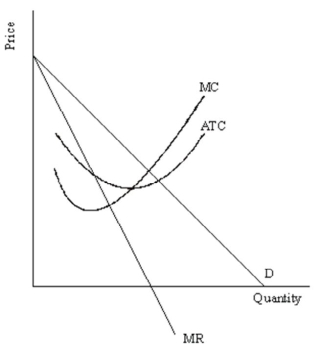
(Essay)
4.9/5 (68)
(68) There are many restaurants in a city, each one offering food and services that differ from those of its competitors. There is also free entry of sellers into the market, and each seller serves a very small fraction of the total number of meals served each day. The restaurant industry in Raleigh is best categorized as:
(Multiple Choice)
4.9/5 (89)
(89) 
Filters
- Essay(0)
- Multiple Choice(0)
- Short Answer(0)
- True False(0)
- Matching(0)