



 Chat with AI
Exam 14: Routine and Point-Of-Care Testing in Hematology: Manual and Semiautomated Methods

Exam 1: An Overview of Clinical Laboratory Hematology6 Questions
Exam 2: Safety in the Hematology Laboratory14 Questions
Exam 3: Specimen Collection23 Questions
Exam 4: Care and Use of the Microscope24 Questions
Exam 5: Quality Assurance in Hematology and Hemostasis Testing19 Questions
Exam 6: Cellular Structure and Function17 Questions
Exam 7: Hematopoiesis21 Questions
Exam 8: Erythrocyte Production and Destruction14 Questions
Exam 9: Energy Metabolism and Membrane Physiology of the Erythrocyte13 Questions
Exam 10: Hemoglobin Metabolism22 Questions
Exam 11: Iron Metabolism19 Questions
Exam 12: Leukocyte Development, Kinetics, and Functions23 Questions
Exam 13: Platelet Production, Structure, and Function15 Questions
Exam 14: Routine and Point-Of-Care Testing in Hematology: Manual and Semiautomated Methods37 Questions
Exam 15: Examination of the Peripheral Blood Film and Correlation With the Complete Blood Count25 Questions
Exam 16: Bone Marrow Examination15 Questions
Exam 17: Body Fluids in the Hematology Laboratory18 Questions
Exam 18: Anemias: Red Blood Cell Morphology and Approach to Diagnosis24 Questions
Exam 19: Disorders of Iron and Heme Metabolism30 Questions
Exam 20: Anemias Caused by Defects of Dna Metabolism21 Questions
Exam 21: Bone Marrow Failure17 Questions
Exam 22: Introduction to Increased Destruction of Erythrocytes22 Questions
Exam 23: Intrinsic Defects Leading to Increased Erythrocyte Destruction29 Questions
Exam 24: Extrinsic Defects Leading to Increased Erythrocytedestructionnonimmune Causes14 Questions
Exam 25: Extrinsic Defects Leading to Increased Erythrocytedestructionimmune Causes12 Questions
Exam 26: Hemoglobinopathies Structural Defects in Hemoglobin21 Questions
Exam 27: Thalassemias21 Questions
Exam 28: Nonmalignant Leukocyte Disorders25 Questions
Exam 29: Introduction to Leukocyte Neoplasms14 Questions
Exam 30: Cytochemistry10 Questions
Exam 31: Cytogenetics17 Questions
Exam 32: Molecular Diagnostics in the Clinical Laboratory11 Questions
Exam 33: Flow Cytometric Analysis in Hematologic Disorders12 Questions
Exam 34: Myeloproliferative Neoplasms20 Questions
Exam 35: Myelodysplastic Syndromes16 Questions
Exam 36: Acute Leukemias13 Questions
Exam 37: Mature Lymphoid Neoplasms20 Questions
Exam 38: Pediatric and Geriatric Hematology14 Questions
Exam 39: Automated Cell-Counting Instrumentation26 Questions
Exam 40: Normal Hemostasis and Coagulation23 Questions
Exam 41: Hemorrhagic Coagulation Disorders27 Questions
Exam 42: Thrombosis Risk Testing24 Questions
Exam 43: Thrombocytopenia and Thrombocytosis24 Questions
Exam 44: Qualitative Disorders of Platelets and Vasculature13 Questions
Exam 45: Laboratory Evaluation of Hemostasis30 Questions
Exam 46: Monitoring Antithrombotic Therapies17 Questions
Exam 47: Coagulation Instrumentation14 Questions
Select questions type


The platelet count from the automated cell counter is 80 * 109/L. Platelet satellites around neutrophils are observed on the blood film estimate. A sodium citrate tube is drawn, and the count reads 300 *109/L from the cell counter. What platelet count * 109/L should be reported?
(Multiple Choice)
5.0/5  (77)
(77) Which of the following red cell indices support microcytic hypochromic red cell morphology?
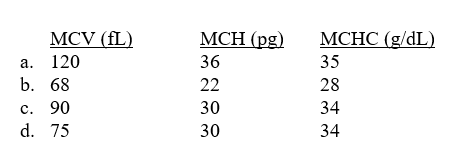
(Short Answer)
4.9/5 (93)
(93) A hemoglobin of 19 g/dL is normal for which of the following patients?
(Multiple Choice)
4.9/5 (84)
(84) Manual cell counting methods in automated hematology laboratories are used for all of the following except:
(Multiple Choice)
4.9/5 (72)
(72) In the center square on one side of a hemocytometer, 100 platelets were found; 200 were found in the center square on the other side. Select the best course of action.
(Multiple Choice)
4.9/5 (84)
(84) On a standard reticulocyte preparation with new methylene blue, 100 cells are counted containing blue-stained granulofilamentous material. The red blood count is 3.22 * 1012/L, and the hematocrit is 30%. Calculate the MCV.
(Multiple Choice)
4.9/5 (81)
(81) Why is it important to have a scrupulously clean hemocytometer when manually counting platelets?
(Multiple Choice)
4.8/5 (69)
(69) On a standard reticulocyte preparation with new methylene blue, 100 cells are counted containing blue-stained granulofilamentous material. The red blood count is 3.22 *1012/L, and the hematocrit is 30%. Calculate the corrected reticulocyte count.
(Multiple Choice)
4.9/5 (75)
(75) Interpret the following results (all tests performed manually) on an adult female named Mary Jones.
RBC: 3.22*1012/L
Hemoglobin: 16.0 g/dL
Hematocrit: 30.0%
(Multiple Choice)
4.9/5 (75)
(75) Diagnostic testing at or near the site of patient care is known as:
(Multiple Choice)
4.9/5 (92)
(92) On a standard reticulocyte preparation with new methylene blue, 100 cells are counted containing blue-stained granulofilamentous material. The red blood count is 3.22 * 1012/L, and the hematocrit is 30%. Using information determined from Questions 23 through 27, what is the correct interpretation for this patient's condition?
(Multiple Choice)
4.9/5 (72)
(72) Ten nucleated red blood cells (NRBCs) are found in a blood film when differentiating 100 white cells. What is the corrected white blood count if the automated cell counter printed a count of 10.0* 109/L?
(Multiple Choice)
4.9/5 (67)
(67) On a standard reticulocyte preparation with new methylene blue, 100 cells are counted containing blue-stained granulofilamentous material. The red blood count is 3.22 * 1012/L, and the hematocrit is 30%. Calculate the reticulocyte production index (RPI).
(Multiple Choice)
4.9/5 (74)
(74) The following RBC indices are obtained on a patient when calculated using results from manual methods:
MCV: 73 fL
MCH: 24 pg
MCHC: 33.4 g/dL
When the stained blood film is evaluated, the RBCs are normocytic normochromic. What conclusion can be made from this information?
(Multiple Choice)
4.7/5 (78)
(78) Any of the following could be an explanation for the invalid hemoglobin for Mary Jones (Questions 13 through 16) except:
(Multiple Choice)
4.9/5 (86)
(86) 
Filters
- Essay(0)
- Multiple Choice(0)
- Short Answer(0)
- True False(0)
- Matching(0)