



 Chat with AI
Exam 45: Laboratory Evaluation of Hemostasis

Exam 1: An Overview of Clinical Laboratory Hematology6 Questions
Exam 2: Safety in the Hematology Laboratory14 Questions
Exam 3: Specimen Collection23 Questions
Exam 4: Care and Use of the Microscope24 Questions
Exam 5: Quality Assurance in Hematology and Hemostasis Testing19 Questions
Exam 6: Cellular Structure and Function17 Questions
Exam 7: Hematopoiesis21 Questions
Exam 8: Erythrocyte Production and Destruction14 Questions
Exam 9: Energy Metabolism and Membrane Physiology of the Erythrocyte13 Questions
Exam 10: Hemoglobin Metabolism22 Questions
Exam 11: Iron Metabolism19 Questions
Exam 12: Leukocyte Development, Kinetics, and Functions23 Questions
Exam 13: Platelet Production, Structure, and Function15 Questions
Exam 14: Routine and Point-Of-Care Testing in Hematology: Manual and Semiautomated Methods37 Questions
Exam 15: Examination of the Peripheral Blood Film and Correlation With the Complete Blood Count25 Questions
Exam 16: Bone Marrow Examination15 Questions
Exam 17: Body Fluids in the Hematology Laboratory18 Questions
Exam 18: Anemias: Red Blood Cell Morphology and Approach to Diagnosis24 Questions
Exam 19: Disorders of Iron and Heme Metabolism30 Questions
Exam 20: Anemias Caused by Defects of Dna Metabolism21 Questions
Exam 21: Bone Marrow Failure17 Questions
Exam 22: Introduction to Increased Destruction of Erythrocytes22 Questions
Exam 23: Intrinsic Defects Leading to Increased Erythrocyte Destruction29 Questions
Exam 24: Extrinsic Defects Leading to Increased Erythrocytedestructionnonimmune Causes14 Questions
Exam 25: Extrinsic Defects Leading to Increased Erythrocytedestructionimmune Causes12 Questions
Exam 26: Hemoglobinopathies Structural Defects in Hemoglobin21 Questions
Exam 27: Thalassemias21 Questions
Exam 28: Nonmalignant Leukocyte Disorders25 Questions
Exam 29: Introduction to Leukocyte Neoplasms14 Questions
Exam 30: Cytochemistry10 Questions
Exam 31: Cytogenetics17 Questions
Exam 32: Molecular Diagnostics in the Clinical Laboratory11 Questions
Exam 33: Flow Cytometric Analysis in Hematologic Disorders12 Questions
Exam 34: Myeloproliferative Neoplasms20 Questions
Exam 35: Myelodysplastic Syndromes16 Questions
Exam 36: Acute Leukemias13 Questions
Exam 37: Mature Lymphoid Neoplasms20 Questions
Exam 38: Pediatric and Geriatric Hematology14 Questions
Exam 39: Automated Cell-Counting Instrumentation26 Questions
Exam 40: Normal Hemostasis and Coagulation23 Questions
Exam 41: Hemorrhagic Coagulation Disorders27 Questions
Exam 42: Thrombosis Risk Testing24 Questions
Exam 43: Thrombocytopenia and Thrombocytosis24 Questions
Exam 44: Qualitative Disorders of Platelets and Vasculature13 Questions
Exam 45: Laboratory Evaluation of Hemostasis30 Questions
Exam 46: Monitoring Antithrombotic Therapies17 Questions
Exam 47: Coagulation Instrumentation14 Questions
Select questions type


A 53-year-old woman arrives at the hospital with bleeding into the back of the throat and has a coagulation screen performed. She has no history of abnormal bleeding before this despite major stress to hemostasis in the past: she was in a major automobile accident at age 37 and has had impacted wisdom teeth extracted. Her coagulation results follow:
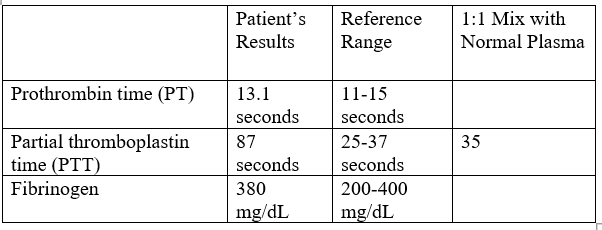 Which of the following is the most likely cause for her bleeding?
Free
(Multiple Choice)
5.0/5  (69)
(69) Correct Answer: Verified
D
How often must the partial thromboplastin time (PTT) reference interval be determined?
Free
(Multiple Choice)
5.0/5 (86)
(86) Correct Answer:Verified
VerifiedC
A patient's platelet count drops 4 days after being placed on heparin. Select the correct interpretation.
Free
(Multiple Choice)
4.9/5 (70)
(70) Correct Answer:Verified
VerifiedD
A platelet aggregation study shows diminished response to all agonists except for a small response to arachidonic acid and full response to ristocetin. Which condition is most likely?
(Multiple Choice)
4.7/5 (89)
(89) Patients with which of the following would have a normal PT?
(Multiple Choice)
4.7/5 (74)
(74) Which of the following is acceptable practice regarding collection of blood when using a syringe and winged needle set?
(Multiple Choice)
4.9/5 (82)
(82) A patient sample has normal platelet aggregation patterns for all agonists except that no reaction occurs with ristocetin. Ristocetin agglutination is not corrected with exogenous VWF. What condition is most likely?
(Multiple Choice)
4.8/5 (89)
(89) A patient is stabilized on warfarin with an international normalized ratio (INR) of 2.7. He develops pneumonia and is admitted to the hospital. His appetite is depressed and he is placed on broad-spectrum antibiotic agents. At 1 week after the admission, his INR is 5.0. What is the most likely interpretation?
(Multiple Choice)
4.9/5 (80)
(80) Which of the following is an acceptable sample for a prothrombin time (PT) test?
(Multiple Choice)
4.9/5 (86)
(86) Standard curves are necessary for which coagulation procedures?
(Multiple Choice)
5.0/5 (86)
(86) A patient admitted to the hospital with thrombosis is given the standard heparin dosage. Twenty-four hours after the heparin is started, the PTT is 38 seconds (reference range, 25 to 37 seconds). Both normal and abnormal controls are within their limits. Which of the following is most likely?
(Multiple Choice)
4.8/5 (70)
(70) Which of the following will cause spuriously prolonged clot-based coagulation tests?
(Multiple Choice)
4.7/5 (59)
(59) A patient is positive for fibrin degradation products and negative for D dimers. Which condition is most likely?
(Multiple Choice)
4.8/5 (73)
(73) Which of the following conditions is associated with an elevated fibrinogen?
(Multiple Choice)
4.8/5 (83)
(83) A prolonged PTT is corrected when mixed with normal plasma and tested immediately and after a 2-hour incubation. Which test (or tests) should be performed next?
(Multiple Choice)
4.8/5 (77)
(77) Which of the following is necessary for normal platelet aggregation?
(Multiple Choice)
4.8/5 (80)
(80) A patient has a hematocrit of 65%. Which of the following is true related to coagulation testing?
(Multiple Choice)
4.9/5 (92)
(92) 
Filters
- Essay(0)
- Multiple Choice(0)
- Short Answer(0)
- True False(0)
- Matching(0)