



 Chat with AI
Exam 5: Quality Assurance in Hematology and Hemostasis Testing

Exam 1: An Overview of Clinical Laboratory Hematology6 Questions
Exam 2: Safety in the Hematology Laboratory14 Questions
Exam 3: Specimen Collection23 Questions
Exam 4: Care and Use of the Microscope24 Questions
Exam 5: Quality Assurance in Hematology and Hemostasis Testing19 Questions
Exam 6: Cellular Structure and Function17 Questions
Exam 7: Hematopoiesis21 Questions
Exam 8: Erythrocyte Production and Destruction14 Questions
Exam 9: Energy Metabolism and Membrane Physiology of the Erythrocyte13 Questions
Exam 10: Hemoglobin Metabolism22 Questions
Exam 11: Iron Metabolism19 Questions
Exam 12: Leukocyte Development, Kinetics, and Functions23 Questions
Exam 13: Platelet Production, Structure, and Function15 Questions
Exam 14: Routine and Point-Of-Care Testing in Hematology: Manual and Semiautomated Methods37 Questions
Exam 15: Examination of the Peripheral Blood Film and Correlation With the Complete Blood Count25 Questions
Exam 16: Bone Marrow Examination15 Questions
Exam 17: Body Fluids in the Hematology Laboratory18 Questions
Exam 18: Anemias: Red Blood Cell Morphology and Approach to Diagnosis24 Questions
Exam 19: Disorders of Iron and Heme Metabolism30 Questions
Exam 20: Anemias Caused by Defects of Dna Metabolism21 Questions
Exam 21: Bone Marrow Failure17 Questions
Exam 22: Introduction to Increased Destruction of Erythrocytes22 Questions
Exam 23: Intrinsic Defects Leading to Increased Erythrocyte Destruction29 Questions
Exam 24: Extrinsic Defects Leading to Increased Erythrocytedestructionnonimmune Causes14 Questions
Exam 25: Extrinsic Defects Leading to Increased Erythrocytedestructionimmune Causes12 Questions
Exam 26: Hemoglobinopathies Structural Defects in Hemoglobin21 Questions
Exam 27: Thalassemias21 Questions
Exam 28: Nonmalignant Leukocyte Disorders25 Questions
Exam 29: Introduction to Leukocyte Neoplasms14 Questions
Exam 30: Cytochemistry10 Questions
Exam 31: Cytogenetics17 Questions
Exam 32: Molecular Diagnostics in the Clinical Laboratory11 Questions
Exam 33: Flow Cytometric Analysis in Hematologic Disorders12 Questions
Exam 34: Myeloproliferative Neoplasms20 Questions
Exam 35: Myelodysplastic Syndromes16 Questions
Exam 36: Acute Leukemias13 Questions
Exam 37: Mature Lymphoid Neoplasms20 Questions
Exam 38: Pediatric and Geriatric Hematology14 Questions
Exam 39: Automated Cell-Counting Instrumentation26 Questions
Exam 40: Normal Hemostasis and Coagulation23 Questions
Exam 41: Hemorrhagic Coagulation Disorders27 Questions
Exam 42: Thrombosis Risk Testing24 Questions
Exam 43: Thrombocytopenia and Thrombocytosis24 Questions
Exam 44: Qualitative Disorders of Platelets and Vasculature13 Questions
Exam 45: Laboratory Evaluation of Hemostasis30 Questions
Exam 46: Monitoring Antithrombotic Therapies17 Questions
Exam 47: Coagulation Instrumentation14 Questions
Select questions type


A patient's white blood cells (WBCs) are counted on an automated cell counter 10 times. The mean white count is 8000/mL, and the standard deviation (SD) is 300. What is the coefficient of variation (CV)?

Free
(Multiple Choice)
4.9/5  (67)
(67) Correct Answer: Verified
C
One of two controls that have been evaluated over the last 28 days gives a result on day 29 between 2 and 3 SDs of the mean; the other control is within 2 SDs of its mean. What is the correct procedure to follow?
Free
(Multiple Choice)
4.8/5 (81)
(81) Correct Answer:Verified
VerifiedB
The following hemoglobin results, reported in g/dL, are obtained on a hospitalized patient on 3 consecutive days:
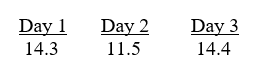 The SD for this hemoglobin method was calculated in Question 18. A delta check was obtained on day 2. Controls were run as appropriate each day and were all within limits for this procedure.
What is the most probable reason for the day 2 result when compared with those for days 1 and 3?
The SD for this hemoglobin method was calculated in Question 18. A delta check was obtained on day 2. Controls were run as appropriate each day and were all within limits for this procedure.
What is the most probable reason for the day 2 result when compared with those for days 1 and 3?Free
(Multiple Choice)
4.7/5 (78)
(78) Correct Answer:Verified
VerifiedB
A purchased hemoglobin standard is used to adjust a hemoglobinometer. This standard is being used as a:
(Multiple Choice)
4.8/5 (94)
(94) The tubing that brings the lyse reagent to the hemoglobin cuvette on an automated cell counter is pinched and not delivering any reagent. All hemoglobin values are greater than 20 g/dL. This represents what type of error?
(Multiple Choice)
4.9/5 (72)
(72) A patient specimen is analyzed on an instrument known to be in control from previous assays performed on a calibrated instrument and gives a hemoglobin result of 13.2 g/dL. Two hours later it is evaluated on another instrument that is being evaluated for purchase by the laboratory. The result is 11.8 g/dL. This result, when compared with the first, is:
(Multiple Choice)
4.9/5 (78)
(78) The antinuclear antibody (ANA) test is positive in almost all people who have systemic lupus erythematosus (SLE). It is also positive in some patients who do not have SLE. The anti-deoxyribonucleic acid (DNA) test is positive only in people with SLE but not in all who do. Which of the following is true?
(Multiple Choice)
4.9/5 (80)
(80) A test that is positive in all patients who have the disease but also in some who do not have the disease is:
(Multiple Choice)
4.8/5 (62)
(62) What does the CV calculated in Question 2 describe about the white cell counts?
(Multiple Choice)
4.7/5 (73)
(73) Proper specimen collection and patient satisfaction are components of:
(Multiple Choice)
4.8/5 (72)
(72) A clinical laboratory scientist performs 30 replicate hemoglobin determinations on a single blood sample. When statistics are used to determine the precision of the method, the mean is 13.8 g/dL and 1 SD is 0.1 g/dL. This means that 95.5% of the results on this specimen lie:
(Multiple Choice)
4.9/5 (81)
(81) The best way to prevent errors in the laboratory is to ensure:
(Multiple Choice)
5.0/5 (74)
(74) A laboratory gets numerous complaints regarding the length of time it takes hematology results to get to the emergency department. What would be an appropriate response?
(Multiple Choice)
4.9/5 (89)
(89) Which of the following would most likely be associated with the situation described in Question 11?
(Multiple Choice)
4.7/5 (73)
(73) The control values for both controls for the prothrombin test were ranging between the mean and 1 SD for the first 19 days of use. Starting on day 20, the values for both were consistently between +1 and +2 SDs. This is an example of a:
(Multiple Choice)
4.9/5 (85)
(85) A laboratory comparing its results to those of other laboratories on the same specimen is an example of:
(Multiple Choice)
4.7/5 (95)
(95) Which of the following groups of patients should not be included in establishing moving averages using red cell indices?
(Multiple Choice)
4.7/5 (80)
(80) 
Filters
- Essay(0)
- Multiple Choice(0)
- Short Answer(0)
- True False(0)
- Matching(0)