



 Chat with AI
Exam 44: Qualitative Disorders of Platelets and Vasculature

Exam 1: An Overview of Clinical Laboratory Hematology6 Questions
Exam 2: Safety in the Hematology Laboratory14 Questions
Exam 3: Specimen Collection23 Questions
Exam 4: Care and Use of the Microscope24 Questions
Exam 5: Quality Assurance in Hematology and Hemostasis Testing19 Questions
Exam 6: Cellular Structure and Function17 Questions
Exam 7: Hematopoiesis21 Questions
Exam 8: Erythrocyte Production and Destruction14 Questions
Exam 9: Energy Metabolism and Membrane Physiology of the Erythrocyte13 Questions
Exam 10: Hemoglobin Metabolism22 Questions
Exam 11: Iron Metabolism19 Questions
Exam 12: Leukocyte Development, Kinetics, and Functions23 Questions
Exam 13: Platelet Production, Structure, and Function15 Questions
Exam 14: Routine and Point-Of-Care Testing in Hematology: Manual and Semiautomated Methods37 Questions
Exam 15: Examination of the Peripheral Blood Film and Correlation With the Complete Blood Count25 Questions
Exam 16: Bone Marrow Examination15 Questions
Exam 17: Body Fluids in the Hematology Laboratory18 Questions
Exam 18: Anemias: Red Blood Cell Morphology and Approach to Diagnosis24 Questions
Exam 19: Disorders of Iron and Heme Metabolism30 Questions
Exam 20: Anemias Caused by Defects of Dna Metabolism21 Questions
Exam 21: Bone Marrow Failure17 Questions
Exam 22: Introduction to Increased Destruction of Erythrocytes22 Questions
Exam 23: Intrinsic Defects Leading to Increased Erythrocyte Destruction29 Questions
Exam 24: Extrinsic Defects Leading to Increased Erythrocytedestructionnonimmune Causes14 Questions
Exam 25: Extrinsic Defects Leading to Increased Erythrocytedestructionimmune Causes12 Questions
Exam 26: Hemoglobinopathies Structural Defects in Hemoglobin21 Questions
Exam 27: Thalassemias21 Questions
Exam 28: Nonmalignant Leukocyte Disorders25 Questions
Exam 29: Introduction to Leukocyte Neoplasms14 Questions
Exam 30: Cytochemistry10 Questions
Exam 31: Cytogenetics17 Questions
Exam 32: Molecular Diagnostics in the Clinical Laboratory11 Questions
Exam 33: Flow Cytometric Analysis in Hematologic Disorders12 Questions
Exam 34: Myeloproliferative Neoplasms20 Questions
Exam 35: Myelodysplastic Syndromes16 Questions
Exam 36: Acute Leukemias13 Questions
Exam 37: Mature Lymphoid Neoplasms20 Questions
Exam 38: Pediatric and Geriatric Hematology14 Questions
Exam 39: Automated Cell-Counting Instrumentation26 Questions
Exam 40: Normal Hemostasis and Coagulation23 Questions
Exam 41: Hemorrhagic Coagulation Disorders27 Questions
Exam 42: Thrombosis Risk Testing24 Questions
Exam 43: Thrombocytopenia and Thrombocytosis24 Questions
Exam 44: Qualitative Disorders of Platelets and Vasculature13 Questions
Exam 45: Laboratory Evaluation of Hemostasis30 Questions
Exam 46: Monitoring Antithrombotic Therapies17 Questions
Exam 47: Coagulation Instrumentation14 Questions
Select questions type


Which of the following is true regarding testing for the diagnosis of vascular disorders?

Free
(Multiple Choice)
4.9/5  (87)
(87) Correct Answer: Verified
A
Platelet count and function studies are performed on a patient with a history of easy bruising, and the following results are obtained:
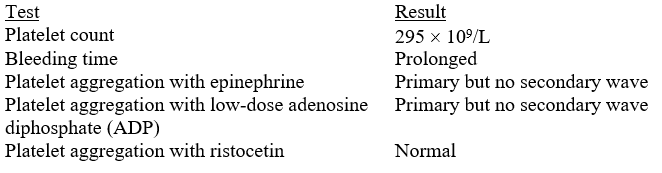 What is the most likely diagnosis for this patient?
Free
(Multiple Choice)
4.9/5 (82)
(82) Correct Answer:Verified
VerifiedB
Which of the following is the most likely diagnosis for a patient with a normal platelet count, prolonged bleeding time, and no aggregation with any agent except ristocetin?
Free
(Multiple Choice)
4.8/5 (91)
(91) Correct Answer:Verified
VerifiedD
Which of the following is a disorder with absent platelet glycoprotein Ib/IX/V and in which the patient has moderate thrombocytopenia, large platelets, and normal aggregometry with all agents except ristocetin?
(Multiple Choice)
4.9/5 (84)
(84) A 78-year-old patient recently noticed dark blotches on his forearms and on the backs of his hands. He seems to bruise even when a phlebotomy is performed using excellent technique with no problems encountered. No other symptoms exist, and all laboratory tests are normal. Which of the following is the most likely diagnosis?
(Multiple Choice)
4.8/5 (87)
(87) Clopidogrel is a drug used therapeutically for patients with a risk of arterial thrombi because it:
(Multiple Choice)
4.8/5 (78)
(78) The qualitative platelet disorders and vascular disorders typically exhibit what type of symptoms?
(Multiple Choice)
4.9/5 (82)
(82) All of the following are common conditions or situations that interfere with platelet function except:
(Multiple Choice)
4.8/5 (85)
(85) Which of the following is normal in a patient regularly taking aspirin?
(Multiple Choice)
4.8/5 (74)
(74) What types of hemostatic complications are found in patients with myeloproliferative disorders?
(Multiple Choice)
4.9/5 (78)
(78) Which of the following is normal in primary dense granule deficiency?
(Multiple Choice)
4.8/5 (73)
(73) Which of the following is the most common cause of acquired platelet dysfunction?
(Multiple Choice)
4.8/5 (84)
(84) What is the mechanism for the platelet dysfunction in multiple myeloma and Waldenström macroglobulinemia?
(Multiple Choice)
4.9/5 (75)
(75) 
Filters
- Essay(0)
- Multiple Choice(0)
- Short Answer(0)
- True False(0)
- Matching(0)