



 Chat with AI
Exam 14: Routine and Point-Of-Care Testing in Hematology: Manual and Semiautomated Methods

Exam 1: An Overview of Clinical Laboratory Hematology6 Questions
Exam 2: Safety in the Hematology Laboratory14 Questions
Exam 3: Specimen Collection23 Questions
Exam 4: Care and Use of the Microscope24 Questions
Exam 5: Quality Assurance in Hematology and Hemostasis Testing19 Questions
Exam 6: Cellular Structure and Function17 Questions
Exam 7: Hematopoiesis21 Questions
Exam 8: Erythrocyte Production and Destruction14 Questions
Exam 9: Energy Metabolism and Membrane Physiology of the Erythrocyte13 Questions
Exam 10: Hemoglobin Metabolism22 Questions
Exam 11: Iron Metabolism19 Questions
Exam 12: Leukocyte Development, Kinetics, and Functions23 Questions
Exam 13: Platelet Production, Structure, and Function15 Questions
Exam 14: Routine and Point-Of-Care Testing in Hematology: Manual and Semiautomated Methods37 Questions
Exam 15: Examination of the Peripheral Blood Film and Correlation With the Complete Blood Count25 Questions
Exam 16: Bone Marrow Examination15 Questions
Exam 17: Body Fluids in the Hematology Laboratory18 Questions
Exam 18: Anemias: Red Blood Cell Morphology and Approach to Diagnosis24 Questions
Exam 19: Disorders of Iron and Heme Metabolism30 Questions
Exam 20: Anemias Caused by Defects of Dna Metabolism21 Questions
Exam 21: Bone Marrow Failure17 Questions
Exam 22: Introduction to Increased Destruction of Erythrocytes22 Questions
Exam 23: Intrinsic Defects Leading to Increased Erythrocyte Destruction29 Questions
Exam 24: Extrinsic Defects Leading to Increased Erythrocytedestructionnonimmune Causes14 Questions
Exam 25: Extrinsic Defects Leading to Increased Erythrocytedestructionimmune Causes12 Questions
Exam 26: Hemoglobinopathies Structural Defects in Hemoglobin21 Questions
Exam 27: Thalassemias21 Questions
Exam 28: Nonmalignant Leukocyte Disorders25 Questions
Exam 29: Introduction to Leukocyte Neoplasms14 Questions
Exam 30: Cytochemistry10 Questions
Exam 31: Cytogenetics17 Questions
Exam 32: Molecular Diagnostics in the Clinical Laboratory11 Questions
Exam 33: Flow Cytometric Analysis in Hematologic Disorders12 Questions
Exam 34: Myeloproliferative Neoplasms20 Questions
Exam 35: Myelodysplastic Syndromes16 Questions
Exam 36: Acute Leukemias13 Questions
Exam 37: Mature Lymphoid Neoplasms20 Questions
Exam 38: Pediatric and Geriatric Hematology14 Questions
Exam 39: Automated Cell-Counting Instrumentation26 Questions
Exam 40: Normal Hemostasis and Coagulation23 Questions
Exam 41: Hemorrhagic Coagulation Disorders27 Questions
Exam 42: Thrombosis Risk Testing24 Questions
Exam 43: Thrombocytopenia and Thrombocytosis24 Questions
Exam 44: Qualitative Disorders of Platelets and Vasculature13 Questions
Exam 45: Laboratory Evaluation of Hemostasis30 Questions
Exam 46: Monitoring Antithrombotic Therapies17 Questions
Exam 47: Coagulation Instrumentation14 Questions
Select questions type


What red cell morphology would support the red cell indices calculated for Mary Jones in Question 14?

Free
(Multiple Choice)
4.8/5  (80)
(80) Correct Answer: Verified
D
What is the total volume of one side of a hemocytometer if the ruled area is 3 * 3 mm and the depth is 0.1 mm?
Free
(Multiple Choice)
4.8/5 (69)
(69) Correct Answer:Verified
VerifiedB
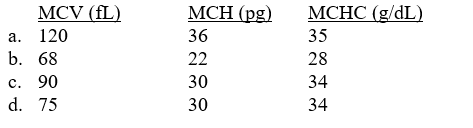
Which of the following red cell indices support macrocytic normochromic red cell morphology?
Free
(Short Answer)
4.7/5 (73)
(73) Correct Answer:Verified
VerifiedA
On a standard reticulocyte preparation with new methylene blue, 100 cells are counted containing blue-stained granulofilamentous material. The red blood count is 3.22 * 1012/L, and the hematocrit is 30%. Calculate the absolute reticulocyte count.
(Multiple Choice)
4.8/5 (79)
(79) What make RBCs settle faster through the plasma when inflammation or infection exist?
(Multiple Choice)
4.8/5 (78)
(78) The MCV on a patient is calculated to be 115 fL and the MCHC is 35 g/dL. What, in general terms, must be true of the MCH if it is consistent with the previous two indices?
(Multiple Choice)
4.9/5 (75)
(75) A 1:20 dilution of blood is made for a white count, and the following number of cells counted in the four large corner mm2 of the hemocytometer: 12, 28, 18, and 15. What should be done next?
(Multiple Choice)
4.7/5 (68)
(68) A manual WBC count is performed using a system that makes a 1:20 dilution of blood. When the cells in the four large corner mm2 of the hemocytometer are counted, the following numbers of cells are obtained: 8, 12, 9, and 11. What would be the next step?
(Multiple Choice)
4.7/5 (74)
(74) 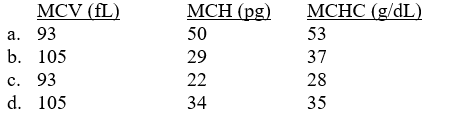
Which of the following could cause the microhematocrit to be falsely decreased?
(Multiple Choice)
4.9/5 (76)
(76) In the four large corner squares of a hemocytometer, 95, 102, 105, and 98 white cells were counted from a 1:20 dilution. Select the correct interpretation for the white blood count calculated from these values.
(Multiple Choice)
4.8/5 (80)
(80) Which of the following is a good use of the erythrocyte sedimentation rate (ESR)?
(Multiple Choice)
4.8/5 (85)
(85) Which of the following could account for the red cell indices on Mary Jones reviewing Questions 13 through 15?
(Multiple Choice)
4.8/5 (77)
(77) Twenty cells are counted in one of the nine large squares of a hemocytometer. The sample is diluted 1:10. How many cells are present per L?
(Multiple Choice)
4.8/5 (84)
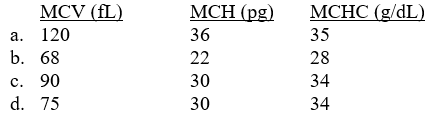
(84) Which of the following red cell indices support normocytic normochromic red cell morphology?
(Short Answer)
4.7/5 (90)
(90) Which of the following would cause a manual cell count to be falsely high?
(Multiple Choice)
4.9/5 (88)
(88) What error was probably made if red cells are seen when attempting to manually count white blood cell (WBCs) on a hemocytometer?
(Multiple Choice)
4.9/5 (71)
(71) On a standard reticulocyte preparation with new methylene blue, 100 cells are counted that contain blue-stained granulofilamentous material. The red blood count is 3.22 *1012/L, and the hematocrit is 30%. Calculate the reticulocyte count as a percentage.
(Multiple Choice)
4.8/5 (70)
(70) A manual hemoglobin is determined on a patient, and the dilution still appears turbid after letting it sit for 15 minutes. The stained blood film is examined, and sickle cells are observed on the blood film. Equal volumes of the diluted hemoglobin sample and water are mixed together, and the absorbance of this read on a spectrophotometer. How should the hemoglobin result be determined from the standard calibrated graph?
(Multiple Choice)
4.8/5 (58)
(58) 
Filters
- Essay(0)
- Multiple Choice(0)
- Short Answer(0)
- True False(0)
- Matching(0)