



 Chat with AI
Exam 7: Carbohydrates and Glycobiology

Exam 1: The Foundations of Biochemistry109 Questions
Exam 2: Water87 Questions
Exam 3: Amino Acids, Peptides, and Proteins112 Questions
Exam 4: The Three-Dimensional Structure of Proteins100 Questions
Exam 5: Protein Function101 Questions
Exam 6: Enzymes106 Questions
Exam 7: Carbohydrates and Glycobiology109 Questions
Exam 8: Nucleotides and Nucleic Acids98 Questions
Exam 9: DNA-Based Information Technologies102 Questions
Exam 10: Lipids102 Questions
Exam 11: Biological Membranes and Transport105 Questions
Exam 12: Biosignaling98 Questions
Exam 13: Bioenergetics and Biochemical Reaction Types105 Questions
Exam 14: Glycolysis, Gluconeogenesis, and the Pentose Phosphate Pathway112 Questions
Exam 15: Principles of Metabolic Regulation101 Questions
Exam 16: The Citric Acid Cycle105 Questions
Exam 17: Fatty Acid Catabolism97 Questions
Exam 18: Amino Acid Oxidation and the Production of Urea98 Questions
Exam 19: Oxidative Phosphorylation and Photophosphorylation96 Questions
Exam 20: Carbohydrate Biosynthesis in Plants and Bacteria94 Questions
Exam 21: Lipid Biosynthesis100 Questions
Exam 22: Biosynthesis of Amino Acids, Nucleotides, and Related Molecules98 Questions
Exam 23: Hormonal Regulation and Integration of Mammalian Metabolism100 Questions
Exam 24: Genes and Chromosomes99 Questions
Exam 25: DNA Metabolism101 Questions
Exam 26: RNA Metabolism101 Questions
Exam 27: Protein Metabolism99 Questions
Exam 28: Regulation of Gene Expression99 Questions
Select questions type


Describe one biological advantage of storing glucose units in branched polymers (glycogen, amylopectin) rather than in linear polymers.
(Short Answer)
5.0/5  (86)
(86) Which statement is NOT a reason that it is difficult to study oligosaccharide composition from biological systems?
(Multiple Choice)
4.9/5 (77)
(77) The primary amino group of hemoglobin can react with glucose to form products that, downstream, generate advanced glycation end products (AGEs). Briefly explain why these AGEs are a problem in people with diabetes.
(Essay)
4.8/5 (84)
(84) D-Glucose is called a reducing sugar because it undergoes an oxidation-reduction reaction at the anomeric carbon. One of the products of this reaction is:
(Multiple Choice)
4.9/5 (84)
(84) In most cases, in order for an informational carbohydrate to become a biologically active molecule, it must:
(Multiple Choice)
4.7/5 (63)
(63) In glycoproteins, the carbohydrate moiety is always attached through the amino acid residues:
(Multiple Choice)
4.9/5 (77)
(77) Why does the cyclization of sugars create an additional chiral center in that molecule? What is the nomenclature of the stereoisomer produced by this reaction?
(Short Answer)
4.9/5 (77)
(77) Which commonality does NOT exist between peptides, nucleic acids, and poly- and oligosaccharides?
(Multiple Choice)
4.7/5 (76)
(76) Why are ruminant animals like cows able to digest cellulose?
(Multiple Choice)
5.0/5 (77)
(77) Briefly explain the procedure involved in using an oligosaccharide microarray to identify the binding specificity for a potential lectin.
(Essay)
4.8/5 (83)
(83) What is the biological advantage to an organism that stores its carbohydrate reserves as starch or glycogen rather than as an equivalent amount of free glucose?
(Short Answer)
4.9/5 (78)
(78) Which glycosaminoglycan is found in the synovial fluid of joints?
(Multiple Choice)
4.8/5 (72)
(72) The two monosaccharides shown below could BEST be described as: 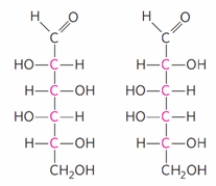
(Multiple Choice)
4.8/5 (91)
(91) Explain how it is possible that a polysaccharide molecule, such as glycogen, may have only one reducing end, and yet have many nonreducing ends.
(Essay)
4.8/5 (73)
(73) 
Filters
- Essay(0)
- Multiple Choice(0)
- Short Answer(0)
- True False(0)
- Matching(0)