



 Chat with AI
Exam 6: Enzymes


Give the Michaelis-Menten equation and define each term in it. Does this equation apply to all enzymes? If not, to which kind does it not apply?

 (70)
 Answered by Examlex AI Copilot
The Michaelis-Menten equation is given by:
V = (Vmax * [S]) / (Km + [S])
Where:
- V is the initial velocity of the reaction
- Vmax is the maximum velocity of the reaction
- [S] is the substrate concentration
- Km is the Michaelis constant, which is the substrate concentration at which the reaction velocity is half of Vmax
This equation applies to enzymes that follow Michaelis-Menten kinetics, which are enzymes that exhibit saturation kinetics and have a characteristic hyperbolic curve when plotting reaction velocity against substrate concentration. Not all enzymes follow this kinetics, particularly enzymes that exhibit cooperative kinetics or allosteric regulation. These enzymes do not follow the Michaelis-Menten equation and require different kinetic models to describe their behavior.
Why is a transition-state analog not necessarily the same as a competitive inhibitor?
(79) Answered by Examlex AI CopilotA transition-state analog is a molecule that mimics the structure of a substrate in its transition state during an enzymatic reaction. The transition state is a high-energy, unstable state that occurs during the conversion of substrates into products. Transition-state analogs are designed to bind to the enzyme's active site with high affinity because enzymes are often most complementary to the transition state of the reaction they catalyze. By resembling the transition state, these analogs can act as potent inhibitors of the enzyme.
On the other hand, a competitive inhibitor is a molecule that competes with the substrate for binding to the active site of an enzyme. It resembles the substrate's structure (not the transition state) and thus can occupy the active site, preventing the actual substrate from binding. Competitive inhibitors typically reduce the rate of the reaction by decreasing the amount of enzyme available to bind to the substrate.
The key difference between a transition-state analog and a competitive inhibitor lies in what they mimic and how they interact with the enzyme:
1. Structural Mimicry:
- Transition-state analog: Mimics the high-energy transition state of the substrate.
- Competitive inhibitor: Mimics the substrate itself in its ground state.
2. Binding Affinity:
- Transition-state analogs often bind with much higher affinity to the enzyme than either the substrate or competitive inhibitors because enzymes are highly optimized to stabilize the transition state.
- Competitive inhibitors generally have a lower affinity compared to transition-state analogs because they are competing with the substrate for the active site rather than exploiting the enzyme's highest affinity state.
3. Inhibition Mechanism:
- Transition-state analogs inhibit the enzyme by stabilizing the enzyme in a form that is complementary to the transition state, effectively "trapping" the enzyme in a non-productive complex.
- Competitive inhibitors simply block the active site, preventing substrate binding without necessarily stabilizing a transition-state-like conformation of the enzyme.
4. Overcoming Inhibition:
- The inhibition caused by transition-state analogs is often very difficult to overcome because of their high affinity for the enzyme.
- Competitive inhibition can often be overcome by increasing the concentration of the substrate, which can outcompete the inhibitor for the active site.
In summary, while both transition-state analogs and competitive inhibitors can prevent an enzyme from catalyzing a reaction, they do so by different mechanisms and with different degrees of affinity and specificity. Transition-state analogs are specialized inhibitors that exploit the unique high-affinity state of the enzyme for the transition state, while competitive inhibitors simply block substrate access to the active site.
Enzymes with a kcat /Km ratio of about 108 M-1s-1 are considered to show optimal catalytic efficiency. Fumarase, which catalyzes the reversible-dehydration reaction  has a ratio of turnover number to the Michaelis-Menten constant, (kcat/Km) of 1.6 × 10⁸ for the substrate fumarate and 3.6 × 10⁷ for the substrate malate. Because the turnover number for both substrates is nearly identical, what factors might be involved that explain the different ratio for the two substrates?
The Mg2+ metal ions involved in the enolase reaction mechanism are required for which reason?
(78) Michaelis-Menten kinetics is sometimes referred to as "saturation" kinetics. Why?
(87) In the following diagram of the first step in the reaction catalyzed by the protease chymotrypsin, the process of general base catalysis is illustrated by the number _____, and the process of covalent catalysis is illustrated by the number _____. 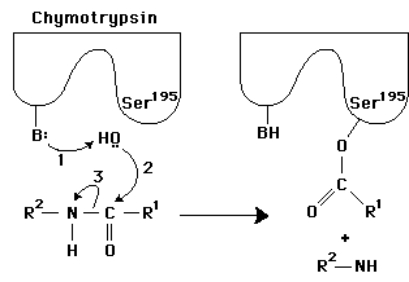
(74) An enzyme follows Michaelis-Menten kinetics. Indicate (with an "x") which of the kinetic parameters at the left would be altered by the following factors. Give only one answer for each. 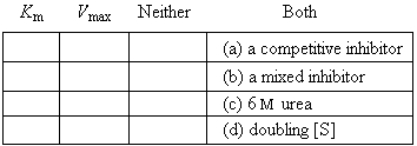
Write an equilibrium expression for the reaction S P and briefly explain the relationship between the value of the equilibrium constant and free energy.
(85) An enzyme can catalyze a reaction with either of two substrates, S1 or S2. The Km for S1 was found to be 2.0 mM, and the Km, for S2 was found to be 20 mM. A student determined that the Vmax was the same for the two substrates. Unfortunately, he lost the page of his notebook and needed to know the value of Vmax. He carried out two reactions: one with 0.1 mM S1, the other with 0.1 mM S2. Unfortunately, he forgot to label which reaction tube contained which substrate. Determine the value of Vmax from the results he obtained:
Tube number
Rate of formation of product
1
0.5
2
4.8
3
4
5
(82) Both water and glucose share an -OH that can serve as a substrate for a reaction with the terminal phosphate of ATP catalyzed by hexokinase. Glucose, however, is about a million times more reactive as a substrate than water. The BEST explanation is that:
(80) One of the enzymes involved in glycolysis, aldolase, requires Zn2+ for catalysis. Under conditions of zinc deficiency, when the enzyme may lack zinc, it would be referred to as the:
(77) For a reaction that can take place with or without catalysis by an enzyme, what would be the effect of the enzyme on the:
(a) standard free energy change of the reaction?
(b) activation energy of the reaction?
(c) initial velocity of the reaction?
(d) equilibrium constant of the reaction?
(89) If chemical reactions will eventually reach an equilibrium state, what is the purpose of enzymes in a biological system?
(82) Which amino acid is NOT capable using its side chain (R group) to participate in general acid-base catalysis?
(68) An enzyme-catalyzed reaction was carried out with the substrate concentration initially a thousand times greater than the Km for that substrate. After 9 minutes, 1% of the substrate had been converted to product, and the amount of product formed in the reaction mixture was 12 mol. If, in a separate experiment, one-third as much enzyme and twice as much substrate had been combined, how long would it take for the same amount (12 mol) of product to be formed?
(88) The following data were obtained in a study of an enzyme known to follow Michaelis-Menten kinetics: V0
Substrate added
( mol/min)
(mmol/L)
217
0)8
325
2
433
4
488
6
647
1,000
The Km for this enzyme is approximately:
(78) The combination of amoxicillin and clavulanic acid into the drug known as Augmentin is widely used as an antibacterial agent. The purpose of amoxicillin in this drug is to target _____, which catalyzes crosslinking of peptidoglycan, and the purpose of clavulanic acid in this drug is to target _____, which normally would inactivate the amoxicillin. Both of these compounds act as _____ inhibitors of enzyme function.
(87) 
Filters
- Essay(0)
- Multiple Choice(0)
- Short Answer(0)
- True False(0)
- Matching(0)