



 Chat with AI
Exam 13: Bioenergetics and Biochemical Reaction Types

Exam 1: The Foundations of Biochemistry109 Questions
Exam 2: Water87 Questions
Exam 3: Amino Acids, Peptides, and Proteins112 Questions
Exam 4: The Three-Dimensional Structure of Proteins100 Questions
Exam 5: Protein Function101 Questions
Exam 6: Enzymes106 Questions
Exam 7: Carbohydrates and Glycobiology109 Questions
Exam 8: Nucleotides and Nucleic Acids98 Questions
Exam 9: DNA-Based Information Technologies102 Questions
Exam 10: Lipids102 Questions
Exam 11: Biological Membranes and Transport105 Questions
Exam 12: Biosignaling98 Questions
Exam 13: Bioenergetics and Biochemical Reaction Types105 Questions
Exam 14: Glycolysis, Gluconeogenesis, and the Pentose Phosphate Pathway112 Questions
Exam 15: Principles of Metabolic Regulation101 Questions
Exam 16: The Citric Acid Cycle105 Questions
Exam 17: Fatty Acid Catabolism97 Questions
Exam 18: Amino Acid Oxidation and the Production of Urea98 Questions
Exam 19: Oxidative Phosphorylation and Photophosphorylation96 Questions
Exam 20: Carbohydrate Biosynthesis in Plants and Bacteria94 Questions
Exam 21: Lipid Biosynthesis100 Questions
Exam 22: Biosynthesis of Amino Acids, Nucleotides, and Related Molecules98 Questions
Exam 23: Hormonal Regulation and Integration of Mammalian Metabolism100 Questions
Exam 24: Genes and Chromosomes99 Questions
Exam 25: DNA Metabolism101 Questions
Exam 26: RNA Metabolism101 Questions
Exam 27: Protein Metabolism99 Questions
Exam 28: Regulation of Gene Expression99 Questions
Select questions type


If the equilibrium constant for the dissociation of lactic acid is 1.38 × 10⁻⁴, what is the G°' for this reaction?

Free
(Multiple Choice)
4.7/5  (78)
(78) Correct Answer: Verified
A
Which redox reaction(s) will NOT proceed as written if the initial concentrations of reactants and products are equal? I. pyruvate + NADH lactate + NAD+
II. FADH2 + NAD+ FAD + NADH + H+
III. succinate + NAD+ fumarate + NADH + H+
IV. NADH + H+ + ubiquinone NAD+ + ubiquinol
V. cytochrome c-Fe3+ + cytochrome b-Fe2+ cytochrome c-Fe2+ + cytochrome b-Fe3+
Free
(Multiple Choice)
4.9/5 (81)
(81) Correct Answer:Verified
VerifiedD
When a mixture of glucose 6-phosphate and fructose 6-phosphate is incubated with the enzyme phosphohexose isomerase (which catalyzes the interconversion of these two compounds) until equilibrium is reached, the final mixture contains twice as much glucose 6-phosphate as fructose 6-phosphate. Which one of the following statements is best applied to this reaction outlined below? (R = 8.315 J/mol · K; T = 298 K) glucose 6-phosphate fructose 6-phosphate
Free
(Multiple Choice)
4.9/5 (78)
(78) Correct Answer:Verified
VerifiedD
Which molecule is NOT considered a universal electron carrier?
(Multiple Choice)
4.8/5 (87)
(87) Glycerol 3-phosphate dehydrogenase catalyzes the following reversible reaction:
glycerol 3-phosphate + NAD+ NADH + H+ + dihydroxyacetone phosphate
Given the standard reduction potentials below, calculate G'° for the glycerol 3-phosphate dehydrogenase reaction, proceeding from left to right as shown. Show your work. (The Faraday constant,  , is 96.48 kJ/V · mol.)
dihydroxyacetone phosphate + 2e- + 2H+ glycerol 3-phosphate
E'° = -0.29 V
NAD+ + H+ + 2e- NADH
E'° = -0.32 V
, is 96.48 kJ/V · mol.)
dihydroxyacetone phosphate + 2e- + 2H+ glycerol 3-phosphate
E'° = -0.29 V
NAD+ + H+ + 2e- NADH
E'° = -0.32 V (Essay)
4.9/5 (74)
(74) In general, when ATP hydrolysis is coupled to an energy-requiring reaction, the actual reaction often consists of the transfer of a phosphate group from ATP to another substrate, rather than an actual hydrolysis of the ATP. Explain.
(Essay)
4.9/5 (89)
(89) Explain why each of the following statements is FALSE.
(a) In a reaction under standard conditions, only the reactants are fixed at 1 M.
(b) When G'° is positive, Keq' > 1.
(c) G and G'° mean the same thing.
(d) When G'° = 1.0 kJ/mol, Keq' = 1.
(Short Answer)
4.8/5 (83)
(83) Which statement is NOT true regarding the biochemical standard state?
(Multiple Choice)
4.9/5 (87)
(87) Which compound has the LARGEST negative value for the standard free-energy change ( G'°) upon hydrolysis?
(Multiple Choice)
4.8/5 (87)
(87) The expression G = G'° + RT ln Keq' for the actual free-energy change for the reaction A + B C + D is incorrect. Why is it wrong, and what is the correct expression for the real free-energy change of this reaction?
(Essay)
4.8/5 (71)
(71) Which is the MOST oxidized carbon atom in a ketohexose sugar?
(Multiple Choice)
4.9/5 (82)
(82) Under standard conditions, ATP can be used in phosphate-transfer reactions to generate which molecule?
(Multiple Choice)
4.9/5 (81)
(81) During glycolysis, glucose 1-phosphate is converted to fructose 6-phosphate in two successive reactions: glucose 1-phosphate glucose 6-phosphate
G'° = -7.1 kJ/mol
Glucose 6-phosphate fructose 6-phosphate
G'° = +1.7 kJ/mol
G'° for the overall reaction is:
(Multiple Choice)
4.8/5 (75)
(75) What is the CORRECT order of substances in terms of electronegativity, greatest to least?
(Multiple Choice)
4.9/5 (87)
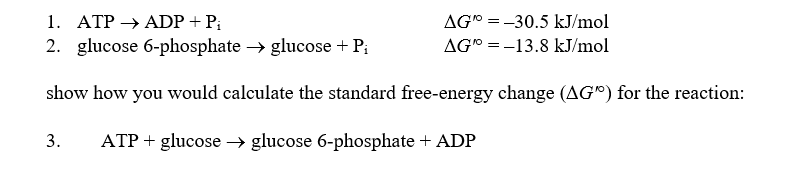
(87) 

Filters
- Essay(0)
- Multiple Choice(0)
- Short Answer(0)
- True False(0)
- Matching(0)