



 Chat with AI
Exam 3: Amino Acids, Peptides, and Proteins

Exam 1: The Foundations of Biochemistry109 Questions
Exam 2: Water87 Questions
Exam 3: Amino Acids, Peptides, and Proteins112 Questions
Exam 4: The Three-Dimensional Structure of Proteins100 Questions
Exam 5: Protein Function101 Questions
Exam 6: Enzymes106 Questions
Exam 7: Carbohydrates and Glycobiology109 Questions
Exam 8: Nucleotides and Nucleic Acids98 Questions
Exam 9: DNA-Based Information Technologies102 Questions
Exam 10: Lipids102 Questions
Exam 11: Biological Membranes and Transport105 Questions
Exam 12: Biosignaling98 Questions
Exam 13: Bioenergetics and Biochemical Reaction Types105 Questions
Exam 14: Glycolysis, Gluconeogenesis, and the Pentose Phosphate Pathway112 Questions
Exam 15: Principles of Metabolic Regulation101 Questions
Exam 16: The Citric Acid Cycle105 Questions
Exam 17: Fatty Acid Catabolism97 Questions
Exam 18: Amino Acid Oxidation and the Production of Urea98 Questions
Exam 19: Oxidative Phosphorylation and Photophosphorylation96 Questions
Exam 20: Carbohydrate Biosynthesis in Plants and Bacteria94 Questions
Exam 21: Lipid Biosynthesis100 Questions
Exam 22: Biosynthesis of Amino Acids, Nucleotides, and Related Molecules98 Questions
Exam 23: Hormonal Regulation and Integration of Mammalian Metabolism100 Questions
Exam 24: Genes and Chromosomes99 Questions
Exam 25: DNA Metabolism101 Questions
Exam 26: RNA Metabolism101 Questions
Exam 27: Protein Metabolism99 Questions
Exam 28: Regulation of Gene Expression99 Questions
Select questions type


Of the 20 standard amino acids, only _____ is not optically active. The reason is that its side chain _____.

Free
(Multiple Choice)
4.8/5  (78)
(78) Correct Answer: Verified
B
Which two amino acids differ from each other by only one atom?
Free
(Multiple Choice)
4.8/5 (75)
(75) Correct Answer:Verified
VerifiedE
Which statement is TRUE about the pKa values for ionizable R-group of amino acids within a polypeptide?
Free
(Multiple Choice)
4.8/5 (69)
(69) Correct Answer:Verified
VerifiedD
Which compound is a side-product of a peptide bond formation?
(Multiple Choice)
4.8/5 (72)
(72) A biochemist is attempting to separate a DNA-binding protein (protein X) from other proteins in a solution. Only three other proteins (A, B, and
C) are present. The proteins have the following properties:
pI
(isoelectric
Size
Bind to
point)
Mr
DNA?
protein A
7.4
82,000
yes
protein B
3.8
21,500
yes
protein C
7.9
23,000
no
protein X
7.8
22,000
yes
What type of protein separation techniques might she use to separate:
(a) protein X from protein A?
(b) protein X from protein B?
(c) protein X from protein C?
(Short Answer)
4.9/5 (78)
(78) A polypeptide is hydrolyzed, and it is determined that there are 3 Lys residues and 2 Arg residues (as well as other residues). How many peptide fragments can be expected when the native polypeptide is incubated with the proteolytic enzyme trypsin?
(Short Answer)
4.9/5 (83)
(83) Distinguish between homologs, paralogs, and orthologs as classes of related proteins.
(Short Answer)
4.9/5 (82)
(82) At pH 7.0, converting a glutamic acid to -carboxyglutamate, will have what effect on the overall charge of the protein containing it?
(Multiple Choice)
4.8/5 (74)
(74) According to the diagram, at pH 1, what is the average net charge on this amino acid? 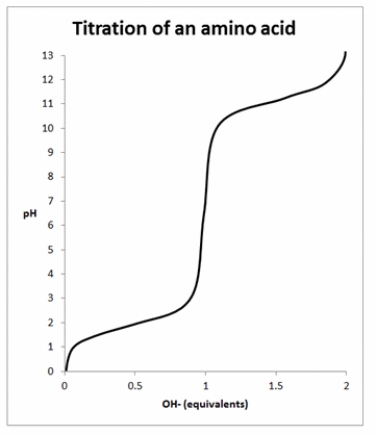
(Multiple Choice)
4.8/5 (78)
(78) If the average molecular weight of the 20 standard amino acids is 138, why do biochemists divide a protein's molecular weight by 110 to estimate its number of amino acid residues?
(Short Answer)
4.8/5 (87)
(87) The protein bovine serum albumin (BSA), has a MW of about 66,400. Using the Lambert-Beer Law, calculate the concentration of a sample of BSA with an absorbance at 280 nm of 1.3, assuming the molar extinction coefficient at 280 nm is 43,824 M-1cm-1.
(Multiple Choice)
4.9/5 (69)
(69) In a highly basic solution, pH = 13, the dominant form of glycine is:
(Multiple Choice)
4.9/5 (88)
(88) All of the amino acids that are found in proteins, except for proline, contain a(n) _____ group.
(Multiple Choice)
4.9/5 (69)
(69) For the study of a protein in detail, an effort is usually made to first:
(Multiple Choice)
5.0/5 (90)
(90) Describe two major differences between chemical synthesis of polypeptides and synthesis of polypeptides in the living cell.
(Essay)
4.8/5 (75)
(75) According to the diagram, which pH is the one at which this amino acid will have a net charge of 0? 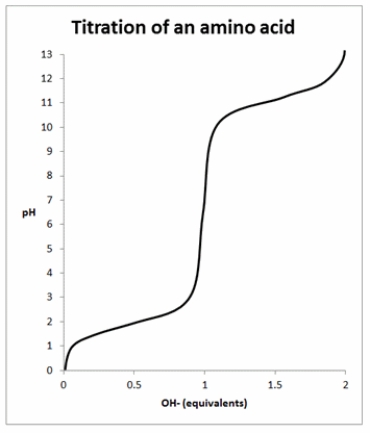
(Multiple Choice)
4.8/5 (84)
(84) Identify the pair of peptides below that CANNOT be distinguished by tandem mass spectrometry.
(Multiple Choice)
4.7/5 (91)
(91) Amino acids are ampholytes because they can function as either a(n):
(Multiple Choice)
5.0/5 (79)
(79) 
Filters
- Essay(0)
- Multiple Choice(0)
- Short Answer(0)
- True False(0)
- Matching(0)