



 Chat with AI
Exam 3: Amino Acids, Peptides, and Proteins

Exam 1: The Foundations of Biochemistry109 Questions
Exam 2: Water87 Questions
Exam 3: Amino Acids, Peptides, and Proteins112 Questions
Exam 4: The Three-Dimensional Structure of Proteins100 Questions
Exam 5: Protein Function101 Questions
Exam 6: Enzymes106 Questions
Exam 7: Carbohydrates and Glycobiology109 Questions
Exam 8: Nucleotides and Nucleic Acids98 Questions
Exam 9: DNA-Based Information Technologies102 Questions
Exam 10: Lipids102 Questions
Exam 11: Biological Membranes and Transport105 Questions
Exam 12: Biosignaling98 Questions
Exam 13: Bioenergetics and Biochemical Reaction Types105 Questions
Exam 14: Glycolysis, Gluconeogenesis, and the Pentose Phosphate Pathway112 Questions
Exam 15: Principles of Metabolic Regulation101 Questions
Exam 16: The Citric Acid Cycle105 Questions
Exam 17: Fatty Acid Catabolism97 Questions
Exam 18: Amino Acid Oxidation and the Production of Urea98 Questions
Exam 19: Oxidative Phosphorylation and Photophosphorylation96 Questions
Exam 20: Carbohydrate Biosynthesis in Plants and Bacteria94 Questions
Exam 21: Lipid Biosynthesis100 Questions
Exam 22: Biosynthesis of Amino Acids, Nucleotides, and Related Molecules98 Questions
Exam 23: Hormonal Regulation and Integration of Mammalian Metabolism100 Questions
Exam 24: Genes and Chromosomes99 Questions
Exam 25: DNA Metabolism101 Questions
Exam 26: RNA Metabolism101 Questions
Exam 27: Protein Metabolism99 Questions
Exam 28: Regulation of Gene Expression99 Questions
Select questions type


The first step in two-dimensional gel electrophoresis generates a series of protein bands by isoelectric focusing. In a second step, a strip of this gel is turned 90 degrees, placed on another gel containing SDS, and electric current is again applied. In this second step:
(Multiple Choice)
4.7/5  (93)
(93) The "signature sequence" shown below represents a portion of a protein from four different organisms. 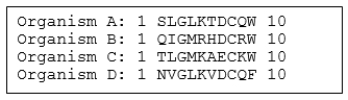 a. At which position(s) are amino acid residues invariant?
b. At which position(s) are amino acids limited to positively charged residues?
c. At which position(s) are amino acids limited to negatively charged residues?
d. At which position(s) are amino acids limited to nonpolar residues?
a. At which position(s) are amino acid residues invariant?
b. At which position(s) are amino acids limited to positively charged residues?
c. At which position(s) are amino acids limited to negatively charged residues?
d. At which position(s) are amino acids limited to nonpolar residues? (Not Answered)
This question doesn't have any answer yet
You are given a solution containing an enzyme that converts B into A. Describe what you would do to determine the specific activity of this enzyme solution.
(Essay)
4.7/5 (99)
(99) The pKa of lysine's carboxyl group, amino group, and side chain are 2.2, 9.0, and 10.5, respectively. If lysine is in a pH 13 solution, what is the net charge on each lysine molecule?
(Multiple Choice)
4.7/5 (74)
(74) Amino acids without ionizable R-groups can act as a zwitterion in a(n) _____ solution.
(Multiple Choice)
4.9/5 (74)
(74) Iodoacetamides, maleimides, benzyl halides, and bromomethyl ketones can all be used to modify the _____ group on _____ residues.
(Multiple Choice)
4.8/5 (73)
(73) How are sequential reactions controlled in the Edman degradation procedure?
(Multiple Choice)
4.9/5 (68)
(68) A biochemist wishes to determine the sequence of a protein that contains 123 amino acid residues. After breaking all of the disulfide bonds, the protein is treated with cyanogen bromide (CNBr), and it is determined that that this treatment breaks up the protein into seven conveniently sized peptides, which are separated from each other. It is your turn to take over. Outline the steps you would take to determine, unambiguously, the sequence of amino acid residues in the original protein.
(Essay)
4.8/5 (70)
(70) For amino acids with neutral R groups, at any pH below the pI of the amino acid, the population of amino acids in solution will have:
(Multiple Choice)
4.9/5 (69)
(69) What are the structural characteristics common to all amino acids found in naturally occurring proteins?
(Short Answer)
4.9/5 (89)
(89) Prosthetic groups in the class of proteins known as glycoproteins are composed of:
(Multiple Choice)
4.8/5 (87)
(87) The average molecular weight of the 20 standard amino acids is 138, but biochemists use 110 when estimating the number of amino acids in a protein of known molecular weight. Why?
(Multiple Choice)
4.8/5 (82)
(82) Which item is NOT a biochemical use/function of peptides of small molecular weight?
(Multiple Choice)
4.7/5 (77)
(77) The gel below illustrates the purification of the RecA protein from E. coli. This gel was loaded from the top. Which statement BEST describes how proteins "run" in an SDS gel? 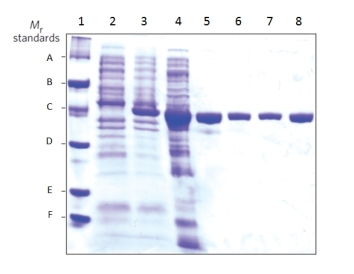
(Multiple Choice)
5.0/5 (85)
(85) In the amino acid glycine, what effect does the positively charged -NH3+ group have on the pKa of an amino acid's -COOH group?
(Short Answer)
4.9/5 (90)
(90) What factors would make it difficult to interpret the results of a gel electrophoresis of proteins in the absence of sodium dodecyl sulfate (SDS)?
(Short Answer)
4.8/5 (74)
(74) 
Filters
- Essay(0)
- Multiple Choice(0)
- Short Answer(0)
- True False(0)
- Matching(0)