



 Chat with AI
Exam 14: Glycolysis, Gluconeogenesis, and the Pentose Phosphate Pathway

Exam 1: The Foundations of Biochemistry109 Questions
Exam 2: Water87 Questions
Exam 3: Amino Acids, Peptides, and Proteins112 Questions
Exam 4: The Three-Dimensional Structure of Proteins100 Questions
Exam 5: Protein Function101 Questions
Exam 6: Enzymes106 Questions
Exam 7: Carbohydrates and Glycobiology109 Questions
Exam 8: Nucleotides and Nucleic Acids98 Questions
Exam 9: DNA-Based Information Technologies102 Questions
Exam 10: Lipids102 Questions
Exam 11: Biological Membranes and Transport105 Questions
Exam 12: Biosignaling98 Questions
Exam 13: Bioenergetics and Biochemical Reaction Types105 Questions
Exam 14: Glycolysis, Gluconeogenesis, and the Pentose Phosphate Pathway112 Questions
Exam 15: Principles of Metabolic Regulation101 Questions
Exam 16: The Citric Acid Cycle105 Questions
Exam 17: Fatty Acid Catabolism97 Questions
Exam 18: Amino Acid Oxidation and the Production of Urea98 Questions
Exam 19: Oxidative Phosphorylation and Photophosphorylation96 Questions
Exam 20: Carbohydrate Biosynthesis in Plants and Bacteria94 Questions
Exam 21: Lipid Biosynthesis100 Questions
Exam 22: Biosynthesis of Amino Acids, Nucleotides, and Related Molecules98 Questions
Exam 23: Hormonal Regulation and Integration of Mammalian Metabolism100 Questions
Exam 24: Genes and Chromosomes99 Questions
Exam 25: DNA Metabolism101 Questions
Exam 26: RNA Metabolism101 Questions
Exam 27: Protein Metabolism99 Questions
Exam 28: Regulation of Gene Expression99 Questions
Select questions type


What is the net yield of ATP produced by the anaerobic fermentation of one molecule of sucrose in myocytes?

Free
(Multiple Choice)
4.8/5  (77)
(77) Correct Answer: Verified
C
Which statement describes the activity of hexokinase I CORRECTLY?
Free
(Multiple Choice)
4.8/5 (72)
(72) Correct Answer:Verified
VerifiedD
Which statement about the pentose phosphate pathway is CORRECT?
Free
(Multiple Choice)
4.8/5 (80)
(80) Correct Answer:Verified
VerifiedE
Explain why a mutation in the gene for fructose 1,6-bisphosphatase in the liver maybe associated with metabolic acidosis.
(Essay)
4.8/5 (83)
(83) In an anaerobic muscle preparation, lactate formed from glucose labeled in C-3 and C-4 would be labeled in:
(Multiple Choice)
4.9/5 (77)
(77) In a tissue that metabolizes glucose via the pentose phosphate pathway, C-1 of glucose would be expected to end up principally in:
(Multiple Choice)
4.8/5 (77)
(77) What is the energetic cost of running the Cori cycle per glucose molecule?
(Multiple Choice)
4.8/5 (80)
(80) Which enzyme catalyzes an energy-capture reaction in glycolysis?
(Multiple Choice)
4.8/5 (82)
(82) Which reaction in glycolysis is a ketose to aldose isomerization?
(Multiple Choice)
4.8/5 (78)
(78) Which process is NOT involved in the steps of glycolysis between glyceraldehyde 3-phosphate and 3-phosphoglycerate?
(Multiple Choice)
4.8/5 (76)
(76) Define "fermentation" and explain, by describing relevant reactions, how it differs from glycolysis. Your explanation should include a discussion of the role of NADH in the reaction(s).
(Essay)
4.8/5 (79)
(79) In an anaerobic muscle preparation, lactate formed from glucose labeled in C-2 would be labeled in:
(Multiple Choice)
4.8/5 (70)
(70) An extract of adipose (fat) tissue can metabolize glucose to CO2. When glucose labeled with 14C in either C-1 or C-6 was added to the extract, 14CO2 was released with the time courses shown below. What is the major path of glucose oxidation in this extract? Explain how you reached this conclusion. 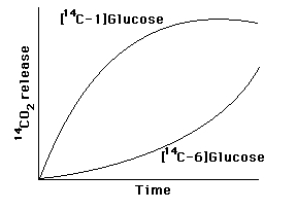
(Not Answered)
This question doesn't have any answer yet
The bacterium E. coli can grow in a medium in which the only carbon source is glucose. How does this organism obtain ribose 5-phosphate for the synthesis of ATP? (Do not describe ATP synthesis, just the origin of ribose 5-phosphate.) Show structures and indicate where cofactors participate.
(Short Answer)
4.8/5 (79)
(79) What is the general name for an enzyme that catalyzes an intramolecular phosphoryl shift?
(Multiple Choice)
4.8/5 (88)
(88) What are the two reactions in glycolysis in which aldose to ketose isomerization is catalyzed by an enzyme? For both reactions the G'° is positive. Briefly explain how the reactions are able to proceed without the input of additional energy.
(Short Answer)
4.8/5 (66)
(66) The metabolic function of the pentose phosphate pathway is to:
(Multiple Choice)
4.9/5 (77)
(77) What are the biological functions of the pentose phosphate pathway?
(Short Answer)
5.0/5 (87)
(87) What is gluconeogenesis, and what useful purposes does it serve in people?
(Essay)
4.8/5 (76)
(76) Glucose breakdown in certain mammalian and bacterial cells can occur by mechanisms other than classic glycolysis. In most of these, glucose 6-phosphate is oxidized to 6-phosphogluconate, which is then further metabolized by:
(Multiple Choice)
4.9/5 (80)
(80) 
Filters
- Essay(0)
- Multiple Choice(0)
- Short Answer(0)
- True False(0)
- Matching(0)