



 Chat with AI
Exam 2: Water


Ice is _____ than water because _____.

 (60)
 Verified
B
Which statement about buffers is TRUE?
(84) VerifiedB
Briefly define "isotonic," "hypotonic," and "hypertonic" solutions. (b) Describe what happens when a cell is placed in each of these types of solutions.
(66)  Answered by Examlex AI Copilot
(a) Definitions:
- Isotonic Solution: An isotonic solution is one where the concentration of solutes is equal both inside and outside the cell. This results in no net movement of water across the cell membrane, maintaining the cell's shape and volume.
- Hypotonic Solution: A hypotonic solution has a lower concentration of solutes compared to the inside of the cell. This causes water to move into the cell by osmosis, potentially leading to cell swelling and possibly bursting if the influx is excessive.
- Hypertonic Solution: A hypertonic solution has a higher concentration of solutes than the inside of the cell. This causes water to move out of the cell, leading to cell shrinkage or crenation as the cell loses water.
(b) Cellular Response in Different Solutions:
- In an Isotonic Solution: When a cell is placed in an isotonic solution, there is no net movement of water into or out of the cell. The cell remains in equilibrium with its environment, and its shape and volume are maintained. This is the ideal situation for most cells, as it does not disrupt their normal function.
- In a Hypotonic Solution: When a cell is placed in a hypotonic solution, water enters the cell due to the higher solute concentration inside the cell compared to the surrounding solution. As water flows into the cell, it swells and may eventually burst in a process called lysis if the cell wall is not strong enough to withstand the pressure. This is particularly a concern for animal cells, which lack a rigid cell wall. Plant cells, on the other hand, have a cell wall that provides structural support and prevents them from bursting, though they may become turgid, which is a healthy state for plant cells.
- In a Hypertonic Solution: When a cell is placed in a hypertonic solution, water moves out of the cell to the surrounding solution where the solute concentration is higher. This results in the cell shrinking or crenating. In plant cells, this can lead to plasmolysis, where the cell membrane pulls away from the cell wall as the cell loses water. This can be detrimental to the cell, as it can impair cellular processes and may lead to cell death if the dehydration is severe.
According to the titration curve to the right, acid A is _____ because the pH _____. 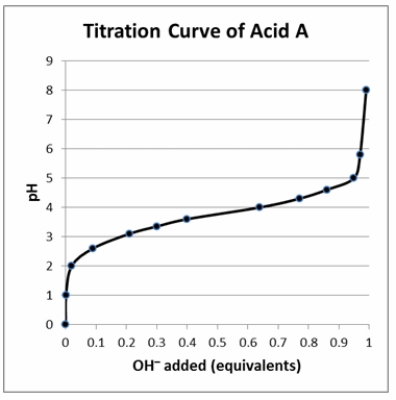
(80) A 1.0 M solution of a compound with 2 ionizable groups (pKa's = 6.2 and 9.5; 100 mL total) has a pH of 6.8. If a biochemist adds 60 mL of 1.0 M HCl to this solution, the solution will change to pH:
(70) Which of the following would have the GREATEST effect on osmotic pressure?
(90) Which property of water has had the MOST profound consequence for aquatic organisms?
(91) The high degree of cohesion of water molecules influences which processe?
(89) Which statement does NOT describe a reason that water can act as a heat buffer for cells and organisms?
(86) Which statement does NOT describe a strategy used by multicellular animals to maintain osmotic balance with their surroundings?
(81) Explain the fact that triethylammonium chloride ((CH3CH2)3N-HCl) is more soluble in water than is triethylamine ((CH3CH2)3N).
(67) For each of the pairs below, circle the conjugate base.
RCOOH
RCOO-
RNH2
RNH3+
H2PO4-
H3PO4
H2CO3
HCO3-
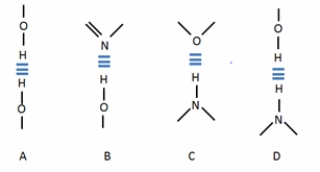
(80) 
Ibuprofen is a weak acid with a pKa of 4.9 (shown with the ionizable hydrogen with a star). It is absorbed through the stomach and the small intestine as a function of polarity-charged and very polar molecules are absorbed slowly; neutral hydrophobic molecules absorb quickly. If the stomach pH is about 1.5 and the small intestine pH is about 6, where (and why) will more ibuprofen be absorbed into the bloodstream? 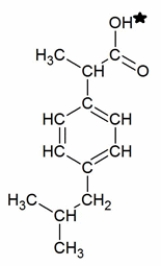
(79) Which statement about biologically important gases is TRUE?
(74) Which result influences the lower limit for an atom's van der Waals radius?
(65) A compound has a pKa of 7.4. To 100 mL of a 1.0 M solution of this compound at pH 8.0 is added 30 mL of 1.0 M hydrochloric acid. The resulting solution is pH:
(67) The OH- concentration of a solution is 4.3 × 10⁻¹⁰ M. What is the pH?
(87) 
Filters
- Essay(0)
- Multiple Choice(0)
- Short Answer(0)
- True False(0)
- Matching(0)