



 Chat with AI
Exam 17: Fatty Acid Catabolism

Exam 1: The Foundations of Biochemistry109 Questions
Exam 2: Water87 Questions
Exam 3: Amino Acids, Peptides, and Proteins112 Questions
Exam 4: The Three-Dimensional Structure of Proteins100 Questions
Exam 5: Protein Function101 Questions
Exam 6: Enzymes106 Questions
Exam 7: Carbohydrates and Glycobiology109 Questions
Exam 8: Nucleotides and Nucleic Acids98 Questions
Exam 9: DNA-Based Information Technologies102 Questions
Exam 10: Lipids102 Questions
Exam 11: Biological Membranes and Transport105 Questions
Exam 12: Biosignaling98 Questions
Exam 13: Bioenergetics and Biochemical Reaction Types105 Questions
Exam 14: Glycolysis, Gluconeogenesis, and the Pentose Phosphate Pathway112 Questions
Exam 15: Principles of Metabolic Regulation101 Questions
Exam 16: The Citric Acid Cycle105 Questions
Exam 17: Fatty Acid Catabolism97 Questions
Exam 18: Amino Acid Oxidation and the Production of Urea98 Questions
Exam 19: Oxidative Phosphorylation and Photophosphorylation96 Questions
Exam 20: Carbohydrate Biosynthesis in Plants and Bacteria94 Questions
Exam 21: Lipid Biosynthesis100 Questions
Exam 22: Biosynthesis of Amino Acids, Nucleotides, and Related Molecules98 Questions
Exam 23: Hormonal Regulation and Integration of Mammalian Metabolism100 Questions
Exam 24: Genes and Chromosomes99 Questions
Exam 25: DNA Metabolism101 Questions
Exam 26: RNA Metabolism101 Questions
Exam 27: Protein Metabolism99 Questions
Exam 28: Regulation of Gene Expression99 Questions
Select questions type


Which compound is NOT considered a "ketone body"?

Free
(Multiple Choice)
4.9/5  (75)
(75) Correct Answer: Verified
D
Which statement(s) about lipases is/are TRUE?
1. Intestinal lipases break down lipids in micelles found in the small intestine.
2. Hormone-sensitive lipase is located primarily in hepatocytes.
3. Lipoprotein lipase is activated in capillaries by apoC-II.
4. Lipoprotein lipase delivers free fatty acids to peripheral tissues.
Free
(Multiple Choice)
4.9/5 (76)
(76) Correct Answer:Verified
VerifiedD
Free fatty acids in the bloodstream are:
Free
(Multiple Choice)
4.8/5 (69)
(69) Correct Answer:Verified
VerifiedB
In the following equation, which substance is being reduced? 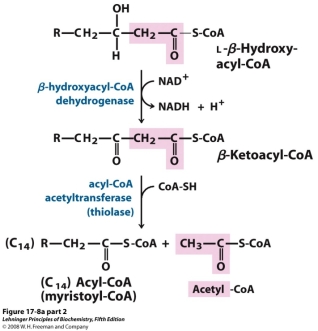
(Multiple Choice)
4.9/5 (66)
(66) What are the two major sites in animals for fatty acid catabolism?
(Multiple Choice)
4.9/5 (89)
(89) In the citric acid cycle, a double bond is introduced into a four-carbon compound containing the -CH2-CH2- group, producing fumarate. Show a similar reaction that occurs in the -oxidation pathway.
(Short Answer)
5.0/5 (77)
(77) Which statement is FALSE regarding the catabolic oxidation of 1 mol of palmitate?
(Multiple Choice)
4.8/5 (78)
(78) An experimenter studying the oxidation of fatty acids in extracts of liver found that when palmitate (16:0) was provided as substrate, it was completely oxidized to CO2. However, when undecanoic acid (11:0) was added as substrate, incomplete oxidation occurred unless he bubbled CO2 through the reaction mixture. The addition of the protein avidin, which binds tightly to biotin, prevented the complete oxidation of undecanoic acid even in the presence of CO2, although it had no effect on palmitate oxidation. Explain these observations in light of what you know of fatty acid oxidation reactions.
(Essay)
4.8/5 (85)
(85) The carbon atoms from a fatty acid with an odd number of carbons will enter the citric acid cycle as acetyl-CoA and:
(Multiple Choice)
4.7/5 (66)
(66) What products from the oxidation of odd-numbered fatty acids enter the citric acid cycle?
(Multiple Choice)
4.8/5 (90)
(90) Explain why lipases are required in BOTH the intestine and in the bloodstream.
(Essay)
4.8/5 (76)
(76) Why is it more efficient to store energy as lipid, rather than as glycogen?
(Short Answer)
4.8/5 (73)
(73) In which cellular compartment are ketone bodies synthesized?
(Multiple Choice)
4.9/5 (73)
(73) If you received a laboratory report showing the presence of a high concentration of ketone bodies in the urine of a patient, what disease would you suspect? Why do ketone bodies accumulate in such patients?
(Short Answer)
5.0/5 (81)
(81) How much carbon dioxide is produced from the complete aerobic catabolism of one molecule of linoleate via catabolic pathways?
(Multiple Choice)
4.8/5 (86)
(86) In solution at pH 6.5, palmitate has an overall negative charge. This means that the pKa of palmitate is:
(Multiple Choice)
4.9/5 (89)
(89) If the fatty acid 16:0 is catabolized completely, to carbon dioxide and water, the net yield of ATP per molecule of fatty acid is _____ ATP.
(Multiple Choice)
4.8/5 (76)
(76) In the first step of fatty acid oxidation, the fatty acid (R-COOH) is converted to its coenzyme A derivative in the following reaction:
R-COOH + ATP + CoA-SH R-CO-S-CoA + AMP + PPi
The standard free-energy change ( G'°) for this reaction is -15 kJ/mol
What will tend to make the reaction even more favorable when it takes place within a cell?
(Short Answer)
4.9/5 (73)
(73) 
Filters
- Essay(0)
- Multiple Choice(0)
- Short Answer(0)
- True False(0)
- Matching(0)