



 Chat with AI
Exam 8: Nucleotides and Nucleic Acids

Exam 1: The Foundations of Biochemistry109 Questions
Exam 2: Water87 Questions
Exam 3: Amino Acids, Peptides, and Proteins112 Questions
Exam 4: The Three-Dimensional Structure of Proteins100 Questions
Exam 5: Protein Function101 Questions
Exam 6: Enzymes106 Questions
Exam 7: Carbohydrates and Glycobiology109 Questions
Exam 8: Nucleotides and Nucleic Acids98 Questions
Exam 9: DNA-Based Information Technologies102 Questions
Exam 10: Lipids102 Questions
Exam 11: Biological Membranes and Transport105 Questions
Exam 12: Biosignaling98 Questions
Exam 13: Bioenergetics and Biochemical Reaction Types105 Questions
Exam 14: Glycolysis, Gluconeogenesis, and the Pentose Phosphate Pathway112 Questions
Exam 15: Principles of Metabolic Regulation101 Questions
Exam 16: The Citric Acid Cycle105 Questions
Exam 17: Fatty Acid Catabolism97 Questions
Exam 18: Amino Acid Oxidation and the Production of Urea98 Questions
Exam 19: Oxidative Phosphorylation and Photophosphorylation96 Questions
Exam 20: Carbohydrate Biosynthesis in Plants and Bacteria94 Questions
Exam 21: Lipid Biosynthesis100 Questions
Exam 22: Biosynthesis of Amino Acids, Nucleotides, and Related Molecules98 Questions
Exam 23: Hormonal Regulation and Integration of Mammalian Metabolism100 Questions
Exam 24: Genes and Chromosomes99 Questions
Exam 25: DNA Metabolism101 Questions
Exam 26: RNA Metabolism101 Questions
Exam 27: Protein Metabolism99 Questions
Exam 28: Regulation of Gene Expression99 Questions
Select questions type


The double helix of DNA in the B-form is stabilized by:

Free
(Multiple Choice)
4.9/5  (72)
(72) Correct Answer: Verified
D
In living cells, nucleotides and their derivatives can serve as:
Free
(Multiple Choice)
4.9/5 (81)
(81) Correct Answer:Verified
VerifiedE
In the Watson-Crick model for the DNA double helix, which statement is NOT true?
Free
(Multiple Choice)
4.9/5 (74)
(74) Correct Answer:Verified
VerifiedD
Which statement describes a function of the addition of methyl groups to DNA?
(Multiple Choice)
4.7/5 (85)
(85) What is the MOST likely length of an mRNA that will code for a polypeptide with 150 amino acids?
(Multiple Choice)
4.7/5 (70)
(70) Hoogsteen base-pairing occurs when a third strand of DNA binds along the _____ of a double helix of DNA.
(Multiple Choice)
4.9/5 (88)
(88) The ribonucleotide polymer (5')GTGATCAAGC(3') could only form a double-stranded structure with:
(Multiple Choice)
4.8/5 (75)
(75) Why does lowering the ionic strength of a solution of double-stranded DNA permit the DNA to denature more readily (for example, to denature at a lower temperature than at a higher ionic strength)?
(Short Answer)
4.9/5 (75)
(75) B-form DNA in vivo is a _____-handed helix, _____ Å in diameter, with a rise of _____ Å per base pair.
(Multiple Choice)
5.0/5 (75)
(75) Which single-stranded nucleic acid could form a hairpin structure?
(Multiple Choice)
4.9/5 (85)
(85) In the laboratory, several factors are known to cause alteration of the chemical structure of DNA. The factor(s) likely to be important in a living cell is/are:
(Multiple Choice)
4.8/5 (80)
(80) 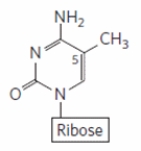
Which statement is NOT true about base stacking when nucleic acids are in a double-stranded conformation?
(Multiple Choice)
4.7/5 (75)
(75) For the helix in double-stranded B-form DNA, the majority of the stability can be attributed to:
(Multiple Choice)
4.9/5 (76)
(76) Describe briefly how noncovalent interactions contribute to the three-dimensional shapes of RNA molecules.
(Essay)
4.7/5 (71)
(71) The experiment of Avery, MacLeod, and McCarty in which nonvirulent bacteria were made virulent by transformation was significant because it showed that:
(Multiple Choice)
4.9/5 (81)
(81) What is the approximate length of a DNA molecule (in the B form) containing 10,000 base pairs?
(Short Answer)
4.9/5 (86)
(86) The composition (mole fraction) of one of the strands of a double-helical DNA is [A] = 0.3, and [G] = 0.24. Calculate the following, if possible. If impossible, write "I."
For the same strand:
[T] = (a) ____
[C] = (b) ____
[T] + [C] = (c) ____
For the other strand:
[A] = (d) ____
[T] = (e) ____
[A] + [T] = (f) ____
[G] = (g) ____
[C] = (h) ____
[G] + [C] = (i) ____
(Short Answer)
4.9/5 (77)
(77) In a double-stranded nucleic acid, cytosine typically base-pairs with:
(Multiple Choice)
4.9/5 (86)
(86) 
Filters
- Essay(0)
- Multiple Choice(0)
- Short Answer(0)
- True False(0)
- Matching(0)