



 Chat with AI
Exam 8: Nucleotides and Nucleic Acids

Exam 1: The Foundations of Biochemistry109 Questions
Exam 2: Water87 Questions
Exam 3: Amino Acids, Peptides, and Proteins112 Questions
Exam 4: The Three-Dimensional Structure of Proteins100 Questions
Exam 5: Protein Function101 Questions
Exam 6: Enzymes106 Questions
Exam 7: Carbohydrates and Glycobiology109 Questions
Exam 8: Nucleotides and Nucleic Acids98 Questions
Exam 9: DNA-Based Information Technologies102 Questions
Exam 10: Lipids102 Questions
Exam 11: Biological Membranes and Transport105 Questions
Exam 12: Biosignaling98 Questions
Exam 13: Bioenergetics and Biochemical Reaction Types105 Questions
Exam 14: Glycolysis, Gluconeogenesis, and the Pentose Phosphate Pathway112 Questions
Exam 15: Principles of Metabolic Regulation101 Questions
Exam 16: The Citric Acid Cycle105 Questions
Exam 17: Fatty Acid Catabolism97 Questions
Exam 18: Amino Acid Oxidation and the Production of Urea98 Questions
Exam 19: Oxidative Phosphorylation and Photophosphorylation96 Questions
Exam 20: Carbohydrate Biosynthesis in Plants and Bacteria94 Questions
Exam 21: Lipid Biosynthesis100 Questions
Exam 22: Biosynthesis of Amino Acids, Nucleotides, and Related Molecules98 Questions
Exam 23: Hormonal Regulation and Integration of Mammalian Metabolism100 Questions
Exam 24: Genes and Chromosomes99 Questions
Exam 25: DNA Metabolism101 Questions
Exam 26: RNA Metabolism101 Questions
Exam 27: Protein Metabolism99 Questions
Exam 28: Regulation of Gene Expression99 Questions
Select questions type


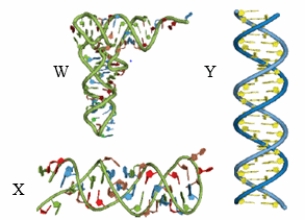

A next-generation method of DNA sequencing, 454 sequencing, uses pyrosequencing in which the addition of nucleotides is detected by a:
(Multiple Choice)
4.8/5  (96)
(96) Define short tandem repeat (STR) and explain briefly how an STR locus can be used to convict or acquit criminal suspects or provide paternity information.
(Short Answer)
4.8/5 (79)
(79) Which type of damage to DNA structure is MOST likely to be caused by UV light?
(Multiple Choice)
4.8/5 (86)
(86) How are a nucleoside and a nucleotide similar and how are they different?
(Essay)
4.8/5 (64)
(64) Mouse DNA hybridizes more extensively with human DNA than with yeast DNA. Explain by describing the factor or factors that determine extent of hybridization.
(Essay)
4.7/5 (83)
(83) When double-stranded DNA is heated at neutral pH, which change does NOT occur?
(Multiple Choice)
4.8/5 (72)
(72) The image below shows a Sanger DNA sequencing gel where one ingredient was left out of all sequencing reactions. The top of the gel is the anode and the bottom of the gel is the cathode. The gel was turned on and ran correctly. What is the MOST likely missing ingredient? 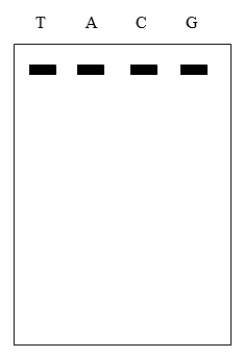
(Multiple Choice)
4.8/5 (71)
(71) Triple-helical DNA structures can result from Hoogsteen (non Watson-Crick) interactions. These interactions are primarily:
(Multiple Choice)
4.8/5 (79)
(79) In the Watson-Crick model of DNA structure (now called B-form DNA):
(Multiple Choice)
4.8/5 (81)
(81) One of the MOST common regulatory second messengers in cells is:
(Multiple Choice)
4.9/5 (88)
(88) The compound that consists of ribose linked by an N-glycosidic bond to N-9 of adenine is:
(Multiple Choice)
4.8/5 (81)
(81) In one sentence, identify the most obvious structural difference between A-form (Watson-Crick) DNA and Z-form DNA.
(Short Answer)
4.7/5 (75)
(75) DNA is _____ chemically stable than RNA due to the _____ on _____.
(Multiple Choice)
4.8/5 (79)
(79) Describe briefly what is meant by saying that two DNA strands are complementary.
(Short Answer)
4.8/5 (88)
(88) The chemical moiety of nucleotides that allows quantification of concentration via UV absorbance is the:
(Multiple Choice)
4.8/5 (74)
(74) 
Filters
- Essay(0)
- Multiple Choice(0)
- Short Answer(0)
- True False(0)
- Matching(0)