



 Chat with AI
Exam 21: Lipid Biosynthesis


The enzyme system for adding double bonds to saturated fatty acids does NOT require:

 (84)
 Verified
B
Explain briefly why we require fats in our diets.
(84)  Answered by Examlex AI Copilot
Fats are an essential part of our diets for several reasons:
1. Energy Source: Fats are a concentrated source of energy, providing more than double the energy per gram compared to carbohydrates and proteins (9 kcal per gram for fats versus 4 kcal per gram for carbs and proteins). This makes them an important fuel source, especially for long-term and moderate to low-intensity exercise.
2. Essential Fatty Acids: Our bodies cannot synthesize certain fatty acids, such as omega-3 and omega-6 fatty acids, which are therefore termed "essential." These must be obtained from our diet and are crucial for various bodily functions, including the development and functioning of the brain and nervous system, regulation of blood pressure, and proper thyroid and adrenal activity.
3. Absorption of Fat-Soluble Vitamins: Fats help in the absorption of fat-soluble vitamins (A, D, E, and K) from the diet. These vitamins are vital for processes such as vision, bone health, antioxidant functions, and blood coagulation.
4. Cell Membrane Integrity: Fats are important components of cell membranes, helping to maintain the structure and fluidity of cells. They also play a role in cell signaling and the regulation of substances moving in and out of cells.
5. Insulation and Protection: Body fat provides insulation to help maintain body temperature, and it also cushions and protects vital organs.
6. Satiety and Flavor: Fats contribute to the feeling of fullness after eating (satiety) and enhance the flavor and texture of foods, which makes meals more satisfying.
While fats are essential, it is important to consume them in moderation and to choose healthier fats, such as those found in fish, nuts, seeds, avocados, and olive oil, over unhealthy fats like trans fats and excessive saturated fats found in many processed and fried foods. Balancing fat intake with other nutrients and maintaining an overall healthy diet is key to good health.
CDP-diglyceride is NOT involved in the biosynthesis of:
(76) VerifiedE
What effect will the presence of citrate have on the activity of acetyl-CoA carboxylase in mammals?
(77) A strategy that is NOT employed in the synthesis of phospholipids is:
(93) Which compound is NOT synthesized by a pathway that includes isoprene precursors?
(87) The synthetic compound mevinolinic acid, also called lovastatin, is a potent competitive inhibitor of HMG-CoA reductase (hydroxymethylglutaryl-CoA reductase). Predict and explain the effect of this drug on serum cholesterol levels in humans.
(68) If you start with acetyl-CoA labeled with 14C in the methyl-carbon, where does the label end up in malonyl-CoA?
(87) What is the source of the polar headgroup in the formation of sphingomyelin?
(92) Describe (briefly) two classes of genetic defects in humans that could produce an elevated blood serum cholesterol level.
(86) The synthesis of fatty acids and their breakdown by oxidation occur by separate pathways. Compare the two paths by filling in the blanks below. (Some blanks may require more than one answer.)

(96) Conversion of VLDL into LDL is associated with what changes?
(84) What are plasma lipoproteins? What is their general role in mammalian metabolism?
(58) Synthesis of phosphatidyl-choline from choline and diacylglycerol in mammals requires which nucleotides as other substrates?
(84) Which phospholipase is critical for eicosanoid synthesis and why?
(74) Describe the formation of farnesyl pyrophosphate from activated isoprenyl units.
(88) Shown below is a molecule of squalene, which is composed of six isoprene units. Draw lines to indicate the junctions between the six isoprene units. 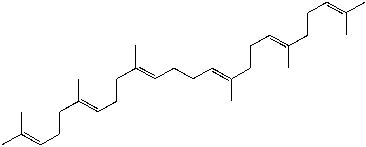

Filters
- Essay(0)
- Multiple Choice(0)
- Short Answer(0)
- True False(0)
- Matching(0)