



 Chat with AI
Exam 8: Nucleotides and Nucleic Acids

Exam 1: The Foundations of Biochemistry109 Questions
Exam 2: Water87 Questions
Exam 3: Amino Acids, Peptides, and Proteins112 Questions
Exam 4: The Three-Dimensional Structure of Proteins100 Questions
Exam 5: Protein Function101 Questions
Exam 6: Enzymes106 Questions
Exam 7: Carbohydrates and Glycobiology109 Questions
Exam 8: Nucleotides and Nucleic Acids98 Questions
Exam 9: DNA-Based Information Technologies102 Questions
Exam 10: Lipids102 Questions
Exam 11: Biological Membranes and Transport105 Questions
Exam 12: Biosignaling98 Questions
Exam 13: Bioenergetics and Biochemical Reaction Types105 Questions
Exam 14: Glycolysis, Gluconeogenesis, and the Pentose Phosphate Pathway112 Questions
Exam 15: Principles of Metabolic Regulation101 Questions
Exam 16: The Citric Acid Cycle105 Questions
Exam 17: Fatty Acid Catabolism97 Questions
Exam 18: Amino Acid Oxidation and the Production of Urea98 Questions
Exam 19: Oxidative Phosphorylation and Photophosphorylation96 Questions
Exam 20: Carbohydrate Biosynthesis in Plants and Bacteria94 Questions
Exam 21: Lipid Biosynthesis100 Questions
Exam 22: Biosynthesis of Amino Acids, Nucleotides, and Related Molecules98 Questions
Exam 23: Hormonal Regulation and Integration of Mammalian Metabolism100 Questions
Exam 24: Genes and Chromosomes99 Questions
Exam 25: DNA Metabolism101 Questions
Exam 26: RNA Metabolism101 Questions
Exam 27: Protein Metabolism99 Questions
Exam 28: Regulation of Gene Expression99 Questions
Select questions type


Which statement is TRUE of the pentoses found in nucleic acids?
(Multiple Choice)
4.8/5  (74)
(74) A tetraplex of DNA is MOST likely to form with which residue?
(Multiple Choice)
4.8/5 (77)
(77) The image below shows a DNA sequencing gel using the Sanger method. The top of the gel is the anode and the bottom is the cathode. What is the sequence of the template DNA? 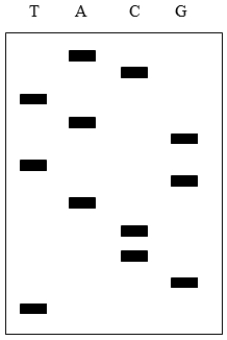
(Multiple Choice)
4.9/5 (76)
(76) The MOST striking difference between A-, B-, and Z-form DNA is that:
(Multiple Choice)
4.9/5 (90)
(90) In comparison with DNA-DNA double helices, the stability of DNA-RNA and RNA-RNA helices is:
(Multiple Choice)
5.0/5 (71)
(71) The scientists who used x-ray crystallography to shed light on the three-dimensional structure of DNA were:
(Multiple Choice)
4.8/5 (85)
(85) In nucleotides and nucleic acids, syn and anti conformations relate to:
(Multiple Choice)
4.9/5 (73)
(73) A) Explain the similarities and differences between monocistronic and polycistronic mRNAs.
B) State the domains (Bacteria, Archaea, Eukaryota) in which these types of mRNAs may be found.
(Essay)
4.8/5 (72)
(72) Write a double-stranded DNA sequence containing a six-nucleotide palindrome.
(Essay)
4.8/5 (84)
(84) A pyrimidine is joined covalently to the pentose sugar through the:
(Multiple Choice)
4.8/5 (77)
(77) Which base compositions for single-stranded RNA are possible? %A
%G
%C
%T
%U
(Multiple Choice)
4.8/5 (84)
(84) The chemical difference between a nucleotide and a nucleoside is that:
(Multiple Choice)
4.8/5 (78)
(78) Which of the following would have the HIGHEST melting temperature?
(Multiple Choice)
5.0/5 (78)
(78) Describe qualitatively how the tm for a double-stranded DNA depends on its nucleotide composition.
(Essay)
4.9/5 (84)
(84) Match the type of bond with the role below:
Bond type
Role
(a) phosphodiester
___ links base to pentose in nucleotide
(b) N-glycosidic
___ joins adjacent nucleotides in one strand
(c) phosphate ester
___ joins complementary nucleotides in two strands
(d) hydrogen
___ difference between a nucleoside and a nucleotide
(Essay)
4.7/5 (86)
(86) What would happen if blocking tags were NOT used in reversible terminator sequencing, a next-generation method of DNA sequencing?
(Multiple Choice)
4.9/5 (90)
(90) 
Filters
- Essay(0)
- Multiple Choice(0)
- Short Answer(0)
- True False(0)
- Matching(0)