



 Chat with AI
Exam 3: Amino Acids, Peptides, and Proteins

Exam 1: The Foundations of Biochemistry109 Questions
Exam 2: Water87 Questions
Exam 3: Amino Acids, Peptides, and Proteins112 Questions
Exam 4: The Three-Dimensional Structure of Proteins100 Questions
Exam 5: Protein Function101 Questions
Exam 6: Enzymes106 Questions
Exam 7: Carbohydrates and Glycobiology109 Questions
Exam 8: Nucleotides and Nucleic Acids98 Questions
Exam 9: DNA-Based Information Technologies102 Questions
Exam 10: Lipids102 Questions
Exam 11: Biological Membranes and Transport105 Questions
Exam 12: Biosignaling98 Questions
Exam 13: Bioenergetics and Biochemical Reaction Types105 Questions
Exam 14: Glycolysis, Gluconeogenesis, and the Pentose Phosphate Pathway112 Questions
Exam 15: Principles of Metabolic Regulation101 Questions
Exam 16: The Citric Acid Cycle105 Questions
Exam 17: Fatty Acid Catabolism97 Questions
Exam 18: Amino Acid Oxidation and the Production of Urea98 Questions
Exam 19: Oxidative Phosphorylation and Photophosphorylation96 Questions
Exam 20: Carbohydrate Biosynthesis in Plants and Bacteria94 Questions
Exam 21: Lipid Biosynthesis100 Questions
Exam 22: Biosynthesis of Amino Acids, Nucleotides, and Related Molecules98 Questions
Exam 23: Hormonal Regulation and Integration of Mammalian Metabolism100 Questions
Exam 24: Genes and Chromosomes99 Questions
Exam 25: DNA Metabolism101 Questions
Exam 26: RNA Metabolism101 Questions
Exam 27: Protein Metabolism99 Questions
Exam 28: Regulation of Gene Expression99 Questions
Select questions type


Why can only some amino acids be used to measure protein concentration based on absorption of UV light?
(Multiple Choice)
4.9/5  (76)
(76) Which type of structure refers to particularly stable arrangements of amino acid residues in a protein that give rise to recurring patterns?
(Multiple Choice)
5.0/5 (86)
(86) According to the table, size-exclusion (gel-filtration) chromatography could NOT be used to separate which protein mixture? Protein
MW
PI
A
12,500
3)2
B
13,200
5)7
C
13,500
10)5
D
25,200
6)3
E
36,900
5)8
F
78,400
6)1
(Multiple Choice)
4.9/5 (83)
(83) Conjugated proteins contain chemical substituents in addition to amino acids. List three classes of conjugated proteins and identify the type of prosthetic group associated with each one.
(Essay)
4.8/5 (82)
(82) In a mixture of the five proteins listed below, which should elute second in size-exclusion (gel- filtration) chromatography?
(Multiple Choice)
4.8/5 (74)
(74) Which of the following CORRECTLY matches the amino acid name with its one letter abbreviation?
(Multiple Choice)
4.8/5 (72)
(72) What is the structure components of Gly-Ala-Glu in the ionic form that predominates at pH 7.
(Short Answer)
4.9/5 (79)
(79) Selective precipitation of a protein from a crude extract is MOST effective by which molecule?
(Multiple Choice)
5.0/5 (80)
(80) Which type of structure describes the overall three-dimensional folding of a polypeptide?
(Multiple Choice)
5.0/5 (84)
(84) Hydrolysis of peptide bonds is an exergonic reaction. Why, then, are peptide bonds quite stable?
(Short Answer)
4.9/5 (79)
(79) By adding SDS (sodium dodecyl sulfate) during the electrophoresis of proteins, it is possible to:
(Multiple Choice)
4.9/5 (79)
(79) An octapeptide composed of four repeating glycylalanyl units has:
(Multiple Choice)
5.0/5 (83)
(83) Name two uncommon amino acids that occur in proteins. By what route do they get into proteins?
(Short Answer)
4.7/5 (84)
(84) The term specific activity differs from the term activity in that specific activity:
(Multiple Choice)
4.8/5 (90)
(90) Describe the structures of the amino acids phenylalanine and aspartate in the ionization state you would expect at pH 7.0. Why is aspartate very soluble in water, whereas phenylalanine is much less soluble?
(Essay)
4.8/5 (91)
(91) Which of the lanes in the gel below would represent an "uninduced" sample? 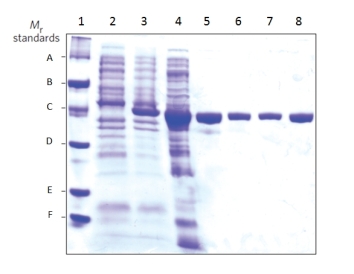
(Multiple Choice)
4.8/5 (66)
(66) The chirality of an amino acid results from the fact that its carbon:
(Multiple Choice)
4.8/5 (71)
(71) According to the diagram, which estimate is BEST of this amino acid's isoelectric point? 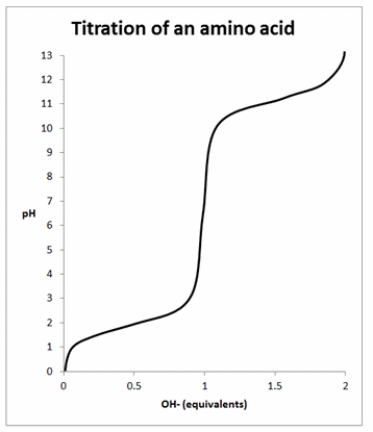
(Multiple Choice)
4.9/5 (71)
(71) The functional differences, as well as differences in three-dimensional structures, between two different enzymes from E. coli result directly from their different:
(Multiple Choice)
4.9/5 (87)
(87) 
Filters
- Essay(0)
- Multiple Choice(0)
- Short Answer(0)
- True False(0)
- Matching(0)