



 Chat with AI
Exam 3: Amino Acids, Peptides, and Proteins

Exam 1: The Foundations of Biochemistry109 Questions
Exam 2: Water87 Questions
Exam 3: Amino Acids, Peptides, and Proteins112 Questions
Exam 4: The Three-Dimensional Structure of Proteins100 Questions
Exam 5: Protein Function101 Questions
Exam 6: Enzymes106 Questions
Exam 7: Carbohydrates and Glycobiology109 Questions
Exam 8: Nucleotides and Nucleic Acids98 Questions
Exam 9: DNA-Based Information Technologies102 Questions
Exam 10: Lipids102 Questions
Exam 11: Biological Membranes and Transport105 Questions
Exam 12: Biosignaling98 Questions
Exam 13: Bioenergetics and Biochemical Reaction Types105 Questions
Exam 14: Glycolysis, Gluconeogenesis, and the Pentose Phosphate Pathway112 Questions
Exam 15: Principles of Metabolic Regulation101 Questions
Exam 16: The Citric Acid Cycle105 Questions
Exam 17: Fatty Acid Catabolism97 Questions
Exam 18: Amino Acid Oxidation and the Production of Urea98 Questions
Exam 19: Oxidative Phosphorylation and Photophosphorylation96 Questions
Exam 20: Carbohydrate Biosynthesis in Plants and Bacteria94 Questions
Exam 21: Lipid Biosynthesis100 Questions
Exam 22: Biosynthesis of Amino Acids, Nucleotides, and Related Molecules98 Questions
Exam 23: Hormonal Regulation and Integration of Mammalian Metabolism100 Questions
Exam 24: Genes and Chromosomes99 Questions
Exam 25: DNA Metabolism101 Questions
Exam 26: RNA Metabolism101 Questions
Exam 27: Protein Metabolism99 Questions
Exam 28: Regulation of Gene Expression99 Questions
Select questions type


One method used to prevent disulfide bond interference with protein sequencing procedures is:
(Multiple Choice)
4.7/5  (84)
(84) The "signature sequence" shown below represents a portion of a protein from four different organisms. The proteins can be classified as: 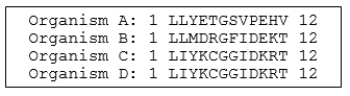
(Multiple Choice)
4.8/5 (93)
(93) Which statement is CORRECT with respect to the amino acid composition of proteins?
(Multiple Choice)
4.8/5 (88)
(88) According to the diagram, how many titratable groups does this amino acid have? 
(Multiple Choice)
4.8/5 (84)
(84) You are trying to determine the sequence of a protein that you know is pure. Give the most likely explanation for each of the following experimental observations. You may use a simple diagram for your answer.
(a) The Sanger reagent (FDNB, fluorodinitrobenzene) identifies Ala and Leu as amino-terminal residues, in roughly equal amounts.
(b) Your protein has an apparent Mr of 80,000, as determined by SDS-polyacrylamide gel electrophoresis. After treatment of the protein with performic acid, the same technique reveals two proteins of Mr 35,000 and 45,000.
(c) Size-exclusion chromatography (gel filtration) experiments indicate the native protein has an apparent Mr of 160,000.
(Essay)
4.8/5 (80)
(80) In one or two sentences, describe the usefulness of each of the following reagents or reactions in the analysis of protein structure:
(a) Edman reagent (phenylisothiocyanate)
(b) protease
(c) reducing agent (dithiothreitol or -mercaptoethanol)
(Essay)
4.9/5 (79)
(79) The uncommon amino acid selenocysteine has an R group with the structure -CH2-SeH (pKa 5). In an aqueous solution, pH = 7.0, selenocysteine would:
(Multiple Choice)
4.8/5 (74)
(74) Briefly describe the five major groupings of amino acids.
79.
A
B
C
D
E
Tyr-Lys-Met
Gly-Pro-Arg
Asp-Trp-Tyr
Asp-His-Glu
Leu-Val-Phe
Which one of the above tripeptides:
____ (a) is most negatively charged at pH 7?
____ (b) will yield DNP-tyrosine when reacted with l-fluoro-2,4-dinitrobenzene and hydrolyzed in acid?
____ (c) contains the largest number of nonpolar R groups?
____ (d) contains sulfur?
____ (e) will have the greatest light absorbance at 280 nm?
(Essay)
4.9/5 (81)
(81) The formation of a peptide bond between two amino acids is an example of a(n) _____ reaction.
(Multiple Choice)
4.7/5 (77)
(77) According to the diagram, at pH 2, what is the average net charge on this amino acid? 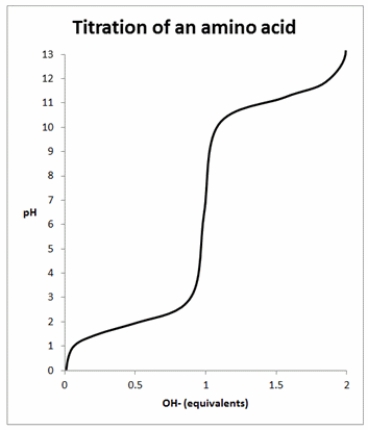
(Multiple Choice)
4.8/5 (80)
(80) How can isoelectric focusing be used in conjunction with SDS gel electrophoresis?
(Short Answer)
4.8/5 (93)
(93) How does the shape of a titration curve confirm the fact that the pH region of greatest buffering power for an amino acid solution is around its pK's?
(Short Answer)
4.8/5 (94)
(94) The structure below is a molecule used in the sweeteners Equal® and NutraSweet®. When heated, the peptide bond will hydrolyze into methanol and which two amino acids? 
(Multiple Choice)
4.8/5 (85)
(85) For each of these methods of separating proteins, describe the principle of the method, and tell what property of proteins allows their separation by this technique.
(a) ion-exchange chromatography
(b) size-exclusion (gel filtration) chromatography
(c) affinity chromatography
(Essay)
4.8/5 (81)
(81) Which pair of amino acids can be used to measure the concentration of proteins based on absorption of UV light?
(Multiple Choice)
5.0/5 (81)
(81) All of the 20 common amino acids contain an R-group that is attached to the:
(Multiple Choice)
4.8/5 (72)
(72) According to the diagram, which pH range offers the GREATEST buffering power for this amino acid? 
(Multiple Choice)
4.7/5 (74)
(74) A nonapeptide was determined to have the following amino acid composition: (Lys)2, (Gly) 2, (Phe) 2, His, Leu, Met. The native peptide was incubated with 1-fluoro-2,4-dinitrobenzene (FDNB) and then hydrolyzed; 2,4-dinitrophenylhistidine was identified by HPLC. When the native peptide was exposed to cyanogen bromide (CNBr), an octapeptide and free glycine were recovered. Incubation of the native peptide with trypsin gave a pentapeptide, a tripeptide, and free Lys. 2,4-Dinitrophenyl-histidine was recovered from the pentapeptide, and 2,4-dinitrophenylphenylalanine was recovered from the tripeptide. Digestion with the enzyme pepsin produced a dipeptide, a tripeptide, and a tetrapeptide. The tetrapeptide was composed of (Lys) 2, Phe, and Gly. The native sequence was determined to be:
(Multiple Choice)
4.9/5 (80)
(80) Why do smaller molecules elute after large molecules when a mixture of proteins is passed through a size-exclusion (gel filtration) column?
(Short Answer)
4.8/5 (91)
(91) 
Filters
- Essay(0)
- Multiple Choice(0)
- Short Answer(0)
- True False(0)
- Matching(0)