



 Chat with AI
Exam 3: Amino Acids, Peptides, and Proteins

Exam 1: The Foundations of Biochemistry109 Questions
Exam 2: Water87 Questions
Exam 3: Amino Acids, Peptides, and Proteins112 Questions
Exam 4: The Three-Dimensional Structure of Proteins100 Questions
Exam 5: Protein Function101 Questions
Exam 6: Enzymes106 Questions
Exam 7: Carbohydrates and Glycobiology109 Questions
Exam 8: Nucleotides and Nucleic Acids98 Questions
Exam 9: DNA-Based Information Technologies102 Questions
Exam 10: Lipids102 Questions
Exam 11: Biological Membranes and Transport105 Questions
Exam 12: Biosignaling98 Questions
Exam 13: Bioenergetics and Biochemical Reaction Types105 Questions
Exam 14: Glycolysis, Gluconeogenesis, and the Pentose Phosphate Pathway112 Questions
Exam 15: Principles of Metabolic Regulation101 Questions
Exam 16: The Citric Acid Cycle105 Questions
Exam 17: Fatty Acid Catabolism97 Questions
Exam 18: Amino Acid Oxidation and the Production of Urea98 Questions
Exam 19: Oxidative Phosphorylation and Photophosphorylation96 Questions
Exam 20: Carbohydrate Biosynthesis in Plants and Bacteria94 Questions
Exam 21: Lipid Biosynthesis100 Questions
Exam 22: Biosynthesis of Amino Acids, Nucleotides, and Related Molecules98 Questions
Exam 23: Hormonal Regulation and Integration of Mammalian Metabolism100 Questions
Exam 24: Genes and Chromosomes99 Questions
Exam 25: DNA Metabolism101 Questions
Exam 26: RNA Metabolism101 Questions
Exam 27: Protein Metabolism99 Questions
Exam 28: Regulation of Gene Expression99 Questions
Select questions type


As a protein is purified, both the amount of total protein and the activity of the purified protein decrease. Why, then, does the specific activity of the purified protein increase?
(Short Answer)
4.9/5  (88)
(88) According to the table, ion-exchange chromatography would be the LEAST effective method to separate which protein mixture? Protein
MW
PI
A
12,500
3)2
B
13,200
5)7
C
13,500
10)5
D
25,200
6)3
E
36,900
5)8
F
78,400
6)1
(Multiple Choice)
4.9/5 (88)
(88) Compare the following sequences taken from four different proteins, and select the answer that BEST characterizes their relationships. A
B
C
1 DVEKGKKIDIMKCS
HTVEKGGKHKTGPNLH
GLFGRKTGQAPGYSYT
2 DVQRALKIDNNLGQ
HTVEKGAKHKTAPNVH
GLADRIAYQAKATNEE
3 LVTRPLYIFPNEGQ
HTLEKAAKHKTGPNLH
ALKSSKDLMFTVINDD
4 FFMNEDALVARSSN
HQFAASSIHKNAPQFH
NLKDSKTYLKPVISET
(Multiple Choice)
4.9/5 (94)
(94) To determine the isoelectric point of a protein, first establish that a gel:
(Multiple Choice)
4.8/5 (86)
(86) A major advance in the application of mass spectrometry to macromolecules came with the development of techniques to overcome which problem?
(Multiple Choice)
5.0/5 (92)
(92) Why do amino acids, when dissolved in water, become zwitterions?
(Short Answer)
4.9/5 (87)
(87) Even when a gene is available and its sequence of nucleotides is known, chemical studies of the protein are still required to determine:
(Multiple Choice)
4.7/5 (80)
(80) Only one of the common amino acids has no free -amino group. Name this amino acid.
(Short Answer)
4.8/5 (79)
(79) What is the approximate charge difference between glutamic acid and -ketoglutarate at pH 9.5?
(Multiple Choice)
4.7/5 (86)
(86) How are "signature sequences" useful in analyzing groups of functionally related proteins?
(Short Answer)
4.9/5 (85)
(85) If protein A has a pI of 3.1, protein B has a pI of 6.8, and protein C has a pI of 8.9, which protein would elute FIRST from a cation exchange column at pH 7?
(Multiple Choice)
4.8/5 (88)
(88) As more OH- equivalents (base) are added to an amino acid solution, what titration reaction will occur around pH = 9.5?
(Short Answer)
4.7/5 (74)
(74) What is the uniquely important acid-base characteristic of the histidine R group?
(Short Answer)
4.9/5 (87)
(87) What is the pI, and how is it determined for amino acids that have nonionizable R groups?
(Short Answer)
4.8/5 (79)
(79) The following reagents are often used in protein chemistry. Match the reagent with the purpose for which it is best suited. Some answers may be used more than once or not at all; more than one reagent may be suitable for a given purpose.
(a) CNBr (cyanogen bromide)
(e) performic acid
(b) Edman reagent (phenylisothiocyanate)
(f) chymotrypsin
(c) Sanger reagent (FDNB)
(g) trypsin
(d) reducing agent (dithiothreitol)
(h) iodoacetamide
___ hydrolysis of peptide bonds on the carboxyl side of Lys and Arg
___ cleavage of peptide bonds on the carboxyl side of Met
___ breakage of disulfide (-S-S-) bonds
___ modification of sulfhydryl groups of Cys
___ determination of the amino acid sequence of a peptide
___ determining the amino-terminal amino acid in a polypeptide
(Essay)
4.8/5 (85)
(85) The amino acid histidine has three ionizable groups, with pKa values of 1.8, 6.0, and 9.2. (a) Which pKa corresponds to the histidine side chain? (b) In a solution at pH 5.4, what percentage of the histidine side chains will carry a positive charge?
(Short Answer)
4.7/5 (81)
(81) According to the diagram, does this amino acid have a titratable R-group? 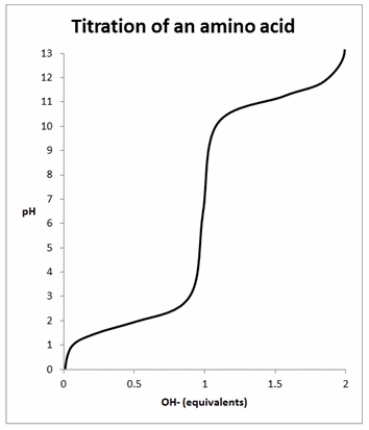
(Multiple Choice)
4.7/5 (92)
(92) 
Filters
- Essay(0)
- Multiple Choice(0)
- Short Answer(0)
- True False(0)
- Matching(0)