



 Chat with AI
Exam 13: Bioenergetics and Biochemical Reaction Types

Exam 1: The Foundations of Biochemistry109 Questions
Exam 2: Water87 Questions
Exam 3: Amino Acids, Peptides, and Proteins112 Questions
Exam 4: The Three-Dimensional Structure of Proteins100 Questions
Exam 5: Protein Function101 Questions
Exam 6: Enzymes106 Questions
Exam 7: Carbohydrates and Glycobiology109 Questions
Exam 8: Nucleotides and Nucleic Acids98 Questions
Exam 9: DNA-Based Information Technologies102 Questions
Exam 10: Lipids102 Questions
Exam 11: Biological Membranes and Transport105 Questions
Exam 12: Biosignaling98 Questions
Exam 13: Bioenergetics and Biochemical Reaction Types105 Questions
Exam 14: Glycolysis, Gluconeogenesis, and the Pentose Phosphate Pathway112 Questions
Exam 15: Principles of Metabolic Regulation101 Questions
Exam 16: The Citric Acid Cycle105 Questions
Exam 17: Fatty Acid Catabolism97 Questions
Exam 18: Amino Acid Oxidation and the Production of Urea98 Questions
Exam 19: Oxidative Phosphorylation and Photophosphorylation96 Questions
Exam 20: Carbohydrate Biosynthesis in Plants and Bacteria94 Questions
Exam 21: Lipid Biosynthesis100 Questions
Exam 22: Biosynthesis of Amino Acids, Nucleotides, and Related Molecules98 Questions
Exam 23: Hormonal Regulation and Integration of Mammalian Metabolism100 Questions
Exam 24: Genes and Chromosomes99 Questions
Exam 25: DNA Metabolism101 Questions
Exam 26: RNA Metabolism101 Questions
Exam 27: Protein Metabolism99 Questions
Exam 28: Regulation of Gene Expression99 Questions
Select questions type


E'° of the NAD+/NADH half reaction is -0.32 V. The E'° of the oxaloacetate/malate half reaction is -0.175 V. When the concentrations of NAD+, NADH, oxaloacetate, and malate are all 10-5 M, the "spontaneous" reaction is:
(Multiple Choice)
4.8/5  (76)
(76) For the reaction A B, G'° = -60 kJ/mol. The reaction is started with 10 mmol of A; no B is initially present. After 24 hours, analysis reveals the presence of 2 mmol of B, 8 mmol of A. Which statement is the MOST likely explanation?
(Multiple Choice)
4.8/5 (84)
(84) Under standard conditions, is the oxidation of NADH by free FAD sufficiently exergonic to drive the synthesis of ATP?
(Multiple Choice)
5.0/5 (79)
(79) G'° for the hydrolysis of ATP is -30.5 kJ/mol. What effect will doubling ATP concentration have on the value of G'° for ATP hydrolysis?
(Multiple Choice)
4.9/5 (81)
(81) The free energy of hydrolysis of phosphoenolpyruvate is -61.9 kJ/mol. Rationalize this large, negative value for G'° in chemical terms.
(Short Answer)
4.8/5 (87)
(87) Which statement is TRUE with respect to the change in free energy for a given reaction?
(Multiple Choice)
4.8/5 (77)
(77) glucose 6-phosphate glucose + Pi
G'° = -13.8 kJ/mol
show how you would calculate the standard free-energy change ( G'°) for the reaction:
(Short Answer)
4.9/5 (86)
(86) Lactate dehydrogenase catalyzes the reversible reaction:
pyruvate + NADH + H+ lactate + NAD+
Given the following facts (a) tell in which direction the reaction will tend to go if NAD+, NADH, pyruvate, and lactate were mixed, all at 1 M concentrations, in the presence of lactate dehydrogenase at pH 7; (b) calculate G'° for this reaction. Show your work.
NAD+ + H+ + 2e- NADH
E'° = -0.32 V
pyruvate + 2H+ + 2e- lactate
E'° = -0.19 V
The Faraday constant,  , is 96.48 kJ/V · mol.
 (Short Answer)
4.9/5 (69)
(69) Classify each of the *ed atoms as an electrophile or a nucleophile: 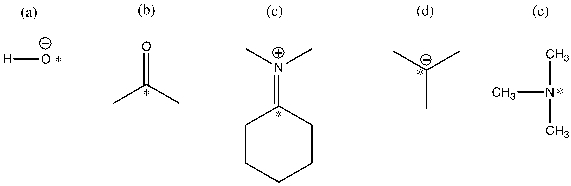
(Not Answered)
This question doesn't have any answer yet
Which statement is NOT true for the nicotinamide cofactors?
(Multiple Choice)
5.0/5 (86)
(86) _____ is used to illustrate the actual free-energy change of a reaction measured at pH 7 and 37°C.
(Multiple Choice)
4.9/5 (85)
(85) Acyl phosphates, phosphoesters, and phosphaoanhydrides are compounds of significantly different phosphoryl group-transfer potentials. Which choice CORRECTLY ranks these phosphorylated intermediates with respect to their phosphoryl group-transfer potential from highest to lowest?
(Multiple Choice)
4.9/5 (70)
(70) The phosphate bonds found in a phosphorylated tyrosine and in an acyl phosphate are likely to have similar standard free energies of hydrolysis.
(Multiple Choice)
4.7/5 (75)
(75) Which compound(s) do(es) NOT have a large negative free energy of hydrolysis?
(Multiple Choice)
4.9/5 (88)
(88) For the reaction A B, the Keq' is 104. If a reaction mixture originally contains 1 mmol of A and no B, which statement must be TRUE?
(Multiple Choice)
4.9/5 (80)
(80) For each pair of ions or compounds below, indicate which is the more highly reduced species.
(a) Co2+/Co+
(b) glucose/CO2
(c) Fe3+/Fe2+
(d) acetate/CO2
(e) ethanol/acetic acid
(f) acetic acid/acetaldehyde
(Essay)
4.9/5 (71)
(71) 
Filters
- Essay(0)
- Multiple Choice(0)
- Short Answer(0)
- True False(0)
- Matching(0)