



 Chat with AI
Exam 6: Enzymes

Exam 1: The Foundations of Biochemistry109 Questions
Exam 2: Water87 Questions
Exam 3: Amino Acids, Peptides, and Proteins112 Questions
Exam 4: The Three-Dimensional Structure of Proteins100 Questions
Exam 5: Protein Function101 Questions
Exam 6: Enzymes106 Questions
Exam 7: Carbohydrates and Glycobiology109 Questions
Exam 8: Nucleotides and Nucleic Acids98 Questions
Exam 9: DNA-Based Information Technologies102 Questions
Exam 10: Lipids102 Questions
Exam 11: Biological Membranes and Transport105 Questions
Exam 12: Biosignaling98 Questions
Exam 13: Bioenergetics and Biochemical Reaction Types105 Questions
Exam 14: Glycolysis, Gluconeogenesis, and the Pentose Phosphate Pathway112 Questions
Exam 15: Principles of Metabolic Regulation101 Questions
Exam 16: The Citric Acid Cycle105 Questions
Exam 17: Fatty Acid Catabolism97 Questions
Exam 18: Amino Acid Oxidation and the Production of Urea98 Questions
Exam 19: Oxidative Phosphorylation and Photophosphorylation96 Questions
Exam 20: Carbohydrate Biosynthesis in Plants and Bacteria94 Questions
Exam 21: Lipid Biosynthesis100 Questions
Exam 22: Biosynthesis of Amino Acids, Nucleotides, and Related Molecules98 Questions
Exam 23: Hormonal Regulation and Integration of Mammalian Metabolism100 Questions
Exam 24: Genes and Chromosomes99 Questions
Exam 25: DNA Metabolism101 Questions
Exam 26: RNA Metabolism101 Questions
Exam 27: Protein Metabolism99 Questions
Exam 28: Regulation of Gene Expression99 Questions
Select questions type


For the reaction E + S ES P the Michaelis-Menten constant, Km, is actually a summary of three terms. What are they? How is Km determined graphically?
(Essay)
4.9/5  (82)
(82) Which statement BEST describes why niacin is required in the mammalian diet?
(Multiple Choice)
4.9/5 (73)
(73) Chymotrypsin catalyzes the cleavage of proteins at peptide bonds adjacent to aromatic amino acid residues by using which catalytic mechanism?
(Multiple Choice)
4.9/5 (79)
(79) Two different enzymes are able to catalyze the same reaction, A B. They both have the same Vmax, but differ their Km the substrate A. For enzyme 1, the Km is 1.0 mM; for enzyme 2, the Km is 10 mM. When enzyme 1 was incubated with 0.1 mM A, it was observed that B was produced at a rate of 0.0020 mmoles/minute. a) What is the value of the Vmax of the enzymes? b) What will be the rate of production of B when enzyme 2 is incubated with 0.1 mM A? c) What will be the rate of production of B when enzyme 1 is incubated with 1 M (i.e., 1000 mM) A?
(Short Answer)
4.7/5 (72)
(72) The HIV protease enzyme uses a general acid-base catalysis mechanism to cleave viral polypeptides but does not use a covalent catalysis. This enzyme functions optimally in the pH range of 4-6. Due to the specific amino acids involved in this catalysis, HIV protease is a member of which subclass of proteases?
(Multiple Choice)
4.9/5 (89)
(89) An enzyme catalyzes a reaction at a velocity of 20 mol/min when the concentration of substrate (S) is 0.01 M. The Km for this substrate is 1 × 10⁻⁵ M. Assuming that Michaelis-Menten kinetics are followed, what will the reaction velocity be when the concentration of S is (a) 1 × 10⁻⁵ M and (b) 1 × 10⁻⁶ M?
(Short Answer)
4.9/5 (79)
(79) Which enzyme uses general acid-base catalysis and/or covalent catalysis mechanisms to hydrolyze peptidoglycan?
(Multiple Choice)
4.8/5 (88)
(88) The enzymatic activity of lysozyme is optimal at pH 5.2 and decreases above and below this pH value. Lysozyme contains two amino acid residues in the active site essential for catalysis: Glu35 and Asp52. The pK value for the carboxyl side chains of these two residues are 5.9 and 4.5, respectively. What is the ionization state of each residue at the pH optimum of lysozyme? How can the ionization states of these two amino acid residues explain the pH-activity profile of lysozyme?
(Essay)
4.8/5 (61)
(61) Michaelis and Menten assumed that the overall reaction for an enzyme-catalyzed reaction could be written as: 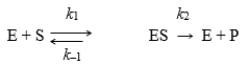 Using this reaction, the rate of breakdown of the enzyme-substrate complex can be described by the expression:
 (Multiple Choice)
4.8/5 (82)
(82) A double-reciprocal plot of 1/V0 versus 1/[S] for an enzyme in the presence of increasing concentrations of an uncompetitive inhibitor will have lines corresponding to the differentinhibitor concentrations that are BEST described by which statement?
(Multiple Choice)
4.9/5 (71)
(71) Compare the two reaction coordinate diagrams below and select the answer that CORRECTLY describes their relationship. In each case, the single intermediate is the ES complex. 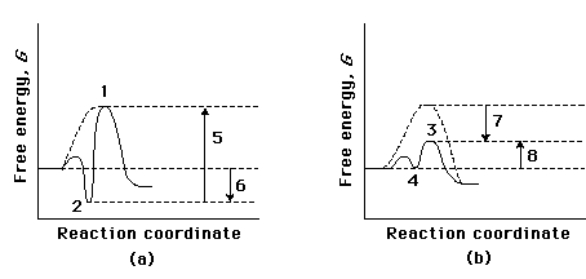
(Multiple Choice)
4.8/5 (75)
(75) If you were attempting to design a new drug for the treatment of a disease by interfering with enzyme activity in the disease-causing organism, which type of inhibitor would likely be the MOST effective?
(Multiple Choice)
4.9/5 (70)
(70) Which amino acid is NOT one that may be targeted for phosphorylation to modulate the activity of an enzyme?
(Multiple Choice)
4.7/5 (86)
(86) A biochemist obtains the following set of data for an enzyme that is known to follow Michaelis-Menten kinetics.
Substrate
Initial
concentration
velocity
( M)
( mol/min)
1
49
2
96
8
349
50
621
100
676
1,000
698
5,000
699
(a) Vmax for the enzyme is _____. Explain in one sentence how you determined Vmax.
(b) Km for the enzyme is _____. Explain in one sentence how you determined Km.
(Short Answer)
4.8/5 (81)
(81) Leucine biosynthesis occurs in a multistep pathway starting from 2-oxovalerate, and the final product of the pathway (leucine) inhibits the first enzyme involved in the biosynthetic pathway through a process called feedback inhibition. This enzyme inhibition occurs, regardless of whether or not the 2-oxovalerate substrate is bound in the active site of the enzyme. Describe what type of inhibitor leucine is and justify your response.
(Essay)
4.9/5 (87)
(87) 
Filters
- Essay(0)
- Multiple Choice(0)
- Short Answer(0)
- True False(0)
- Matching(0)