



 Chat with AI
Exam 7: Carbohydrates and Glycobiology

Exam 1: The Foundations of Biochemistry109 Questions
Exam 2: Water87 Questions
Exam 3: Amino Acids, Peptides, and Proteins112 Questions
Exam 4: The Three-Dimensional Structure of Proteins100 Questions
Exam 5: Protein Function101 Questions
Exam 6: Enzymes106 Questions
Exam 7: Carbohydrates and Glycobiology109 Questions
Exam 8: Nucleotides and Nucleic Acids98 Questions
Exam 9: DNA-Based Information Technologies102 Questions
Exam 10: Lipids102 Questions
Exam 11: Biological Membranes and Transport105 Questions
Exam 12: Biosignaling98 Questions
Exam 13: Bioenergetics and Biochemical Reaction Types105 Questions
Exam 14: Glycolysis, Gluconeogenesis, and the Pentose Phosphate Pathway112 Questions
Exam 15: Principles of Metabolic Regulation101 Questions
Exam 16: The Citric Acid Cycle105 Questions
Exam 17: Fatty Acid Catabolism97 Questions
Exam 18: Amino Acid Oxidation and the Production of Urea98 Questions
Exam 19: Oxidative Phosphorylation and Photophosphorylation96 Questions
Exam 20: Carbohydrate Biosynthesis in Plants and Bacteria94 Questions
Exam 21: Lipid Biosynthesis100 Questions
Exam 22: Biosynthesis of Amino Acids, Nucleotides, and Related Molecules98 Questions
Exam 23: Hormonal Regulation and Integration of Mammalian Metabolism100 Questions
Exam 24: Genes and Chromosomes99 Questions
Exam 25: DNA Metabolism101 Questions
Exam 26: RNA Metabolism101 Questions
Exam 27: Protein Metabolism99 Questions
Exam 28: Regulation of Gene Expression99 Questions
Select questions type


Based on the form of the cyclic sugar shown below in a Haworth projection, which Fischer projection formula could have formed this structure? 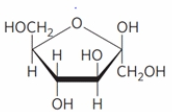
(Multiple Choice)
4.9/5  (75)
(75) (a) How many asymmetric carbons (chiral centers) does each of the anomers of glucose in the pyranose ring form structure have? (b) How many stereoisomers of the glucose are theoretically possible?
(Short Answer)
4.8/5 (66)
(66) Describe the process by which "old" serum glycoproteins are removed from the mammalian circulatory system.
(Short Answer)
4.9/5 (72)
(72) Describe the structure of a proteoglycan aggregate such as is found in the extracellular matrix.
(Essay)
5.0/5 (81)
(81) Match these molecules with their biological roles.
(a) glycogen
__ viscosity, lubrication of extracellular secretions
(b) starch
__ carbohydrate storage in plants
(c) trehalose
__ transport/storage in insects
(d) chitin
__ exoskeleton of insects
(e) cellulose
__ structural component of bacterial cell wall
(f) peptidoglycan
__ structural component of plant cell walls
(g) hyaluronate
__ extracellular matrix of animal tissues
(h) proteoglycan
__ carbohydrate storage in animal liver
(Essay)
4.9/5 (74)
(74) When forming the disaccharide maltose from two glucose monosaccharides:
(Multiple Choice)
4.8/5 (73)
(73) Which arrow CORRECTLY identifies the atom that will become the anomeric carbon? 
(Multiple Choice)
4.9/5 (68)
(68) About what percentage of mammalian proteins are glycosylated?
(Multiple Choice)
4.9/5 (80)
(80) Identify all the epimeric pairs in the structures shown below. 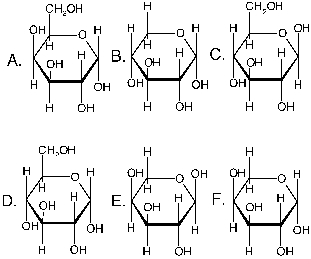
(Not Answered)
This question doesn't have any answer yet
Explain in molecular terms why humans cannot use cellulose as a nutrient, but goats and cattle can.
(Essay)
4.9/5 (84)
(84) Which pair is interconverted in the process of mutarotation?
(Multiple Choice)
4.7/5 (80)
(80) _____ is the determination of the full component and function of sugar-containing molecules in a cell or tissue.
(Multiple Choice)
4.7/5 (78)
(78) Define "reducing sugar." (b) Show the reaction product of glucose after it is used as a reducing sugar. (c) Explain why fructose is also considered a reducing sugar. (Hint: It must first undergo a chemical conversion.) (d) Sucrose is a disaccharide composed of glucose and fructose (Glc( 1 2)Fru). Explain why sucrose is not a reducing sugar, even though both glucose and fructose are.
(Essay)
4.9/5 (89)
(89) The glycosaminoglycans are negatively charged at neutral pH. What components of these polymers confer the negative charge?
(Short Answer)
4.8/5 (85)
(85) Which modification CANNOT be made to a sugar molecule by an organism?
(Multiple Choice)
4.9/5 (90)
(90) Briefly explain how the drugs Tamiflu and Relenza work to prevent the flu.
(Short Answer)
4.7/5 (81)
(81) In measuring long-term glucose levels in the bloodstream, glycated hemoglobin must be separated from unmodified hemoglobin to determine the percentage of glycated hemoglobin. Suggest a simple chromatographic method by which this separation can be performed.
(Essay)
4.9/5 (74)
(74) 
Filters
- Essay(0)
- Multiple Choice(0)
- Short Answer(0)
- True False(0)
- Matching(0)