



 Chat with AI
Exam 26: Monetary Policy

Exam 1: Economics: Foundations and Models447 Questions
Exam 2: Trade-Offs, comparative Advantage, and the Market System492 Questions
Exam 3: Where Prices Come From: the Interaction of Demand and Supply476 Questions
Exam 4: Economic Efficiency, government Price Setting, and Taxes420 Questions
Exam 5: Externalities, environmental Policy, and Public Goods263 Questions
Exam 6: Elasticity: the Responsiveness of Demand and Supply294 Questions
Exam 7: The Economics of Health Care338 Questions
Exam 8: Firms,the Stock Market,and Corporate Governance522 Questions
Exam 9: Comparative Advantage and the Gains From International Trade377 Questions
Exam 10: Consumer Choice and Behavioral Economics300 Questions
Exam 11: Technology,production,and Costs327 Questions
Exam 12: Firms in Perfectly Competitive Markets296 Questions
Exam 13: Monopolistic Competition: the Competitive Model in a More Realistic Setting272 Questions
Exam 14: Oligopoly: Firms in Less Competitive Markets258 Questions
Exam 15: Monopoly and Antitrust Policy279 Questions
Exam 16: Pricing Strategy261 Questions
Exam 17: The Markets for Labor and Other Factors of Production281 Questions
Exam 18: Public Choice, taxes, and the Distribution of Income258 Questions
Exam 19: Gdp: Measuring Total Production and Income261 Questions
Exam 20: Unemployment and Inflation291 Questions
Exam 21: Economic Growth, the Financial System, and Business Cycles253 Questions
Exam 22: Long-Run Economic Growth: Sources and Policies262 Questions
Exam 23: Aggregate Expenditure and Output in the Short Run301 Questions
Exam 24: Aggregate Demand and Aggregate Supply Analysis286 Questions
Exam 25: Money,banks,and the Federal Reserve System281 Questions
Exam 26: Monetary Policy275 Questions
Exam 27: Fiscal Policy306 Questions
Exam 28: Inflation, unemployment, and Federal Reserve Policy257 Questions
Exam 29: Macroeconomics in an Open Economy278 Questions
Exam 30: The International Financial System258 Questions
Select questions type


When the Fed embarked on a policy known as quantitative easing,they
(Multiple Choice)
4.9/5  (91)
(91) With the federal funds rate near zero and the economy still struggling,In response to already low interest rates doing little to stimulate the economy,the Fed began buying 10-year Treasury notes and certain mortgage-backed securities to keep interest rates low.This policy is known as
(Multiple Choice)
4.8/5 (76)
(76) By the 2000s,an important change in the mortgage market had occurred when ________ became significant participants in the secondary market for mortgages.
(Multiple Choice)
4.9/5 (91)
(91) Inflation targeting is a framework for carrying out monetary policy whereby
(Multiple Choice)
4.9/5 (82)
(82) When calculating GDP,the Bureau of Economic Analysis revises its quarterly data
(Multiple Choice)
4.9/5 (71)
(71) Although the Federal Reserve had traditionally made discount loans only to ________,in response to the financial crisis in 2008 the Fed made primary dealers eligible for discount loans as well.
(Multiple Choice)
4.8/5 (83)
(83) The ability of the Federal Reserve to use monetary policy to affect economic variables such as real GDP ultimately depends upon its ability to affect
(Multiple Choice)
5.0/5 (81)
(81) For purposes of monetary policy,the Federal Reserve has targeted the interest rate known as the
(Multiple Choice)
4.9/5 (91)
(91) Inflation rates during the years 1979-1981 were the highest the United States has ever experienced during peacetime.
(True/False)
4.8/5 (73)
(73) Use the money demand and money supply model to show graphically and explain the effect on interest rates of the Federal Reserve's open market sale of Treasury securities.
(Essay)
4.9/5 (84)
(84) The Federal Reserve could target both the money supply and the interest rate at the same time if it controlled money demand along with money supply.
(True/False)
4.8/5 (95)
(95) Despite saving Lehman Brothers from failing,the Fed and the Treasury decided to allow Bear Stearns to go bankrupt,which it did in September,2008.
(True/False)
4.9/5 (76)
(76) Federal Reserve Board Chairmen Paul Volcker,Alan Greenspan,and Ben Bernanke all have focused on which of the following as their main goal of monetary policy?
(Multiple Choice)
4.9/5 (68)
(68) Figure 26-11 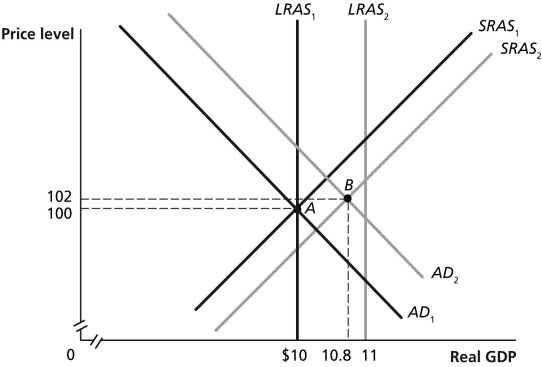 -Refer to Figure 26-11.In the dynamic model of AD-AS in the figure above,the economy is at point A in year 1 and is expected to go to point B in year 2,and the Federal Reserve pursues policy.This will result in
 (Multiple Choice)
4.9/5 (85)
(85) Figure 26-10 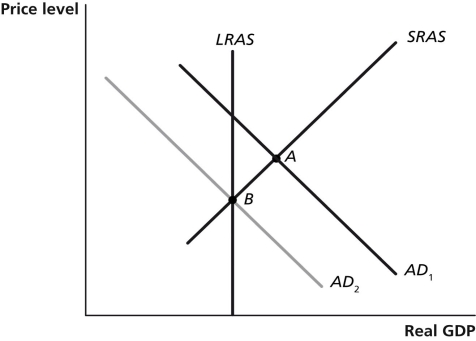 -Refer to Figure 26-10.In the figure above,suppose the economy is initially at point A.The movement of the economy to point B as shown in the graph illustrates the effect of which of the following policy actions by the Federal Reserve?
 (Multiple Choice)
4.9/5 (75)
(75) The leader of the monetarist school and major proponent of a monetary growth rule was
(Multiple Choice)
4.9/5 (76)
(76) 
Filters
- Essay(0)
- Multiple Choice(0)
- Short Answer(0)
- True False(0)
- Matching(0)