



 Chat with AI
Exam 26: Monetary Policy

Exam 1: Economics: Foundations and Models447 Questions
Exam 2: Trade-Offs, comparative Advantage, and the Market System492 Questions
Exam 3: Where Prices Come From: the Interaction of Demand and Supply476 Questions
Exam 4: Economic Efficiency, government Price Setting, and Taxes420 Questions
Exam 5: Externalities, environmental Policy, and Public Goods263 Questions
Exam 6: Elasticity: the Responsiveness of Demand and Supply294 Questions
Exam 7: The Economics of Health Care338 Questions
Exam 8: Firms,the Stock Market,and Corporate Governance522 Questions
Exam 9: Comparative Advantage and the Gains From International Trade377 Questions
Exam 10: Consumer Choice and Behavioral Economics300 Questions
Exam 11: Technology,production,and Costs327 Questions
Exam 12: Firms in Perfectly Competitive Markets296 Questions
Exam 13: Monopolistic Competition: the Competitive Model in a More Realistic Setting272 Questions
Exam 14: Oligopoly: Firms in Less Competitive Markets258 Questions
Exam 15: Monopoly and Antitrust Policy279 Questions
Exam 16: Pricing Strategy261 Questions
Exam 17: The Markets for Labor and Other Factors of Production281 Questions
Exam 18: Public Choice, taxes, and the Distribution of Income258 Questions
Exam 19: Gdp: Measuring Total Production and Income261 Questions
Exam 20: Unemployment and Inflation291 Questions
Exam 21: Economic Growth, the Financial System, and Business Cycles253 Questions
Exam 22: Long-Run Economic Growth: Sources and Policies262 Questions
Exam 23: Aggregate Expenditure and Output in the Short Run301 Questions
Exam 24: Aggregate Demand and Aggregate Supply Analysis286 Questions
Exam 25: Money,banks,and the Federal Reserve System281 Questions
Exam 26: Monetary Policy275 Questions
Exam 27: Fiscal Policy306 Questions
Exam 28: Inflation, unemployment, and Federal Reserve Policy257 Questions
Exam 29: Macroeconomics in an Open Economy278 Questions
Exam 30: The International Financial System258 Questions
Select questions type


Table 26-3
Year Potential Real GDP Real GDP Price Level 2016 \ 18.0 trillion \ 18.0 trillion 150 2017 18.5 trillion 18.8 trillion 154
-Refer to Table 26-3.Consider the hypothetical information in the table above for potential real GDP,real GDP,and the price level in 2016 and in 2017 if the Federal Reserve does not use monetary policy.If the Fed uses monetary policy successfully to keep real GDP at its potential level in 2017,which of the following will be lower than if the Fed had taken no action?
(Multiple Choice)
4.9/5  (90)
(90) Ceteris paribus,an increase in the money supply will lower short-term interest rates.
(True/False)
4.9/5 (66)
(66) From an initial long-run macroeconomic equilibrium,if the Federal Reserve anticipated that next year aggregate demand would grow significantly faster than long-run aggregate supply,then the Federal Reserve would most likely
(Multiple Choice)
4.8/5 (95)
(95) What is a mortgage? What were the important developments in the mortgage market during the years after 1970?
(Essay)
4.7/5 (80)
(80) An advantage of the personal consumption expenditures price index (PCE)over the Consumer Price Index (CPI)as a measure of inflation is that the PCE
(Multiple Choice)
4.8/5 (80)
(80) Figure 26-15 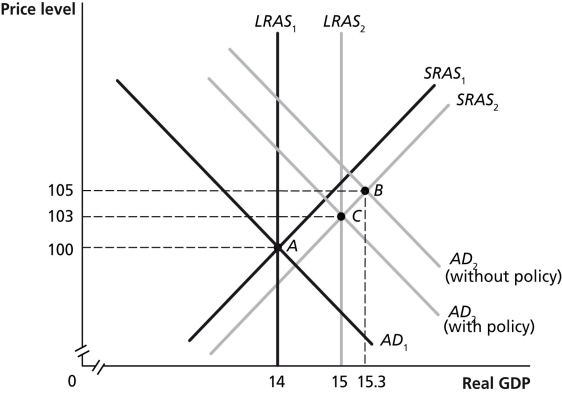 -Refer to Figure 26-15.In the figure above,suppose the economy in Year 1 is at point A and is expected in Year 2 to be at point B.Which of the following policies could the Federal Reserve use to move the economy to point C?
 (Multiple Choice)
4.8/5 (80)
(80) Use the money demand and money supply model to show the money market in equilibrium with an interest rate of 5 percent and the quantity of money of $800 billion.Suppose the Federal Reserve increases the money supply to $850 billion.At the previous equilibrium interest rate of 5 percent,will households and firms now be holding more money or less money than they want to hold,and will they be buying or selling short-term financial assets? At the new equilibrium interest rate,households and firms will desire to hold the entire $850 billion of the money supply.What causes households and firms to want to hold the additional $50 billion of the money supply?
(Essay)
4.7/5 (82)
(82) The Federal Reserve System's four monetary policy goals are
(Multiple Choice)
4.8/5 (79)
(79) Table 26-2
Year Potential Real GDP Real GDP Price Level 2016 \ 18.0 trillion \ 18.0 trillion 150 2017 18.5 trillion 18.2 trillion 152
-Refer to Table 26-2.Consider the hypothetical information in the table above for potential real GDP,real GDP,and the price level in 2016 and in 2017 if the Federal Reserve does not use monetary policy.If the Fed uses monetary policy successfully to keep real GDP at its potential level in 2017,which of the following will be higher than if the Fed had taken no action?
(Multiple Choice)
4.8/5 (76)
(76) The Federal Reserve can directly affect its monetary policy ________,which then affect its monetary policy ________.
(Multiple Choice)
4.7/5 (103)
(103) Figure 26-1 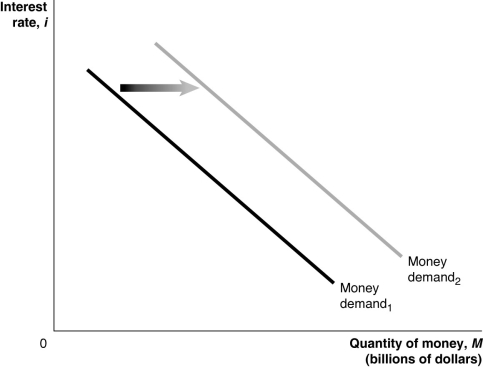 -Refer to Figure 26-1.In the figure,the money demand curve would move from Money demand1 to Money demand2 if
 (Multiple Choice)
4.8/5 (87)
(87) What is a banking panic,and what role did banking panics play in the decision by Congress to establish the Federal Reserve?
(Essay)
4.9/5 (77)
(77) Expansionary monetary policy enacted during a recession will cause the inflation rate to increase.
(True/False)
4.8/5 (72)
(72) In November 2008,the Fed began its first round of quantitative easing.In total,the Fed conducted ________ rounds of quantitative easing before ending the program in October 2014.
(Multiple Choice)
4.8/5 (87)
(87) Suppose the equilibrium real federal funds rate is 5 percent,the target rate of inflation is 3 percent,the current inflation rate is 5 percent,and real GDP is 4 percent above potential real GDP.If the weights for the inflation gap and the output gap are both 1/2,then according to the Taylor rule the federal funds target rate equals
(Multiple Choice)
4.9/5 (84)
(84) Suppose the equilibrium real federal funds rate is 3 percent,the target rate of inflation is 3 percent,the current inflation rate is 1 percent,and real GDP is 8 percent below potential real GDP.If the weights for the inflation gap and the output gap are both 1/2,then according to the Taylor rule the federal funds target rate equals
(Multiple Choice)
4.9/5 (73)
(73) In the following table,fill in the columns for your return on investment if the price of your house increased or decreased by 40 percent,based on the down payments specified in the first column.
Return on Your Investment From
Dawn Payment A 40 Percent Increase in the Price of Your Hause A 40 Percent Decrease in the Price of Your House 100\% 20 10 5
(Essay)
4.9/5 (84)
(84) In March 2008,the Fed announced that primary dealers would be eligible to receive discount loans.
(True/False)
5.0/5 (78)
(78) 
Filters
- Essay(0)
- Multiple Choice(0)
- Short Answer(0)
- True False(0)
- Matching(0)