



 Chat with AI
Exam 26: Monetary Policy

Exam 1: Economics: Foundations and Models447 Questions
Exam 2: Trade-Offs, comparative Advantage, and the Market System492 Questions
Exam 3: Where Prices Come From: the Interaction of Demand and Supply476 Questions
Exam 4: Economic Efficiency, government Price Setting, and Taxes420 Questions
Exam 5: Externalities, environmental Policy, and Public Goods263 Questions
Exam 6: Elasticity: the Responsiveness of Demand and Supply294 Questions
Exam 7: The Economics of Health Care338 Questions
Exam 8: Firms,the Stock Market,and Corporate Governance522 Questions
Exam 9: Comparative Advantage and the Gains From International Trade377 Questions
Exam 10: Consumer Choice and Behavioral Economics300 Questions
Exam 11: Technology,production,and Costs327 Questions
Exam 12: Firms in Perfectly Competitive Markets296 Questions
Exam 13: Monopolistic Competition: the Competitive Model in a More Realistic Setting272 Questions
Exam 14: Oligopoly: Firms in Less Competitive Markets258 Questions
Exam 15: Monopoly and Antitrust Policy279 Questions
Exam 16: Pricing Strategy261 Questions
Exam 17: The Markets for Labor and Other Factors of Production281 Questions
Exam 18: Public Choice, taxes, and the Distribution of Income258 Questions
Exam 19: Gdp: Measuring Total Production and Income261 Questions
Exam 20: Unemployment and Inflation291 Questions
Exam 21: Economic Growth, the Financial System, and Business Cycles253 Questions
Exam 22: Long-Run Economic Growth: Sources and Policies262 Questions
Exam 23: Aggregate Expenditure and Output in the Short Run301 Questions
Exam 24: Aggregate Demand and Aggregate Supply Analysis286 Questions
Exam 25: Money,banks,and the Federal Reserve System281 Questions
Exam 26: Monetary Policy275 Questions
Exam 27: Fiscal Policy306 Questions
Exam 28: Inflation, unemployment, and Federal Reserve Policy257 Questions
Exam 29: Macroeconomics in an Open Economy278 Questions
Exam 30: The International Financial System258 Questions
Select questions type


Expansionary monetary policy to prevent real GDP from falling below potential real GDP would cause the inflation rate to be ________ and real GDP to be ________.
(Multiple Choice)
4.8/5  (72)
(72) Table 26-3
Year Potential Real GDP Real GDP Price Level 2016 \ 18.0 trillion \ 18.0 trillion 150 2017 18.5 trillion 18.8 trillion 154
-Refer to Table 26-3.Consider the hypothetical information in the table above for potential real GDP,real GDP,and the price level in 2016 and in 2017 if the Federal Reserve does not use monetary policy.If the Fed wants to keep real GDP at its potential level in 2017,it should
(Multiple Choice)
4.9/5 (78)
(78) If the Fed raises its target for the federal fund rate,this indicates that
(Multiple Choice)
4.9/5 (75)
(75) The top policy goal for Paul Volcker when he became chairman of the Federal Reserve's Board of Governors in 1979 was
(Multiple Choice)
4.8/5 (82)
(82) Use the money demand and money supply model to show graphically and explain the effect on interest rates of the Federal Reserve's open market purchase of Treasury securities.
(Essay)
4.9/5 (87)
(87) If the amount you owe on your house is greater than the price of the house,you have
(Multiple Choice)
4.9/5 (72)
(72) Consider the Taylor rule for the target of the federal funds rate.Suppose the equilibrium real federal funds rate is 2 percent,the target rate of inflation is 3 percent,the current inflation rate is 3 percent,real GDP equals potential real GDP,and the weights are 1/2 for the inflation gap and the output gap.Using the Taylor rule,what does the target for the federal funds rate equal? Next,if the Federal Reserve lowered the target for the inflation rate to 1 percent,how much would the target for the federal funds rate change?
(Essay)
4.8/5 (66)
(66) Contractionary monetary policy to prevent real GDP from rising above potential real GDP would cause the inflation rate to be ________ and real GDP to be ________.
(Multiple Choice)
4.8/5 (83)
(83) Between September 2007 and March 2008 there was a substantial reduction in the demand for housing.What action did the Fed take in response to the reduction in the demand for housing?
(Multiple Choice)
4.8/5 (92)
(92) The Federal Reserve responded to the 2008 financial crisis in several ways.Which of the following is one of the ways the Fed responded?
(Multiple Choice)
4.8/5 (74)
(74) The Fed can use contractionary monetary policy in an attempt to keep inflation from increasing.
(True/False)
4.8/5 (76)
(76) Expansionary monetary policy refers to the ________ to increase real GDP.
(Multiple Choice)
4.9/5 (84)
(84) In 2008,the Treasury and Federal Reserve took several actions in response to the deepening financial crisis.One action was the creation of the Term Securities Lending Facility,under which the Fed will loan up to $200 billion of treasury securities in exchange for
(Multiple Choice)
4.7/5 (82)
(82) Figure 26-12 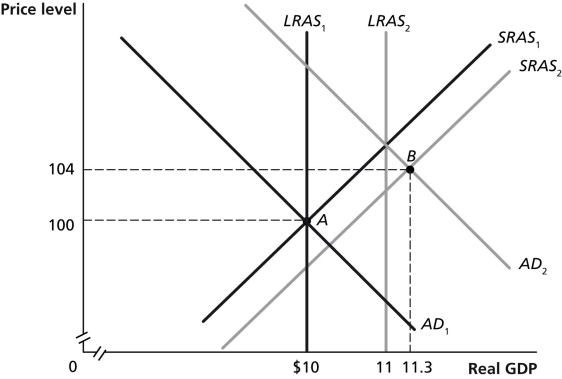 -Refer to Figure 26-12.In the dynamic AD-AS model,if the economy is at point A in year 1 and is expected to go to point B in year 2,the Federal Reserve would most likely
 (Multiple Choice)
4.9/5 (79)
(79) Firms that participate in regular open market transactions with the Federal Reserve are called
(Multiple Choice)
4.8/5 (84)
(84) The situation in which short-term interest rates are pushed to zero,leaving the central bank unable to lower them further is known as
(Multiple Choice)
4.8/5 (97)
(97) 
Filters
- Essay(0)
- Multiple Choice(0)
- Short Answer(0)
- True False(0)
- Matching(0)